

Most NFT channel problems buyers meet in year three — sag between supports, brittle corners after one summer, algae blooming through the inner wall — are decided on the extrusion line in year zero. Understanding how PVC NFT channels are extruded tells you which questions to ask a supplier before the order, and which certificates are doing real work.
This guide walks through the line itself, the two tolerances that matter most, how UV stability is built into the compound, and how a buyer can verify any of it from the other side of the world.
What Is the Extrusion Process for an NFT Channel?
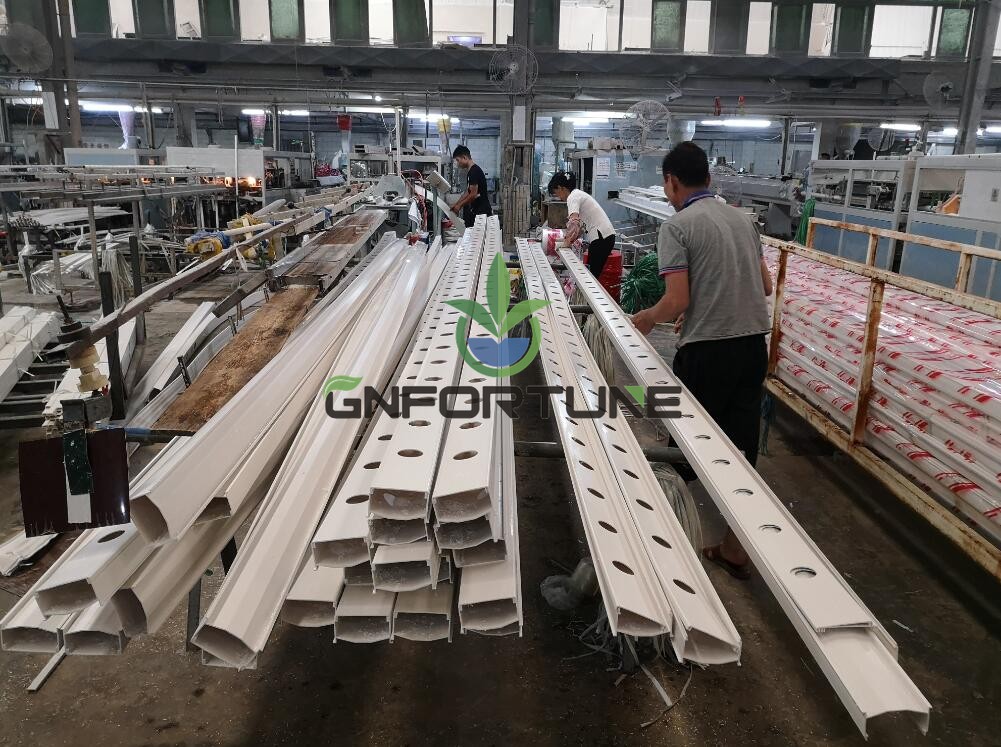
Extrusion is a continuous forming process: PVC compound is melted, pushed through a profile die that shapes the channel cross-section, calibrated to final dimensions, cooled, and cut to length. A production line runs from hopper to haul-off without interruption, which is why a factory running multiple lines can quote in metres rather than pieces.
On a typical NFT channel line the sequence is: compound feeding, twin-screw extrusion, profile die, calibration sleeve, vacuum cooling tank, haul-off and cutting, then belling or end finishing where the design includes lids or connecting sockets. Channel speed is set by cooling capacity more than by extruder power — pull the profile too fast and the walls will not hold dimension.
Why Does Wall Thickness Tolerance Matter So Much?
Wall thickness is the spec that quietly governs everything else. On a 100×50mm channel, a nominal 2.0mm wall is the commercial norm for greenhouse duty: thin enough to keep the per-metre cost sensible, thick enough to hold shape under water load and clipping force across a multi-year service life.
| Parameter | Typical spec | What goes wrong when it drifts |
|---|---|---|
| Wall thickness | 2.0mm nominal, tolerance within ±0.1–0.2mm | Thin spots sag between supports, distort at clip points, crack in transit |
| Straightness | No visible bow over a 4m length | Bowed channels rock on the rack, create low spots where solution ponds and algae starts |
| Cross-section squareness | Lid seats without force | Twisted profiles leak at joints and resist the planting-hole punch |
| Inner surface finish | Smooth, glossy inner wall | Rough inner walls hold biofilm and make wash-down slower |
Sag is the symptom buyers notice first. A channel that drops visibly between 2-metre supports usually has either a thin wall, a recycled blend with lower stiffness, or both — and no amount of extra supports fully fixes it.
How Is UV Stability Built Into the Compound?
PVC degrades under ultraviolet light by losing hydrochloric acid from the polymer chain, which shows up as yellowing, then brittleness. Outdoor-rated channel is therefore specified with a UV stabiliser package in the compound, not as a coating that can wear off.
Three formulation choices do the work. Virgin uPVC resin gives a predictable base; recycled PVC carries unknown residues and inconsistent stabiliser levels, which is why reputable factories declare virgin material on the datasheet. Lead-free heat stabilisers keep the compound processable and keep the finished channel compliant with RoHS-type restrictions on heavy metals. And where the design is dual-colour — a black outer layer with a light or white inner layer — the inner layer blocks light entering the channel, which suppresses algae without chemical dosing.
The practical proof is a warranty figure. A channel compound rated for more than 10 years of service is a materially different formulation from generic construction PVC, and a supplier who will state that in writing has usually tested it, not just printed it.
What Does In-Process Quality Control Look Like on the Line?
- Compound check: resin and masterbatch lots recorded, moisture verified before feeding.
- Melt condition: extruder temperature zones logged; a burnt or under-plasticised melt shows as surface streaks.
- Dimensional sampling: wall thickness and profile width measured at intervals on a vernier or ultrasonic gauge, not once per shift.
- Straightness and fit: sample lengths laid flat and lid-seated by hand at the line, not just at final inspection.
- Batch traceability: production date and line number marked or recorded so a field complaint can be traced to a compound lot.
A factory that can describe these five steps in specific terms — gauges used, intervals, who signs off — is usually running them. One that answers in generalities is usually inspecting at the end and hoping.
How Can a Buyer Verify Extrusion Quality Remotely?
- Ask for the datasheet: nominal wall, tolerance band, resin declaration, stabiliser type.
- Request a short video of the line running your profile, showing the gauge readings.
- Order samples and measure them yourself — wall thickness with a caliper at several points, lid fit by hand, straightness on a flat table.
- Put the agreed values in the purchase contract, not just in a brochure.
None of this is adversarial. Factories confident in their lines expect measurement; the resistance itself is a data point.
FAQs About PVC NFT Channel Extrusion
Is 2.0mm wall thickness enough for commercial NFT channels?
For 100×50mm and 73×62mm profiles in normal greenhouse duty, a 2.0mm nominal wall with a tight tolerance band is the industry norm and holds span lengths of 2–4 metres. Heavier substrate gutters and long unsupported spans need thicker walls. What matters more than the nominal number is the tolerance — a “2.0mm” channel that measures 1.6mm at the thin spot is the real failure cause.
Why do some NFT channels turn yellow and brittle after one season?
That is UV degradation of an under-stabilised compound, usually recycled PVC or construction-grade material relabelled for horticulture. Stabiliser packages are invisible from outside; the only reliable checks are the resin declaration on the datasheet, sample ageing, and the supplier’s willingness to state service life in the contract.
Is recycled PVC ever acceptable in hydroponic channels?
For food-adjacent production, no. Recyclate carries uncontrolled residues and inconsistent stabiliser levels, and the inner wall contacts nutrient solution for the whole crop cycle. Virgin uPVC with a documented compound is the standard any serious buyer should specify.
What is the dual-colour channel for?
The black outer layer blocks light and carries the UV package; the white or light inner layer reflects light to the root zone and makes root health visible, while the opaque wall suppresses algae inside the channel. It is a formulation and design solution, not a coating — which is why it lasts the life of the channel.
Can I verify wall thickness without visiting the factory?
Yes. Samples plus a caliper are enough for the nominal check, and a video of the line gauge covers process control. For large orders, a third-party inspection at loading is cheap insurance, and most established factories accommodate it routinely.
What to Send When You Request a Quotation
To get an extrusion-relevant quotation rather than a price list, send: profile choice (100×50mm, 73×62mm or custom), total metres and span lengths, indoor or outdoor exposure, and your destination port. A factory can then confirm wall thickness, compound and lead time against your actual project instead of a generic SKU.
Related reading: choose between profiles in 100×50mm vs 73×62mm compared, see how material choice affects compliance in food-safe materials and RoHS, plan the installation the channels feed with the layout, slope and flow rate guide, and check a supplier against the factory audit checklist.
Send your profile, total metres and exposure conditions, and we will confirm wall thickness, compound specification and lead time for the exact channel you need: contact our team.