Refurbishing an Older Hydroponic Greenhouse: What First
Greenhouse refurbishment almost always fails in the sequence rather than the budget. A ten-year-old house gets quoted for new film, gutters and a control refresh, the crew starts at the gable end, and by week three the rusted purlins behind the gutter and a settled slab under the center path are both discovered. Retrofit old greenhouse hydroponics projects go wrong the same way: the fast trades are scheduled first, and the slow ones inherit the mess. This article sets out the survey order, what each finding means for cost and downtime, and how to stage the work inside a crop turnaround without losing a season.
Nothing is ordered until the survey is measured rather than eyeballed. A tape measure, a laser level, a coating thickness gauge and an insulation resistance tester settle most of the argument in a day.
Item
How to check
Act when
Cover condition
Haze, chalking, tear count, light meter
Below 70 percent transmission
Gutter and channel slope
Laser level along each run
Under 0.5 percent fall
Frame coating
Coating gauge on flats, caliper at member ends
Zinc gone at connections
Foundation and levels
Level survey of base plates and paths
Settlement over 10 mm
Drainage and floor
Flood test, watch where water stands
Water standing after 30 minutes
Electrics
Insulation resistance, RCD trip, thermal scan
Below local code limit
Vents and doors
Open and close each one under load
Binding, or gaps over 10 mm
Survey findings written without numbers turn into arguments during strip-out.
The expensive surprises in a refurbishment are almost always the items nobody measured: a gutter that holds water over 6 m of its length, a base plate buried in a path that has been washed clean every day for a decade, and a duct run that no drawing shows. Photograph every finding with a scale in frame.
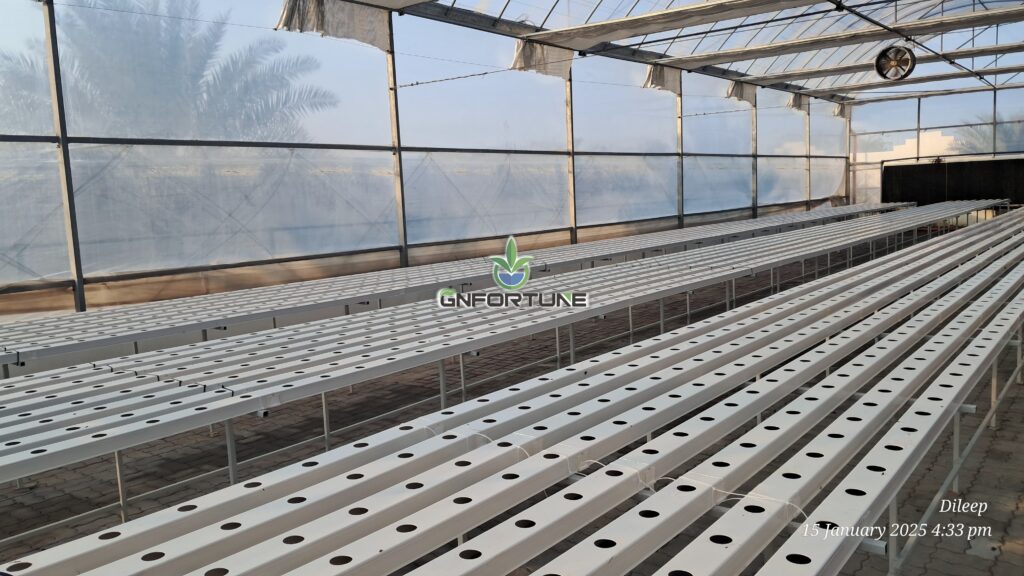
Empty raft beds drained for refurbishment between crop cycles
Cover Replacement: Film Versus Polycarbonate
Film runs 3 to 5 years in most climates and costs least per square meter, but each replacement carries labor, disposal and a crop-free day. Twin-wall polycarbonate runs 8 to 15 years, costs several times more per square meter, and gives up roughly 8 to 12 percentage points of light transmission when new. Compare cost per square meter per year, then add downtime: a house that cannot lose a week favors the longer service life.
Cover
Service life
Light transmission
Insulation
Best fit
PE or EVA film
3 to 5 years
88 to 92 percent
Low
Short cycles, mild climates
Twin-wall polycarbonate
8 to 15 years
78 to 84 percent
Moderate to high
Heated houses, long crop cycles
Glass
20 years and beyond
90 to 92 percent
Low
Where the frame carries the load
Coatings matter as much as the base material, since anti-drip behavior decides whether condensation falls on the leaf and diffusion decides canopy light distribution. On retrofit old greenhouse hydroponics work, glazing bar condition is checked at the same time: a bar that no longer grips the film or the sheet turns a cover job into a steel job. The full comparison sits in greenhouse covering materials compared.
Gutters and Channels: Replace or Re-level
Start with slope. Channels are set at 0.5 to 1 percent fall, meaning 5 to 10 mm per meter, and the common fault is a run that has sagged to zero or reversed. A laser survey along each run takes an hour and tells which hangers need adjusting.
Re-level: channel intact, sag from loose or stretched hangers. Adjustable brackets and a laser set it in a day.
Replace: UV brittleness, cracks at the end caps, deformed profile under foot traffic, or a cross-section no longer made.
Patch: local impact damage only, with a joint that stays watertight under movement.
Ordering new channel is a house-level decision rather than a bay-level one, since extruded NFT gutter carries a 1,000 m minimum order quantity. That suits a full-house change and rules out a three-bay patch. Where used channel is offered instead, the inspection list in buying used hydroponic equipment applies before anything is unloaded.
Steel: What Rust Means and When to Act
Rust on a galvanized frame is either surface staining or section loss, and only measurement separates them. Hot-dip galvanizing on greenhouse steel is commonly 45 to 85 µm; once the zinc is gone at a connection, the base metal thins from the outside in, and connections go first.
Under about 10 percent section loss: clean back to bright metal, treat, and recoat with a zinc-rich system.
10 to 20 percent: reinforce or sleeve the member, and check the load path above it.
Over 20 percent, or visible deflection: replace the member before re-covering.
Base plates and anchor bolts: treat as suspect by default, since that is the wet zone.
Floor works are the slowest item and the least negotiable. Slab repairs, new falls of 1 to 2 percent, drainage channels and catch pits need a dry floor, and then 7 to 28 days of cure before trolleys and pallet jacks run on them. Schedule them right after strip-out and before anything electrical goes in, because grinding and washing produce slurry that finds its way into conduit.
Drain layout, footbaths and the route from the house to the pack area are settled in the same window. Those decisions are cheap on paper and expensive once the slab is poured, and they are why the drainage drawing is signed off before the first bag of cement arrives.
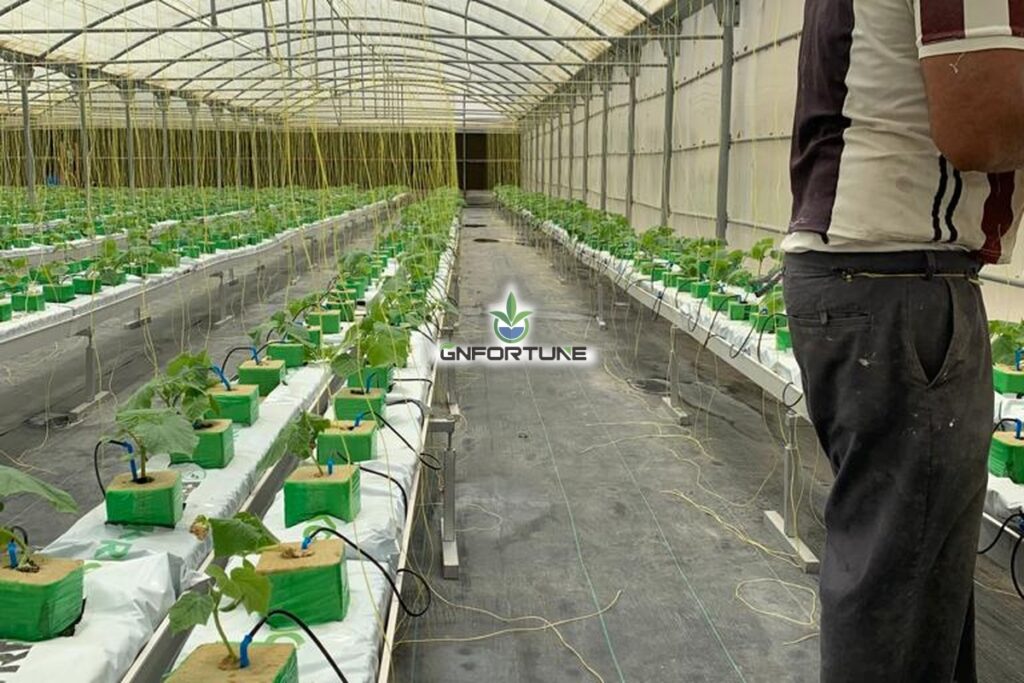
Worker walking past newly planted gutter rows in a renovated greenhouse
Electrical and Controls Refresh
Electrics come after the structure and the floor. Insulation resistance on the wet-zone circuits, RCD trip times, spare ways in the panel and the condition of sensor cable are checked once the house is dry and safe to work in. Expect to replace cable in the wash-down areas, add ways for the new zone layout, and move sensors to positions the previous crop never needed.
Where the house carried soil beds before, the electrical and irrigation changes are larger than the structural ones, and the full list of changes is set out in converting a soil greenhouse to hydroponics. Second-hand panels and control gear look attractive at refurbishment; the same used-equipment inspection list applies.
Greenhouse Refurbishment Sequence Between Crops
Work backwards from the planting date. A leafy green turnaround gives 7 to 21 days; a tomato or cucumber house gives a longer gap once the crop is pulled. A typical block runs like this:
Week 1: survey, measurements, and ordering of long-lead items.
Week 2: clear the crop, strip and dispose of the cover.
Week 3: steel repairs, base plates, then glazing bars.
Week 4: floor and drainage wet trades, left to cure.
Week 5: new cover, gutters and channel, then leak test.
Week 6: electrics, controls, commissioning and planting.
Extruded gutter, polycarbonate sheet and control hardware are ordered in week 1, since those three decide whether week 5 happens at all. Staging by bay keeps part of the house producing: refurbish three or four bays, move the crop into the finished end, and repeat. The same phased logic is described for expansion work in greenhouse extension without downtime. A greenhouse refurbishment planned this way costs the same as a badly staged one and loses no crop, which is the only comparison that matters at season end.
Frequently Asked Questions
How long does a greenhouse refurbishment take? A: Six to eight weeks from strip-out to replanting for a 2,000 to 5,000 m² house, with long-lead items ordered two to four weeks earlier.
Should the cover or the gutters come off first? A: The cover, since gutter hangers and glazing bars are reachable only once it is off, and the steel is inspected then.
How much rust is too much on a frame member? A: About 20 percent section loss, or any visible deflection under self-weight, at which point the member is replaced rather than treated.
Can the house stay in production during the work? A: Yes, bay by bay, provided dust, noise and irrigation downtime stay inside the tolerance of the standing crop.
Is polycarbonate worth the extra cost over film? A: On heated houses with long crop cycles it usually is, while short-cycle leafy green production in a mild climate favors film on cost per year.
Plan Your Refurbishment Sequence
The order that protects the schedule is survey, long-lead ordering, strip-out, steel, wet trades, cover, then electrics and commissioning. Cost follows slope measurements, section loss readings and how much channel has to be replaced, not the square meter figure on the first quote. To send photos of your current gutters and frames and we will list what to replace first, include the house dimensions, cover age and the crop calendar.