

By the G&N commercial export team · First published: September 2026 · Reviewed for field accuracy
The single biggest reason a hydroponic system design quote fails to produce a workable farm is that the buyer sent an inquiry with one line and the supplier quoted that one line. After three decades of shipping to more than 60 countries, we can tell you the projects that succeed always start with the same dozen inputs. This guide walks a procurement manager through the inputs we collect from every client before our engineering team produces a layout. If you are evaluating a hydroponic system design company, the fastest test is whether they ask for these inputs before sending a pro forma.
Why “Send Me a Quote” Rarely Produces a Workable System
An RFQ with one paragraph and no data is a request for a price, not for a design. The supplier responds with a catalog price for the closest-looking system, the buyer accepts it, and the containers arrive at the site missing the pumps, plumbing, or climate kit the buyer actually needed. Four reasons one-line quotes fail:
- Missing climate data. A system designed for a 22°C Dutch greenhouse will not cool a 45°C Saudi summer. Without outdoor and indoor design temperatures, the supplier cannot size cooling, ventilation, or shade screens.
- Unspecified yield target. “A lettuce farm” tells the supplier nothing about kilograms per square meter per year, which decides bench count, light load, and reservoir turnover.
- Unanalyzed water source. Sodium, chloride, bicarbonate, and iron dictate whether the system needs RO pre-treatment and how the nutrient recipe is built. A quote that ignores water analysis ignores operating cost.
- Unstated electrical and gas constraints. Three-phase power, gas pressure, and drainage fall are site-specific. If the supplier cannot see them, the delivered equipment either cannot be commissioned or cannot be permitted.
The cheapest buyer trap in this industry: the lowest first-quote assumes the most favorable climate, the most generous water, and the simplest crop. A quote that does not name those assumptions is a quote that does not own them. Ask the supplier to put the assumptions in writing before you compare prices.
The 12 Inputs We Collect: Site, Climate, Crop, Water, Market
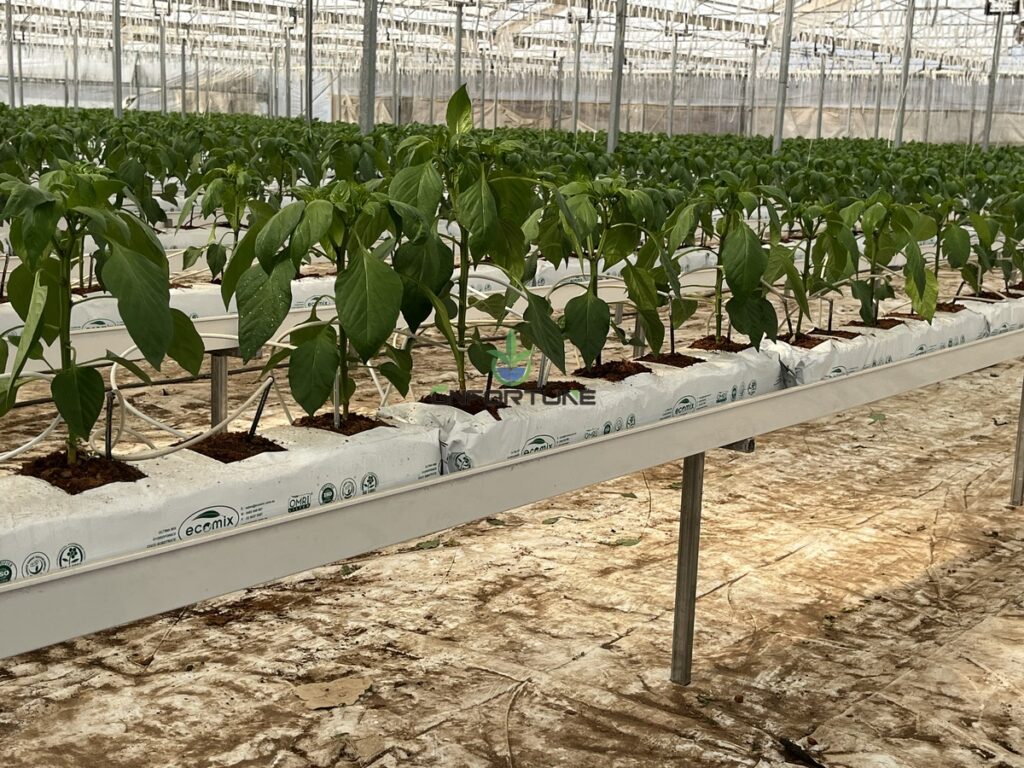
Commercial greenhouse with parallel rows of substrate gutter troughs, illustrating the layout input for system designThe input list a serious hydroponic system design company will request is structured into five blocks. The table below is the version we email to every new inquiry; the rest of the article explains each block and the cost of skipping it.
| # | Input | Block | Why it matters |
|---|---|---|---|
| 1 | Site location & elevation | Site | Latitude for light; altitude for cooling load |
| 2 | Greenhouse dimensions & orientation | Site | Bay length, span count, ridge height |
| 3 | Outdoor design temperature & RH | Climate | Cooling and ventilation sizing |
| 4 | Indoor target temperature & RH | Climate | HVAC and screen control setpoint |
| 5 | Light: DLI target, supplemental plan | Climate | Fixture count and electrical load |
| 6 | Crop & cycle plan | Crop | System type (NFT, DWC, dutch bucket, ebb & flow) |
| 7 | Yield target (kg/m²/year) | Crop | Capacity & bench count |
| 8 | Market window & postharvest | Market | Cold chain, packaging, export compliance |
| 9 | Water analysis (EC, pH, Na, Cl, HCO3, Fe) | Water | RO pre-treatment, nutrient recipe |
| 10 | Electrical service (V, phase, Hz, kVA) | Site | Pump, light, HVAC capacity |
| 11 | Drainage & floor slope | Site | Gravity drain design |
| 12 | Budget, MOQ, shipping destination | Market | Quote tier, container plan, certifications |
The first eleven are technical; the twelfth is commercial, and it is the one most RFQs skip. Without a budget band and a destination port, the supplier cannot tell you whether the design fits a 40 ft high-cube container, whether MOQ applies to spare parts, or whether the shipment needs CE, UL, or SASO marks.
Climate Data: Temperature, Humidity, Light, DLI
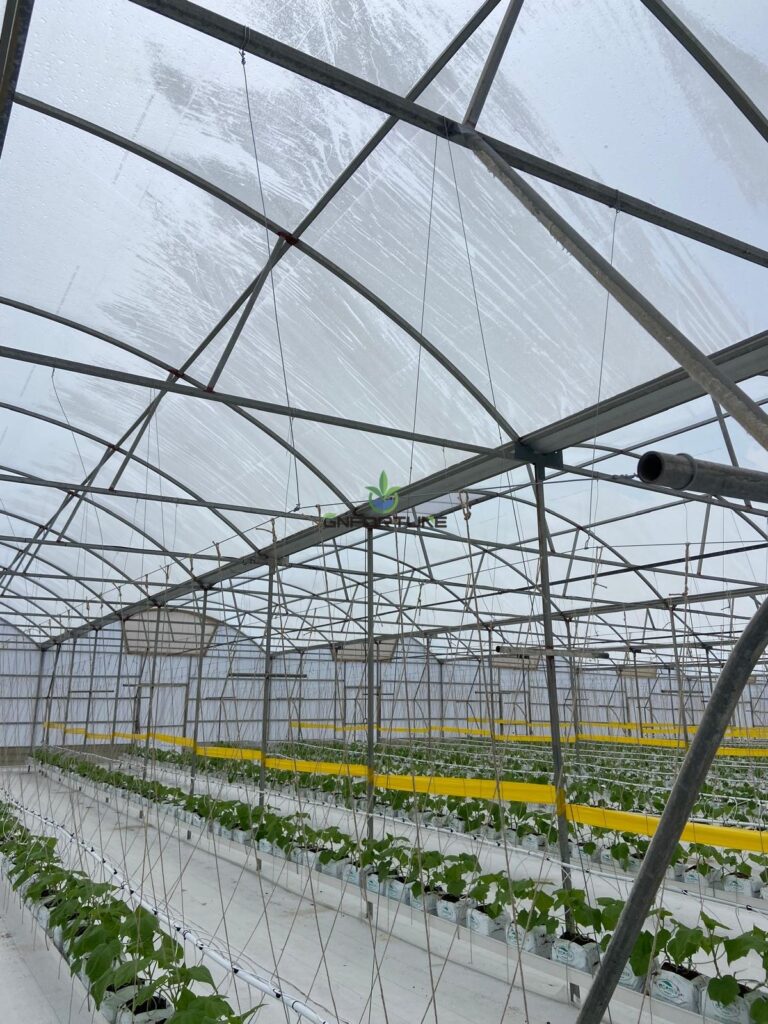
Arched white greenhouse structure with hanging crop rows, showing site constraints to capture before designClimate decides the most expensive line items: cooling, screens, and supplemental light. The minimum data set:
- Outdoor design dry-bulb temperature. The 1% hottest hour, not the annual average. A Saudi summer requires cooling sized for 45°C+; a UK summer rarely passes 32°C. The wrong number is a five-figure cooling mistake.
- Indoor target temperature and RH. Lettuce runs at 18–22°C and 60–70% RH; tomatoes want 22–26°C and 60–80%. The target drives vent opening, screen position, and pad-and-fan capacity.
- DLI target. Leafy greens need 12–17 mol/m²/day; tomatoes need 20–30. If natural light is short, the supplier must add supplemental light to the electrical load.
- Prevailing wind and snow load. Wind decides structural anchoring; snow load decides roof strength. Both feed the greenhouse structure and permit filing.
Our hydroponic system design resource page explains how the climate block feeds the BOM and the calculation path for cooling load.
Crop Selection: Yield Target, Market Window, Postharvest
Crop drives system type. The same greenhouse can run NFT for lettuce, dutch buckets for cucumbers, or ebb-and-flow benches for herbs, but the equipment is not interchangeable. Three commercial inputs:
- Yield target in kg/m²/year. This single number sizes the bench count, reservoir volume, and daily nutrient demand. A 40 kg/m²/year lettuce target implies different infrastructure than an 80 kg/m²/year target.
- Market window. Year-round, summer-only, or a defined export window. The window drives whether supplemental lighting, heating, or both are required.
- Postharvest chain. Cold-room capacity, packaging line, and buyer format. A farm with no cold chain cannot sell to a retailer that demands 4°C delivery.
If two crops share a facility, the design must accommodate the worst-case climate, yield, and equipment footprint, not the average. We have seen projects designed for the easier crop fail because the second crop’s harvest weight exceeded the bench rating.
Water Analysis: EC, pH, Hardness, Sodium, Iron
Water analysis is the input most often omitted, and the one with the longest operating-cost tail. The six parameters that change equipment and recipe:
- EC and pH at the source. Source EC above 0.7 mS/cm usually means the recipe needs RO blending; source pH above 7.5 drives acid demand in the injectors.
- Sodium and chloride. Above 50 ppm, sensitive crops (lettuce, basil) show tip burn. RO is the standard answer; a softener plus carbon filter helps when the feed is borderline.
- Bicarbonate (HCO3). Above 150 ppm drives pH up faster than a single acid injector can compensate. A twin-tank acid system is the typical answer.
- Iron and manganese. Above 0.3 ppm Fe in well water stains NFT channels and clogs drippers. Oxidation plus sediment filtration is the standard pre-treatment.
For sizing the reservoir and pump that uses this analysis, see the reservoir and pump sizing worksheet; for sizing NFT channels that match the implied flow rates, see the NFT channel flow, slope, and length guide.
Layout: Dimensions, Slopes, Drainage, Electrical, Gas
Site layout is where engineering meets the existing building. Five inputs the supplier needs to draw a workable layout:
- Greenhouse internal dimensions. Bay length, span count, gutter height, ridge orientation. The layout drawing has to fit inside these.
- Working aisle width. 1.2 m minimum for wheeled harvest carts; less than 0.9 m forces hand-carrying.
- Drainage fall and reservoir position. NFT and dutch bucket systems need gravity return to the reservoir. The reservoir location sets the pump head and the drain line slope.
- Electrical service. Three-phase 380–415 V is typical; some sites are single-phase 220 V. Pump and light kVA must be checked against transformer size.
- Gas and compressed air. For CO2 enrichment, the supplier needs gas supply pressure and pipe routing. For pneumatic valves or aeration, the compressor size must match.
From Inputs to Layout: How We Run a 7-Day Design Sprint
Once all twelve inputs are in hand, a serious hydroponic system design company runs a structured sprint. Our end-to-end version takes seven working days:
- Day 1–2: input validation. Climate data is checked against historical norms; water analysis is sanity-checked for the crop; site dimensions are cross-checked against the building plan.
- Day 3–4: layout draft. Bench layout, NFT/dutch bucket/DWC arrangement, pump head math, and reservoir sizing. The supplier returns a CAD package with a BOM draft.
- Day 5: red-flag review. Internal review for MOQ gaps, certification gaps (CE, UL, SASO), and container-loading issues. The red-flag list goes back to the buyer with the second draft.
- Day 6: quote packaging. Itemized quote with line items per system, freight estimate, and payment terms.
- Day 7: hand-off. Pro forma invoice, datasheets, and the certification pack for the buyer’s compliance team.
A supplier that promises a “design in 24 hours” is either quoting a template or skipping the validation step. Neither produces a workable farm.
MOQ, Certifications, and Red Flags in the Quote
The v3 procurement lens asks three questions of the quote, beyond the price:
Quote red flags: a single line “hydroponic system, USD X” with no itemized BOM; no mention of certifications; no freight terms (FOB, CIF, EXW); no spare-parts list; no MOQ stated for spares; a warranty shorter than 12 months; no third-party test report cited; payment terms requiring 100% upfront.
For the procurement manager, the itemized quote should break out:
- Equipment line items. Channels, buckets, trays, pumps, reservoirs, plumbing, automation — each with quantity, spec, and unit price.
- Spare parts MOQ. Most factories have an MOQ on spare gaskets, pumps, and sensors that is a fraction of a production run. The quote should state the spare-parts MOQ so the buyer can decide whether to bundle them.
- Certifications. CE, RoHS, REACH for Europe; UL, CSA, NSF/ANSI 61 for North America; SASO for Saudi Arabia; FSANZ for Australia. Each must be named with the certificate or test report attached.
- Freight and Incoterms. FOB, CIF, or EXW changes the buyer’s risk and the supplier’s responsibility for damage in transit.
- Warranty and post-sale support. 12 months minimum on equipment; remote commissioning support; spare-parts lead time stated in weeks.
When the quote has all five blocks, the buyer can compare two or three suppliers on the same page. When the quote has only the first block, the buyer is comparing prices on different scopes and will pay the difference later.
FAQ
How long does it take a supplier to produce a workable hydroponic system design?
A: For a standard greenhouse with complete inputs, 5–7 working days from input to a CAD layout with an itemized quote. Larger or more complex projects take longer.
What if I don’t have a water analysis yet?
A: Get one before the design sprint. A basic mineral analysis costs a few hundred dollars at any commercial lab and saves several thousand in wrong equipment.
Does the supplier need the greenhouse already built?
A: No. If the greenhouse is not yet built, the design can run on the planned dimensions. If it already exists, share the builder’s drawings and structural load certificates.
What certifications should a serious supplier have?
A: ISO 9001 for quality systems; CE, RoHS, REACH for Europe; UL 8801 / CSA C22.2 / NSF/ANSI 61 for North America; SASO for Saudi Arabia; FSANZ for Australia. Each must come with a current certificate.
How does MOQ affect the design?
A: Some components have factory MOQs (a custom NFT profile requires minimum meterage; a custom reservoir requires a minimum unit count). The supplier should disclose the MOQ up front so the buyer can adjust quantity or accept it before signing.
Download the 12-Input Worksheet
Send the 12 inputs through the quote form, and our design team will return a free CAD layout with an itemized BOM and an Incoterms-aware pro forma. The same hydroponic system design resource page explains how the inputs feed the layout, and the FAQ page lists the most common procurement questions we receive. The 12-input worksheet is the single most cost-effective document in any hydroponic RFQ.
— G&N Fortune Limited · hydroponic equipment manufacturer since 1996 · Reviewed by the engineering team