

Hydroponic reservoir sizing is the calculation most often skipped between choosing channels and placing an order — and it quietly decides crop uniformity. An undersized reservoir lets EC and pH swing between dosing events, lets solution temperature climb through the afternoon, and forces the pump to cycle on its limits. An undersized pump shows up differently: weak flow at the end of the manifold and a motor running hot. This worksheet covers both calculations for NFT, DWC, and Dutch bucket systems — the formulas, the target turnover rates, and the under-sizing mistakes we keep finding on audits.
Why Reservoir Size Decides Crop Uniformity
The reservoir is the buffer that keeps the root environment stable between correction events. Plants remove water and nutrients in varying amounts through the day, dosing systems add concentrate in pulses, and temperature moves the whole system up and down. A small reservoir has little inertia, so each event moves the EC and the pH visibly; a large one absorbs them.
The symptom pattern on a farm with a small tank is recognizable: EC reads fine at dawn, climbs by mid-morning as transpiration outpaces uptake, and the dose controller chases it with top-ups all afternoon. The result is uneven tip burn, patchy head weights, and a nutrient log that never settles. A second effect is temperature: a small tank tracks greenhouse air within a degree or two, while a larger thermal mass damps the swings that stress roots on hot afternoons. Before running the numbers, have the targets in hand — the nutrient solution mixing guide covers EC and pH by crop.
The Formula: Reservoir Volume = Daily Uptake × Safety Factor
The base calculation has two inputs: daily water uptake across the system, and a safety factor. For commercial leafy greens a working planning figure is roughly 0.5–1.5 liters per square meter of growing area per day, with the high end applying to mature crops in hot, dry climates. Multiply by a safety factor of 1.5–2, which covers refills between monitoring rounds, cleaning cycles that drain part of the tank, and the day a valve sticks open.
A worked example for a 1,000 m² lettuce operation in a warm climate:
- Daily uptake: 1,000 m² × 1.0 L/m²/day = 1,000 L/day (mid-range figure for a mixed-age crop)
- Safety factor: 1.5–2 → minimum reservoir of 1,500–2,000 L
- In practice, round up: a 2,000–3,000 L tank gives room to grow and better temperature damping
The per-plant version of the same rule for smaller systems is 0.5–1 L of reservoir capacity per plant, which lands in the same place. Both versions are minimums, not targets — the only real penalties for a larger tank are the purchase cost, the floor space, and the nutrient volume you commit to each batch. Where the reservoir is undersized from the start, everything downstream of it (pump cycling, dosing frequency, temperature control) gets harder simultaneously, which is why reservoir volume belongs in the earliest stage of hydroponic system design, not in a retrofit.
Pump Flow Rate vs Head Loss: Reading a Pump Curve
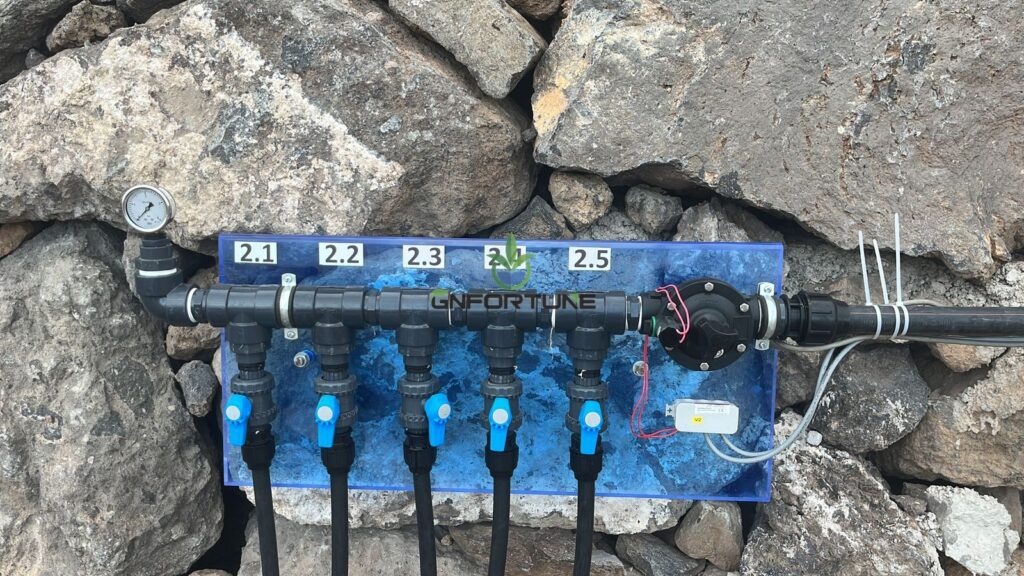
Blue PVC irrigation manifold with multiple solenoid and ball valves, representing the pumping and distribution network of a hydroponic reservoirA pump has two numbers on its label — maximum flow and maximum head — and neither is what it will deliver on your farm. The actual operating point sits on the pump curve where the flow it produces meets the resistance of your system: the vertical lift from the tank surface to the highest channel, plus friction losses through pipes, filters, valves, and the manifold. As head rises, flow falls; the curve shows exactly how much.
Read the curve like this:
- Calculate total dynamic head: static lift (tank surface to the top of the highest channel) plus friction losses — budget an extra 10–20% of the straight-pipe calculation for fittings, filters, and a partially clogged screen.
- Find the required flow: sum of all channel flows for NFT (see the NFT flow rate and slope worksheet), or the fill-rate requirement for flood tables.
- Plot the duty point on the pump curve and check it lands in the middle third of the curve, not at the far right where flow is maximum but efficiency and component life are lowest.
- Add 20–30% margin at the duty point for root mats that grow into the lines and filters that slowly load up.
A worked example: a bay of 100 lettuce channels at 1.2 L/min each needs about 7,200 L/h. With 2.5 m of static lift and a long manifold, the total head might reach 4 m. The pump to look for is one delivering roughly 9,000 L/h (the 25% margin) at 4 m — not one whose label says 9,000 L/h at zero head, which is a different, much smaller machine in practice.
The under-sizing pattern behind most audit calls: the pump was chosen by label flow at zero head, it now runs at the extreme right of its curve, and it is transferring its own motor heat into a small reservoir that has no thermal mass to absorb it. Flow is weak at the far channels, solution temperature creeps up, and the farm concludes it has a disease problem when it has a pump-selection problem. Match the duty point and the margin first; everything else follows.
Pump Types: Submersible, Inline, and Centrifugal
Once the duty point is known, the pump type follows from where it can physically live and how the system is run:
| Type | Where it lives | Strengths | Watch-outs |
|---|---|---|---|
| Submersible | In the reservoir | Simple to install, quiet, no priming, self-draining | Transfers motor heat to the solution; must be lifted for cleaning; corrode if not specified for continuous nutrient duty |
| Inline (in-line circulator) | Dry-mounted in the pipework | Serviceable without entering the tank; compact | Needs correct installation to avoid running dry; seal quality decides lifespan |
| Centrifugal (mag-drive) | Dry-mounted, central plant | Built for continuous duty; no shaft seal in the liquid; good for large recirculating loops | Needs priming or a flooded suction; oversized units waste energy at partial flow |
For NFT lines that run around the clock, continuous-duty rating is non-negotiable — a pump marketed for intermittent hydroponic use will not survive 24-hour service. For DWC and large tank farms, the pump rarely needs pressure at all; circulation volumes are modest and aeration is handled by air, not by the water pump.
Turnover Rate by System Type
Turnover — how many times per hour the whole reservoir volume passes through the system — is the check that ties the pump and tank calculations together:
| System | Target turnover | What the pump is really doing |
|---|---|---|
| NFT | ~1× tank volume per hour | Maintaining a continuous film; flow is set by channel count, not by tank size |
| DWC | 0.25–0.5× per hour circulation | Gentle mixing and temperature distribution; dissolved oxygen comes from air, not flow |
| Dutch bucket (recirculating) | Pulsed, 4–8 irrigation events per day | Pump sized to flood the bucket lines quickly, then rest between events |
| Ebb and flow tables | Pulsed, 2–6 floods per day | Pump sized to fill the tables in minutes, not hours |
The NFT figure deserves a note because it confuses buyers: the tank may hold three hours of buffer, but the pump must still deliver the sum of the channel flows every minute it runs. Turnover is a sanity check on mixing and temperature, not a substitute for the channel-flow calculation.
The Worksheet, Step by Step
The downloadable worksheet compresses to eight lines:
- Growing area and crop: ______ m², crop ______
- Daily uptake: area × 0.5–1.5 L/m²/day = ______ L/day
- Reservoir volume: uptake × 1.5–2 = ______ L minimum
- Channel count × per-channel flow = system flow ______ L/h
- Static lift + friction (×1.1–1.2) = total head ______ m
- Duty point = system flow × 1.25 at total head → pump spec
- Check: does the pump deliver 1× tank volume per hour (NFT) or 0.5× (DWC)? If not, revisit the tank or the pump
- Spare pump on shelf: yes / no (the correct answer is yes)
Run the worksheet once at design time and again whenever the crop plan changes — a switch from lettuce to a heavier-feeding crop can double the uptake figure and invalidate a reservoir that was only adequate before.
Common Under-Sizing Mistakes We See on Audits
- Sizing the pump by label flow at zero head — the most common error; the delivered flow at working head can be half the label figure.
- No margin for root mats and filter loading. A pump that was adequate at week one runs short by week five because the lines have half-filled with roots.
- Reservoir sized to floor space, not to crop plan. The tank is squeezed into a leftover corner and the safety factor disappears.
- One reservoir for everything. A single shared tank means one disease event or one bad batch of solution reaches every plant in the building; commercial operators increasingly split reservoirs per bay or per crop family.
- Ignoring solution temperature. A small tank in a hot greenhouse can hold the roots above their comfort range all summer regardless of how correct the volumes are.
None of these are expensive to fix on paper. All of them are expensive to fix after commissioning, which is why the worksheet belongs in the quotation stage of every project.
FAQ
How big should a hydroponic reservoir be?
A: As a minimum, daily water uptake multiplied by 1.5–2. For commercial leafy greens that works out to roughly 1–2 liters of tank per square meter of growing area, or 0.5–1 L per plant on smaller systems.
How do I calculate the pump size for a hydroponic system?
A: Sum the flow every outlet needs (channels, tables, or drip lines), calculate total head including lift and friction with a 10–20% friction allowance, then pick a pump that delivers about 25% more than required flow at that head — in the middle third of its curve.
Can a hydroponic pump be too powerful?
A: Yes. Excess flow floods NFT root mats, erodes growing media in Dutch buckets, and adds unnecessary motor heat to the solution. Match the duty point instead of buying headroom you cannot use.
Should I run one big reservoir or several smaller ones?
A: Several, for commercial operations. Splitting by bay or crop family contains disease, lets you run different EC targets in parallel, and means a cleaning cycle takes one bay offline instead of the whole farm.
What turnover rate does a DWC system need?
A: Around 0.25–0.5 tank volumes per hour of gentle circulation for mixing and temperature. In DWC the oxygen is supplied by aeration, not by pump flow, so a big turnover number is wasted energy.
Download the Reservoir and Pump Sizing Worksheet
Request the worksheet through the quote form and the engineering team will return the sizing sheet together with a checked calculation for your own project — send the growing area, crop plan, channel or table count, and the tank position relative to the crop, and you will get back the recommended reservoir volume, pump duty point, and a comparison against your current specification before you sign an order.
— G&N Fortune Limited · hydroponic equipment manufacturer since 1996 · Reviewed by the engineering team