

When we sit down with a purchasing team to review a dutch bucket quote, the first thing we do is separate the bucket price from the system price. They are rarely the same thing. A 10,000-bucket order can differ by 40% between two suppliers who quote “the same system” — and the gap is never in the buckets themselves. It is in the drip lines, the piping, the filtration, and the spare parts nobody mentions.
This guide is written from the buyer’s side: how to read a dutch bucket quote, which configuration items you can’t cut, and how to tell a real manufacturer from a reseller quoting a markup.
Read the Quote as Six Line Items, Not One Number
A complete dutch bucket (bato bucket) system for tomatoes or peppers breaks down like this. Ask any supplier to split the quote this way — the honest ones do it without hesitation.
| Line item | What it covers | Where savings hide |
|---|---|---|
| Buckets & lids | Bucket body, lid, drain stub | Wall thickness and recycled-resin content |
| Drip irrigation | Drippers, micro-tubing, stakes | Non-pressure-compensating drippers |
| Supply & return piping | Main lines, valves, fittings | Pipe wall thickness (SDR rating) |
| Filtration & dosing | Filter, nutrient dosing, EC/pH | Filter undersized for your water |
| Media | Coco, perlite or rockwool | Left out of the quote entirely |
| Spares & installation | Seals, extra drippers, assembly | Quoted as “extra” later |
Rule of thumb: if a supplier refuses to itemize, that is a red flag on its own. We have seen “system” quotes that turned out to be buckets only — the buyer discovered irrigation, media and pipework were all extras.
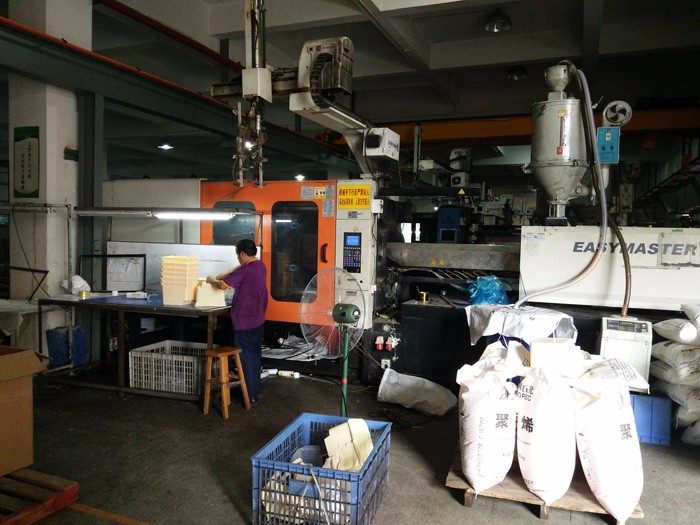
The Two Specs That Decide Whether a Bucket Lasts
1. Wall thickness and resin quality
Commercial buckets live under direct sun and repeated handling. A bucket molded from recycled or off-spec resin becomes brittle in 12–18 months and cracks at the drain stub — the one place you cannot repair without cutting the line. Ask for the nominal wall thickness and the resin grade. UV-stabilized virgin PP with a wall around 2 mm is the baseline for commercial duty. If the supplier cannot tell you the resin grade, assume the worst.
2. Dripper flow uniformity
In a recirculating dutch bucket line, every plant should get the same volume. Non-pressure-compensating drippers on a long row deliver 20–30% more at the head of the line than at the end. That shows up as uneven plants and a yield gap you will blame on the crop. Pressure-compensating drippers rated at 2 L/h are the minimum we specify on every commercial system — they are not expensive, and they remove a whole class of problems.
Filtration Is the Item Procurement Teams Cut First — and Regret First
The classic story: the buyer saves $200 on the filter, then spends $800 a month in labor unclogging drippers. In hard-water regions this is not an if — it is a question of when.
Match the filter stage to your water source:
- Well / borehole water: sand or disk filter before the pump, then a screen filter at each zone
- Municipal water: screen filter + inline mesh is usually enough
- Surface water (pond, river): sand filter + disk filter + 130-micron screen — do not skip stages to save money
Ask the supplier what filter package their quote assumes. If the quote has no filter line, add one before comparing prices — or your drip irrigation system will make the comparison for you.
Media Is a Recurring Cost, Not a One-Time Buy
Dutch buckets run on coco coir, perlite, or rockwool cubes. Whatever you choose, media is replaced, not reused: coco every 1–2 cycles, perlite often washed and reused, rockwool per cycle for high-value crops. Budget it as an annual line item. When comparing quotes, check whether media is included in the first-year price — if not, add it to your cash-flow plan.
Row Layout: Where the Yield per Square Meter Is Decided
Standard commercial spacing for tomatoes is 3 rows per 5 m span with 2 buckets per square meter of greenhouse. The layout drives your drip line length, return pipe diameter, and pump sizing. A supplier who asks for your greenhouse drawing and recommends a layout before quoting is doing engineering work, not just selling boxes. Prefer that supplier.
Three Configurations, Three Budget Levels
| Configuration | Scope | Best for |
|---|---|---|
| Basic drip-to-drain | Buckets, drip kit, manual valves | Pilot projects, small growers |
| Recirculating standard | + return lines, filter, tank | Most commercial tomato/pepper farms |
| Automated recirculating | + EC/pH dosing, controller, remote monitoring | Multi-greenhouse operations, scarce labor |
Our honest advice: do not jump to automation on year one if you have never run a recirculating system. Learn the basics with the standard setup, then add dosing — the learning curve is cheaper on a manual system.
Checklist Before You Sign a Dutch Bucket Order
- Quote itemized into buckets / irrigation / piping / filtration / media / spares
- Bucket resin grade and wall thickness stated in writing
- Pressure-compensating drippers specified (2 L/h)
- Filter package matched to your water source
- Media cost confirmed for year one, and replacement cycle documented
- Spare parts list included (seals, drippers, drain stubs) — not quoted “as extra”
- Layout recommendation based on your greenhouse drawing, not a guess
FAQ
Q: What is the difference between a dutch bucket and a bato bucket?
A: Nothing functionally — “Bato” is the original Dutch brand, and “dutch bucket” has become the generic name for the same 10-liter bucket with a drain stub. We supply both under the dutch bucket system line.
Q: Can dutch buckets work for crops other than tomatoes?
A: Yes — peppers, cucumbers, eggplant and even melons. They are the standard commercial choice for vine crops that need individual plant volume.
Q: What media do you recommend?
A: For vine crops we default to coco coir + perlite. Rockwool is an option for high-value crops. We will match the recommendation to your water quality and labor.
Q: What is the minimum order quantity?
A: Buckets and drip kits ship from standard pallet quantities. A complete recirculating system can be quoted as one project order — send us your greenhouse area and row layout for an exact quote.
Get a Dutch Bucket System Quote → · WhatsApp
Related reading: Commercial Irrigation Systems · Growing Tomatoes in Dutch Buckets · Dutch Bucket vs NFT