

Water touches every plant in the facility every day, and it is usually the last input tested before an equipment order is signed. Hydroponic water treatment is a matching exercise rather than a machine purchase: reverse osmosis, UV sterilization, ozone, and staged filtration each remove a different slice of the contaminant list, and none removes all of it. Sizing the train backwards from a laboratory report, instead of forwards from a catalog page, is what keeps a facility out of trouble in year three.
Your Water Source Sets the Ceiling on Every Recipe
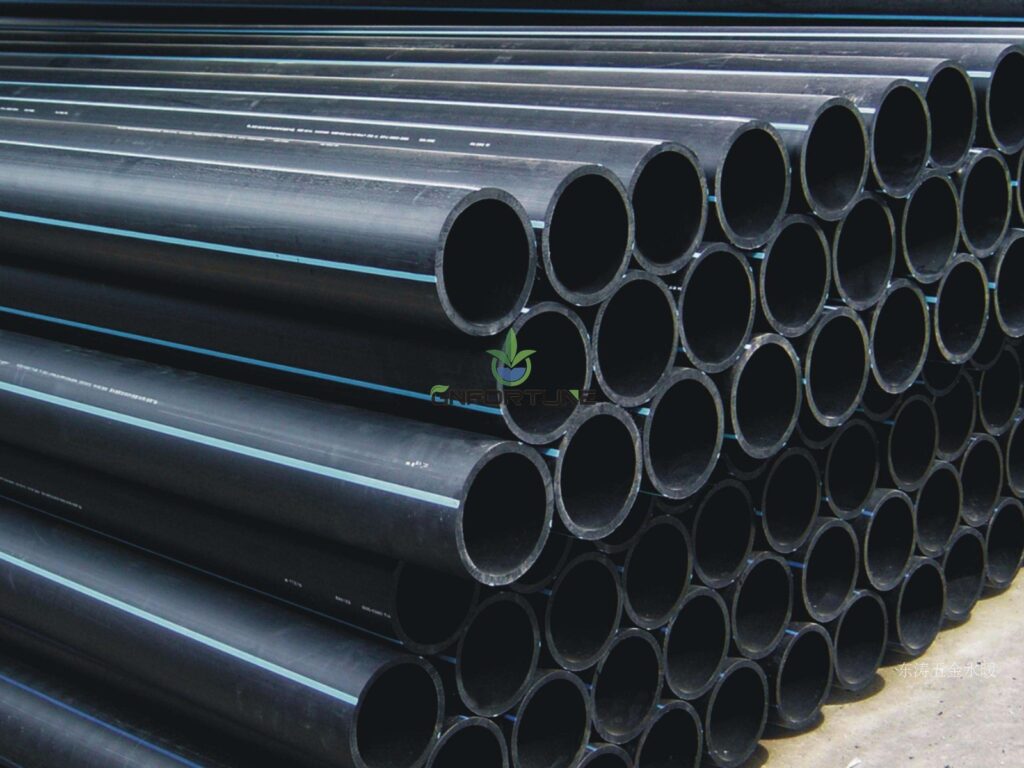
Stockyard of PE water supply pipes used to build the distribution side of a hydroponic water treatment trainEvery fertigation program starts from what the source water already contains. A supply arriving at 0.6 mS/cm with 80 mg/L sodium and 4 meq/L of bicarbonate alkalinity has already spent most of the EC budget before a single bag is opened, and the acid needed to strip that alkalinity runs every day of the cycle. Four source types dominate commercial projects:
- Municipal supply — clean, but carries chlorine or chloramine plus 0.3–0.8 mS/cm of hardness.
- Borehole or well water — the widest site-to-site variance: reducing aquifers bring iron, limestone aquifers bring alkalinity, coastal wells bring sodium and chloride.
- Rainwater — near-zero EC and alkalinity, but turbidity spikes after storms.
- Desalinated supply — a good sodium profile with almost no buffering capacity.
The gap shows up in the EC and pH measurement routine long before it shows up in yield.
What You Actually Need to Remove
Contaminants are best sorted by what they do to the crop. Suspended solids blind a UV reactor, alkalinity fights every pH adjustment, sodium and chloride accumulate in recirculating systems with no way out, and pathogens multiply in the return water.
| Contaminant class | Typical source signal | Stage that removes it | Working target |
|---|---|---|---|
| Suspended solids, turbidity | Rainwater, open storage tanks | 5 µm then 1 µm cartridge | Below 1 NTU before UV |
| Free chlorine, chloramine | Municipal supply | Granular activated carbon | Below 0.1 mg/L |
| Bicarbonate alkalinity | Boreholes in limestone | Acid injection, or RO | 0.5–1.5 meq/L |
| Sodium, chloride | Coastal wells | Reverse osmosis | Na below 50 mg/L |
| Iron, manganese, boron | Deep wells, some groundwaters | Oxidation plus filtration, then RO | Fe below 0.1 mg/L |
| Pathogens (Pythium, Fusarium) | Recirculating return water | UV, ozone, heat pasteurization | Dose-dependent |
Sediment and Carbon Filtration: The Cheap First Stage
The first stage is the cheapest and the one most often deleted to protect a budget. A three-step train — 5 µm nominal cartridge, 1 µm absolute cartridge, then granular activated carbon — costs a fraction of the RO skid it protects and does three jobs: it removes particles that foul membrane surfaces, strips free chlorine that would oxidize thin-film composite elements, and removes chloramine where a catalytic carbon grade is specified. Two details decide whether it earns its money: a differential pressure gauge across each housing, read weekly, so cartridge changes are driven by pressure rise rather than the calendar, and a chlorine test point downstream, because breakthrough is silent.
Reverse Osmosis: The Sodium and Alkalinity Answer
Reverse osmosis is the only stage that removes dissolved salts at scale. A well-maintained thin-film composite element rejects 95–99 percent of dissolved salts and the bulk of the alkalinity, with system recovery typically landing between 50 and 75 percent depending on feed chemistry. Without it, sodium and chloride accumulate cycle after cycle in any closed system, which is why RO sits upstream of the nutrient solution mixing protocol rather than beside it.
Two triggers justify the capital cost without argument: source EC above roughly 0.5 mS/cm, or sodium above roughly 50 mg/L. Either number means the alternative is a permanently compromised recipe. Below those thresholds, blending raw water with permeate usually beats full treatment, because it retains buffering capacity and cuts concentrate volume. Two things are consistently underestimated: concentrate disposal is a permitting question rather than a plumbing question, and permeate is aggressive water needing re-mineralization.
UV Sterilization: Dose, Contact Time, and the Clarity Trap
Ultraviolet treatment is a dose calculation, not a device purchase. The measure is millijoules per square centimeter: greenhouse recirculation systems commonly run 30–40 mJ/cm² of delivered dose for routine control, with 100–250 mJ/cm² for high-risk propagation water. Dose depends on intensity, contact time in the chamber, and the transmittance of the water itself.
That last variable is where UV programs fail. Turbidity and dissolved organics absorb and scatter ultraviolet light, so a reactor sized for clean permeate delivers a fraction of its rated dose once the water cloudies. The reactor belongs after filtration and after RO, and it should also see return water from the loop, where pathogen pressure builds. Quartz sleeves foul within months and lamp output decays long before the lamp stops lighting, so an intensity sensor and a scheduled sleeve clean separate a working barrier from a decorative blue glow.
The mistake we fix on site: a UV reactor installed ahead of the fine cartridge looks correct on the drawing and does almost nothing in service. Above roughly 5 NTU of turbidity, the transmittance loss across the water path wipes out the delivered dose while the unit keeps running with its lamp indicator green. We size reactors from a turbidity figure and place them last in the train.
Ozone: Powerful, But It Needs an Off-Gas Step
Ozone is the strongest oxidizer in the standard greenhouse toolkit and the one with the shortest margin for error. It is generated on site, dissolved into a contact tank, and dosed to a residual measured by oxidation-reduction potential. Its real advantage is biofilm inside pipes and tanks, which UV cannot reach because UV only treats the water that passes the lamp.
The off-gas step is not optional. Residual ozone reaching the irrigation water oxidizes root tissue and breaks down chelated micronutrients — iron first — damaging the plant before any pathogen does. A complete installation therefore includes a contact tank, a degassing step, and an activated carbon polish before the water rejoins the fertigation tank.
The Treatment Train We Spec by Source Type
The train is assembled from the front: pre-treatment first, then the salt-removal decision, then disinfection last, so each downstream stage receives water it can work with.
| Source type | Pre-treatment | Reverse osmosis | Disinfection | Site watch point |
|---|---|---|---|---|
| Municipal, low EC | 5 µm plus carbon block | Blending only | UV 30–40 mJ/cm² | Chloramine breakthrough |
| Borehole or well | 5 µm, 1 µm, acid dosing | Required, 50–75 percent recovery | UV plus periodic ozone | Concentrate disposal permit |
| Rainwater | 5 µm, 1 µm, carbon | Case by case | UV plus filtration | Turbidity swings after storms |
| Desalinated or blended | 5 µm | Blending only | UV | Re-mineralization for alkalinity |
Mistakes we fix on site
The recurring failures are predictable. A carbon stage sized on flow rate with no chlorine test point, so breakthrough goes unnoticed for months. An RO skid ordered without a concentrate plan, then run at 85 percent recovery to cut waste, which scales the membranes. And ozone injected with no degassing step, which surfaces as interveinal chlorosis two weeks later and gets misdiagnosed as a micronutrient deficiency. Every one is a plumbing or sequencing error, not a technology failure. Consumable and energy costs track feed chemistry and utility tariffs, and figures vary by region and season.
Water Analysis: The Six Numbers a Hydroponic Water Treatment Plan Needs
A treatment train can be sized from six numbers, supplied by a certified laboratory rather than a handheld meter at the tap: EC, pH, total alkalinity in meq/L or as CaCO₃, sodium, chloride, and iron, with manganese and boron as useful additions for well water. Those six values answer the RO question, the acid dosing question, and the disinfection intensity question in one pass.
Sampling discipline matters as much as the analysis. Draw after the pressure tank and before any treatment, let the line run several minutes, fill a clean container with no headspace, and submit it cold within 24 hours. For rainwater, sample in both wet and dry season. Both reports belong on the engineering input list that precedes any quotation.
FAQ
Q: Do I always need reverse osmosis, or can filtration alone work?
A: Only where source EC is below roughly 0.5 mS/cm and sodium below roughly 50 mg/L. Above either threshold, filtered water still carries the salt load into the root zone.
Q: Is UV enough for a recirculating system, or is ozone required?
A: UV controls free-floating pathogens in the water passing the reactor. Ozone also attacks biofilm inside pipes and tanks, which UV cannot reach, so systems with organic load justify both.
Q: What recovery rate should I specify for a commercial RO skid?
A: Recovery in the 50–75 percent range is normal. Push higher and scaling risk rises sharply on hard feed water, and figures vary by region and season.
Q: How often do RO membranes and UV lamps need replacing?
A: Membrane elements typically last two to five years under good pre-treatment. UV lamps are rated around 9,000–12,000 operating hours, so roughly annual on continuous duty.
Send Your Water Analysis and We Will Size the Train
Hydroponic water treatment sizing is a numbers exercise, not a catalog pick, and the difference shows up in operating cost long before it shows up in yield. Send EC, pH, alkalinity, sodium, chloride, and iron to /quote/, with peak daily water demand and whether the system recirculates, and we will return a treatment train layout with recovery rate and a consumables schedule.
- Root rot and Pythium control — the problem disinfection is meant to hold back.
- Fungal diseases in hydroponics — the climate-driven diseases that follow poor water management.
- Automation and control systems — dosing, ORP, and sensor integration for the treatment train.