

By the G&N commercial engineering team · First published: September 2026 · Reviewed for field accuracy
This case study walks through a 4,000 m² Dutch bucket cucumber greenhouse from the first brief to the end of the second crop cycle, with a 28-week primary harvest and a payback modelled against the buyer’s first-year P&L. The buyer is anonymized; the climate, layout, yield data, and engineering decisions are representative of the work we ship to commercial cucumber growers. The framing is engineering, which means the focus is on the design choices that drove the result and the issues we caught on site.
Project Brief: Buyer, Market, Climate
The brief came from a mid-size vegetable grower expanding into premium long-English cucumbers for the domestic retail and HORECA market. The buyer had greenhouse experience with field soil production and wanted to move into substrate-based hydroponics for yield, quality, and labour efficiency. The target was a 4,000 m² greenhouse that could produce continuously for 28–30 weeks, with a clear path to a second cycle in the same calendar year.
| Project parameter | Value |
|---|---|
| Footprint | 4,000 m² under glass |
| Crop | Long-English cucumber (single-fruit cultivar) |
| Market | Domestic retail + HORECA, premium tier |
| Climate | Humid continental, 32 °C summer / −8 °C winter |
| Existing infrastructure | Glass greenhouse with concrete floors and three-phase power |
| Target payback | 3–4 years from first planting |
| Cultivation system | Dutch buckets on drip, with coco-peat slabs in bucket |
The buyer’s existing glasshouse and three-phase power were the two reasons the project was commercially viable — a new build would have pushed the payback past 5 years. The retrofit case is the one we ship most often.
Why Dutch Buckets for Cucumber
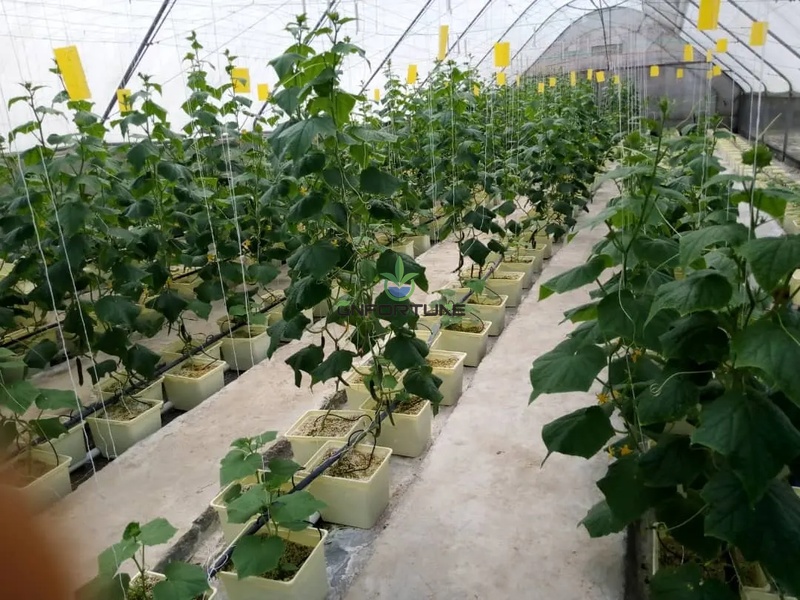
Dutch bucket cucumber greenhouse with trellised vine rows, drip irrigation, and yellow sticky traps between rowsCucumber is one of the crops where the choice of hydroponic system is largely settled. Dutch buckets (also called bato buckets) dominate commercial cucumber production for four reasons:
- Substrate flexibility. Dutch buckets accept coco-peat slabs, perlite, or rockwool cubes — the substrates a cucumber grower can actually source locally.
- Per-plant control. Each bucket is its own irrigation zone, which matters for cucumber where individual plant vigour varies more than in lettuce.
- Trellising friendly. The bucket line anchors a single-line trellis system that supports the plant from propagation through 28 weeks of harvest.
- Reuse across cycles. A bucket line is washed and re-substrated between cycles; the hardware lasts 8–10 years.
NFT and DWC are technically possible for cucumber but rare in commercial production. The capital cost difference is modest and the operational risk is higher, because a pump failure on an NFT cucumber line is a same-day crop loss. The Dutch bucket drip system tolerates pump downtime for hours without damage. The Dutch bucket system page covers the configuration we ship most often.
Layout: 4,000 m² with 8-Row Bucket Lines
The 4,000 m² footprint was laid out as a single greenhouse span with 8-row bucket lines. The geometry is a function of the existing column spacing and the trellis height:
- Bay width: 8.0 m between column rows, accommodating 8 bucket lines per bay.
- Bucket spacing: 50 cm between buckets along the line, giving 16 plants per linear meter.
- Line length: 32 m, with a single fertigation line feeding each row through a pressure-compensating dripper per bucket.
- Trellis height: 2.8 m above the bucket, with overhead support cables and a single-string lowering system.
- Aisles: 1.0 m working aisles between every two bucket lines.
| Layout element | Specification |
|---|---|
| Total bucket lines | 8 rows per bay, multiple bays |
| Plant population | ≈ 6,400 plants across the 4,000 m² |
| Substrate | Coco-peat slabs, one slab per bucket |
| Drippers | Pressure-compensating, 2 L/min, one per bucket |
| Drain return | 10–15 % drain-to-feed ratio, returned to drain tank |
Climate: Hybrid Pad-and-Fan + Screen
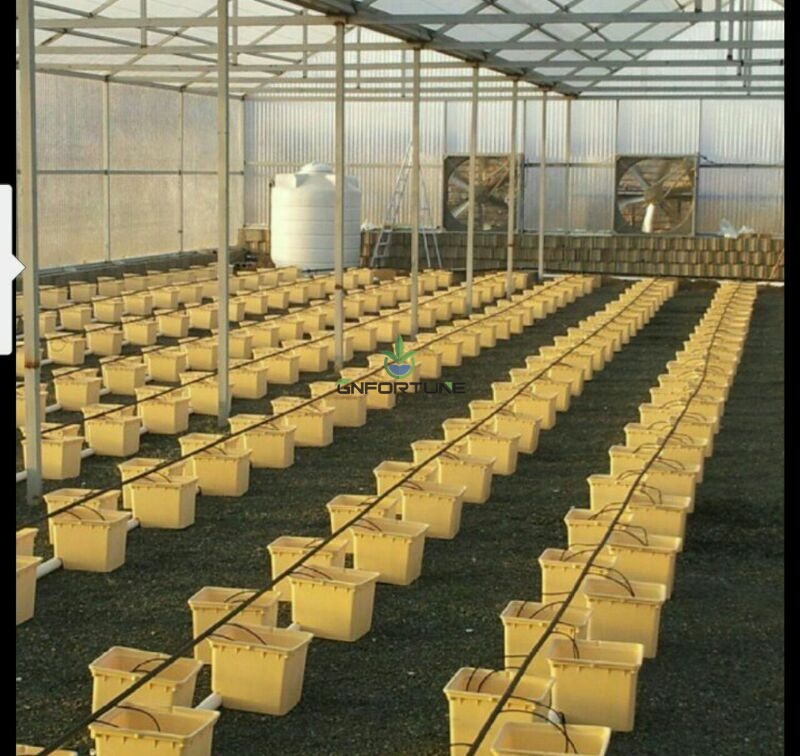
Wide view of a 4,000 m² Dutch bucket greenhouse showing parallel bucket rows, irrigation lines, and exhaust fansCucumber wants a stable climate — not too hot, not too cold, with humidity controlled to avoid powdery mildew and botrytis. The hybrid system on this project:
- Pad-and-fan cooling. Sized for a 32 °C outdoor design day, with 30 % reserve margin. The 4,000 m² greenhouse uses two pad walls and six exhaust fans, balanced against a single-zone control loop.
- Internal shade screen. 30 % shade deployed above the canopy from late spring to early autumn, dropping the leaf-surface temperature by 3–4 °C during the hottest hours.
- Heating. Hydronic heating pipes below the bucket line, set to maintain an 18 °C minimum night temperature even when outdoor drops to −8 °C.
- Horizontal airflow. Six circulation fans per bay to eliminate humidity stratification, which is what drives botrytis outbreaks in cucumber canopies.
The climate system is sized to keep the leaf temperature inside 20–28 °C for the entire production cycle. Outside that band, the cucumber plant drops fruit set or accelerates toward senescence. The engineering work on this section is what decides whether the 28-week cycle stays productive.
Plant Management: Pruning, Trellising, Harvest
The agronomic decisions that drive yield in a Dutch bucket cucumber line:
- Single-stem pruning. All side shoots removed up to the trellis wire, then allowed to fruit on the main stem. This produces uniform long-English fruit and simplifies harvest scheduling.
- Trellising. A single string per plant, with overhead support cable at 2.8 m. The string is lowered once during the cycle to keep the fruiting zone at working height.
- Pollination. Parthenocarpic cultivar, so no bees required. This removes one variable and one cost from the operation.
- Harvest cadence. Every 2–3 days during peak summer, every 4–5 days in shoulder seasons. A missed cut costs fruit weight and quality; the labour schedule has to absorb that.
The plant-management SOP is part of the handover package we provide after commissioning. For buyers running long-English cucumber for the first time, the SOP is the difference between a 28-week cycle and a 20-week cycle on the same equipment.
Yield and ROI: 28 Weeks, kg per m², Payback Months
The first cycle ran 28 weeks from transplant to final cut. The numbers, anonymized and rounded:
| Metric | Target | First cycle result | Second cycle result |
|---|---|---|---|
| Yield (kg/m²) | 50–60 | 52 | 58 (improved canopy management) |
| Fruit length distribution | 90 % premium grade | 87 % | 92 % |
| Cycle length | 26–30 weeks | 28 weeks | 30 weeks |
| Powdery mildew incidents | None expected | One localized outbreak, controlled within 10 days | None |
| Payback (modelled) | 3–4 years | Tracking inside the band | Confirming the band |
The buyer’s first-year P&L landed inside the band modelled in our hydroponic farm ROI guide. Numbers vary by region and season; this buyer’s market window and premium positioning are what made the payback work, and the same equipment in a saturated market would have produced a longer payback.
The on-site fix that mattered: during the first cycle we found that the original dripper spec delivered 4 L/min per bucket at the start of the line and 1.2 L/min at the end — a 70 % pressure drop that translated into uneven fruit size across the bay. Pressure-compensating drippers are not optional on a 32 m run; the cheaper non-PC drippers looked identical on day one and produced uneven fruit by week six. We retrofitted the line with PC drippers in two days; the second cycle ran uniform. We fix on site, but the cheaper dripper is the kind of fitting we now refuse to ship on long runs.
Lessons Learned from the Second Crop Cycle
The second cycle ran 30 weeks and beat the first on yield, grade, and disease pressure:
- Canopy management. Earlier leaf removal below the fruiting zone improved airflow and reduced botrytis pressure to zero in the second cycle.
- EC schedule. A stepped EC ramp (1.8 to 2.4 mS/cm across the cycle) replaced a fixed 2.2 mS/cm recipe, improving fruit firmness without yield loss.
- Dripper audit. Quarterly dripper flow checks became part of the SOP. A 5% dripper failure rate is invisible until it shows up as uneven fruit.
- Spare-parts kit. The buyer now stocks 5% spare drippers, 2% spare buckets, and one full fertigation service kit.
Frequently Asked Questions
How long is a Dutch bucket cucumber cycle?
A: Typically 26–32 weeks from transplant to final cut, depending on cultivar, climate, and canopy management.
What is a realistic yield for a Dutch bucket cucumber greenhouse?
A: 50–60 kg/m² across a full cycle is a typical commercial band. Numbers vary by region and season.
How long does it take to install a 4,000 m² Dutch bucket cucumber line?
A: Approximately 10–14 weeks from contract signature to first transplant, depending on civil works and climate equipment lead time.
What is the most common on-site issue on a Dutch bucket cucumber project?
A: Dripper uniformity. Pressure-compensating drippers are not optional on runs above 15 m; non-PC drippers produce uneven fruit that the market rejects.
Can the same Dutch bucket line run tomato or pepper?
A: Yes, with substrate and spacing adjustments. Dutch buckets are a versatile platform across vine crops; the bucket and frame hardware stays the same.
Plan a Cucumber Greenhouse
Send your greenhouse dimensions, target cycle length, and market window through the quote form, and our engineering team will return a layout and ROI model based on this case study and our other cucumber deliveries. The Dutch bucket system page covers the standard configuration, and the cucumber growing guide goes deeper on the agronomic side of the cycle.
— G&N Fortune Limited · hydroponic equipment manufacturer since 1996 · Reviewed by the engineering team