

By the G&N commercial engineering team · First published: September 2026 · Reviewed for field accuracy
This case study walks through the full delivery of a 2-hectare hydroponic lettuce farm in the Tashkent region — from the first project brief to the first commercial harvest, four months after the container ship docked. The buyer is anonymized; the climate, equipment list, layout, and lessons are real and representative of the work we ship to Central Asia. The case is written from the engineering perspective, which means the focus is on the design decisions that mattered, the mistakes we caught on site, and what we would do differently the next time.
Project Brief: Buyer, Climate, Crop, Market Window
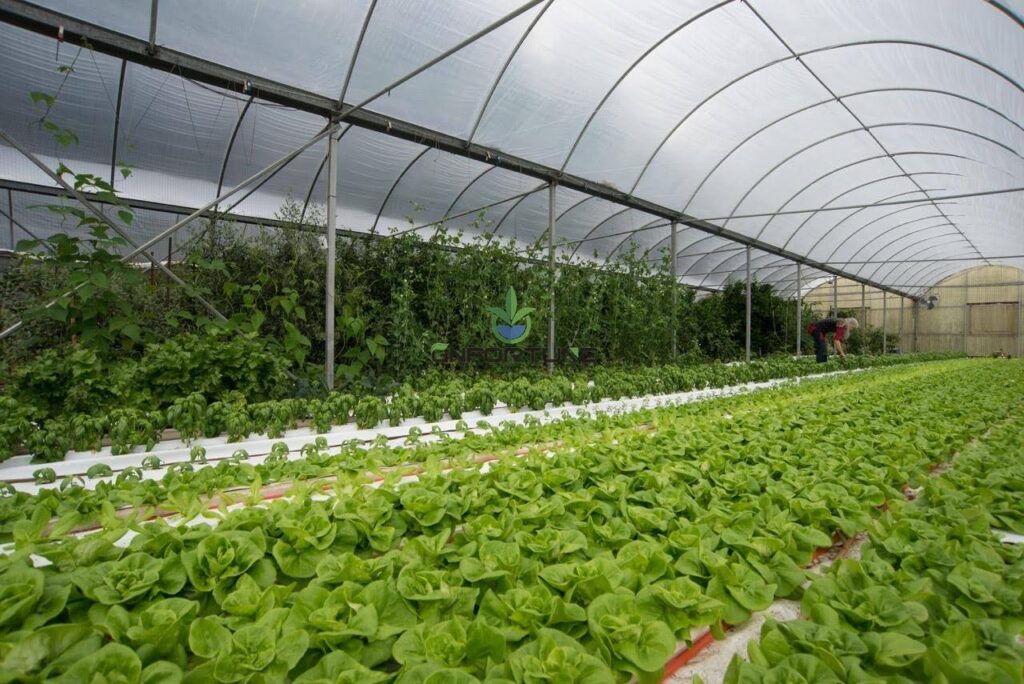
Long rows of dense lettuce heads under a high-tunnel structure showing the scale of a commercial hydroponic farmThe brief arrived with a tight four-month deadline before the first summer harvest. The buyer is a regional agricultural group with existing field acreage, expanding into premium leafy-greens supply for domestic retail and HORECA channels. The crop is butterhead and multi-leaf lettuce for bagged-salad processors. The market window is the May–September shoulder season, when local field supply drops in quality and import competition softens.
| Project parameter | Value |
|---|---|
| Footprint | 2 hectares (≈ 20,000 m²) under glass |
| Region | Tashkent region, Uzbekistan |
| Crop | Butterhead and multi-leaf lettuce for bagged salad |
| Market window | May–September premium window |
| Climate envelope | Summer peaks 35 °C; winter lows −15 °C |
| Water source | Municipal, hard (≈ 350 ppm CaCO₃) |
| Power | Three-phase, 50 Hz, with frequent voltage events |
| First harvest target | Month 5 from contract signature |
The water quality was the single most important non-obvious parameter. Hard municipal water interacts badly with the Pythium profile in NFT lettuce, and it locks out iron and manganese at the higher pH the local supply runs. We designed around it from day one.
System Design: NFT + Ebb & Flow + Harvest Line
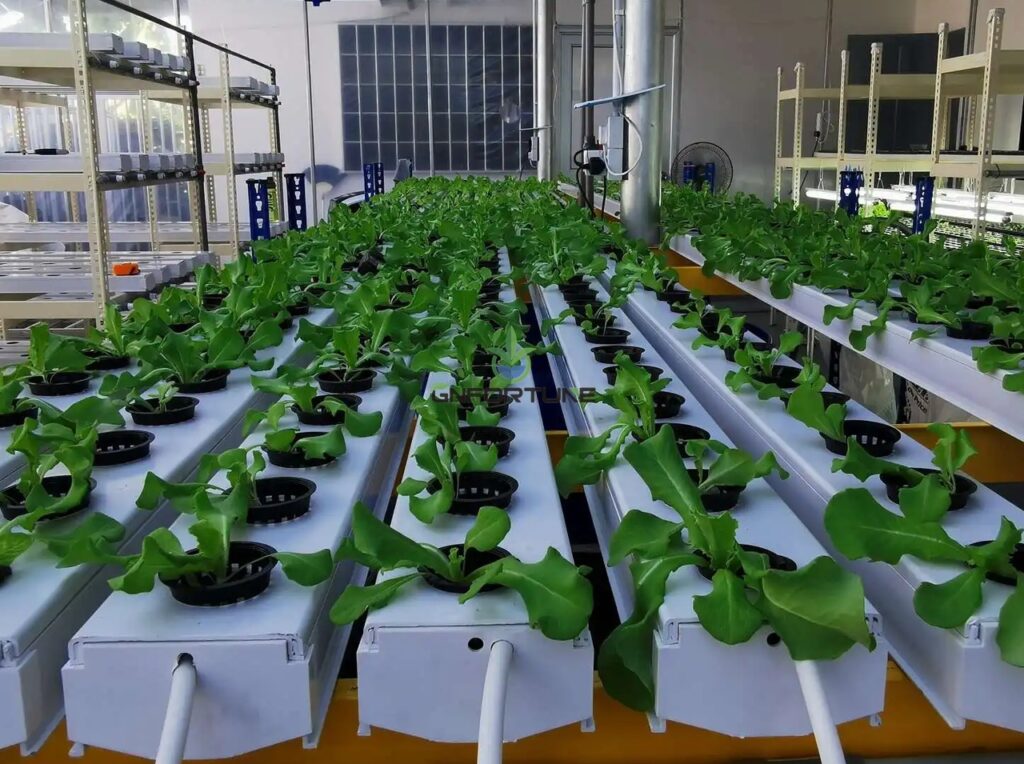
Dense NFT channels with net-cup lettuce heads in a high-density commercial hydroponic setupThe 2-hectare footprint was split into two systems. Roughly 75% is NFT for butterhead, which is the buyer’s volume crop and benefits from the high dissolved oxygen and clean IPM profile of a well-run NFT channel. The remaining 25% is ebb and flow for the multi-leaf lettuces and propagation, where the deeper flood helps the propagation trays and gives the operation a backup channel in case of NFT pump downtime.
- NFT bay layout. 1.5 hectares of NFT in 6.0 m wide bays with 8 channels per bay, each channel 12 m long. Channel slope set at 1.5%, flow per channel 1.5 L/min. The bay width was driven by the greenhouse column spacing; the channel length was capped at 12 m to avoid stagnation in the lower third of the run.
- Ebb and flow. 0.5 hectare of flood tables in 4 × 8 ft trays on galvanized steel frames, with a central reservoir and dosing skid.
- Propagation and harvest line. A dedicated propagation room running 4 × 8 ft trays, a transplant line, and a harvest conveyor with hydrocool and cold-room tie-in.
The design documents were reviewed against the 12 inputs a supplier must have, with particular attention to climate data, water analysis, and the layout constraints imposed by the existing greenhouse columns.
Climate Envelope: 35 °C Summer, −15 °C Winter
Central Asia sits at the climate extremes hydroponic lettuce dislikes most. Summer days hit 35 °C and warm nights stay above 20 °C, both of which accelerate bolting and Pythium. Winter lows reach −15 °C, which freezes unprotected reservoirs and stresses NFT fittings. The engineering response:
- Cooling. Pad-and-fan cooling sized for the 35 °C summer design day, with a 30% reserve margin. Internal shade screens at 35% shade from May to September.
- Reservoir chilling. A water chiller on the NFT reservoir holds the nutrient solution at 18–20 °C through summer.
- Winter protection. Heating sized for an indoor setpoint of 12 °C even when outdoor drops to −15 °C. The reservoir and dosing skid are installed in an insulated enclosure.
- Backup power. A standby generator on the critical load sized for the longest expected grid outage.
The chiller and the generator together account for roughly 18 % of the equipment budget. They are not optional in this climate.
Equipment Shipped: Container List (Anonymized)
The full equipment list shipped across four 40-foot high-cube containers:
| Container | Main equipment |
|---|---|
| Container 1 | NFT channels, channel stands, fittings, fasteners |
| Container 2 | Flood trays, ebb and flow frames, bulkheads, standpipes |
| Container 3 | Reservoirs, dosing skids, pumps, chiller, electrical panels |
| Container 4 | Propagation trays, harvest conveyor, hydrocool, cold-room refrigeration |
Total shipment was approximately 4 × 40 HC, with container loading planned around installation sequence. Channels and stands were loaded last-in-first-out. The packing list, the pro forma invoice, and the installation drawings were sent to the buyer’s engineer before shipment left the factory, which is standard for our multi-hectare deliveries.
Installation Timeline: 4 Months
The installation was sequenced in four phases over four months:
- Month 1 — Civil works and reservoir. Concrete pad, reservoir placement, main electrical and water tie-in. Local contractor, supervised by our installation engineer for the first 10 days.
- Month 2 — NFT and ebb and flow assembly. Channel stands and channels installed; flood tables and frames set. Two installation engineers on site for the duration.
- Month 3 — Dosing, chiller, electrical, controls. Dosing skid, pumps, chiller, and electrical panels commissioned. Cold-room and harvest conveyor installed. SCADA and IPM scouting handed over to the buyer’s agronomist.
- Month 4 — First sow and pre-harvest check. Propagation started week 13, transplant to NFT week 15, first harvest week 18.
First Harvest Results: Yield, Quality, Market Reaction
First commercial harvest hit the buyer’s target window in the second half of May. The performance numbers, anonymized and rounded:
| Parameter | Target | First-harvest result |
|---|---|---|
| Yield (kg/m²/year, butterhead NFT) | 35–45 | In range; second cycle running 10 % above target |
| Cycle time (transplant to cut) | 30–35 days | 32 days at summer setpoints |
| Tip burn rate | < 5 % | 3 % across the first three cuts |
| Downy mildew incidents | None | None; preventive IPM protocol in place |
| Shelf life at retail | 10 days at 4 °C | 11–13 days measured at the buyer’s packhouse |
Market reaction was strong: the buyer’s bagged-salad customers moved the hydroponic line into a premium SKU tier within six weeks, citing leaf cleanliness, uniformity, and shelf life as the differentiators over the existing field supply. Numbers vary by region and season, but the buyer’s first-year economics landed inside the band modelled in our hydroponic farm ROI guide.
The on-site fix that almost became a delay: during commissioning we found that the local three-phase voltage was spiking to 440 V on a hot afternoon, which would have burned out the dosing pumps inside a week. The buyer’s existing surge protection was sized for residential equipment. We installed industrial three-phase surge protectors on the dosing and chiller lines within 48 hours; the rest of the project timeline held because the engineering team flagged the issue during the design review, not at the point of failure. We fix on site, but we would rather fix on the drawing.
What the Buyer Learned and What We Would Do Differently
Every project leaves a list. The honest debrief from this delivery:
- Water analysis earlier. The municipal water hardness came as a surprise during the design review. We now request a full water analysis as one of the first three documents on every Central Asia project.
- Generator sizing. The buyer originally specced a smaller standby set. We increased it after modelling a summer grid outage that coincided with a 35 °C day; the larger set kept the NFT alive through the first heat event.
- Local language documentation. A translated handover would have shortened the buyer’s staff training by a week. We now produce bilingual handover documents for non-English-speaking markets.
- Spare-parts kit. We shipped a 2% spare-parts kit. The buyer has used fittings from it twice for routine maintenance and once for an emergency repair. The 2% recommendation holds.
Frequently Asked Questions
How long does a 2-hectare hydroponic farm take to install?
A: Approximately four months from contract signature to first commercial harvest, with civil works running in parallel with equipment installation.
What is the largest cost driver in a multi-hectare hydroponic project?
A: Climate control (cooling and heating), followed by the NFT and ebb and flow equipment itself. On this project, climate control was approximately 35 % of the equipment budget.
Can hydroponic lettuce be profitable in a continental climate?
A: Yes. The premium market window and the lower competition from field supply in summer typically offset the higher cooling and heating costs. Numbers vary by region and season.
What is the most common on-site issue on a multi-hectare project?
A: Electrical quality. Voltage events and phase imbalance are the most common causes of pump and dosing failures on first-year projects. Surge protection and a proper generator are not optional.
Do you share the full project plan with new buyers?
A: Yes. Send a project brief through the quote form and we return a draft project plan including the equipment list, container loading plan, installation sequence, and timeline.
Plan a Multi-Hectare Farm
If you are planning a multi-hectare farm, send your brief — site, climate, crop, water analysis, market — through the quote form, and our engineering team will return a draft project plan based on this case study and our other multi-hectare deliveries. The 12 system design inputs is the same list we use to start every project, and the turnkey greenhouse solution page covers how we scope, ship, and commission multi-hectare builds.
— G&N Fortune Limited · hydroponic equipment manufacturer since 1996 · Reviewed by the engineering team