

A hydroponic farm is a commercial growing facility that produces crops without soil, delivering water and dissolved nutrients directly to plant roots in a controlled environment — typically a greenhouse or indoor facility. Hydro farms range from 500 m² leafy-green operations to multi-hectare greenhouse complexes, and they exist because they produce more food per square meter, per liter of water, and per unit of labor than soil farming in the same climate. For investors and growers evaluating hydro agri in 2026, the questions that matter are not whether the technology works — it does — but what a facility costs, which model fits the local market, and how the numbers close against the crops and channels available.
What Is a Hydroponic Farm?
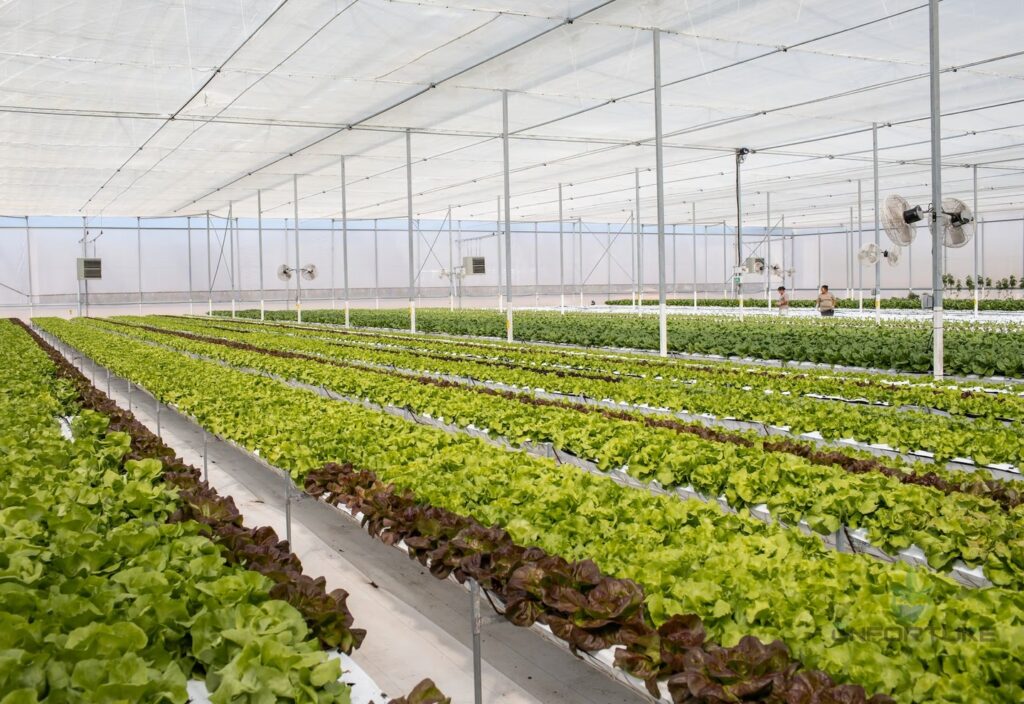
Large commercial hydroponic farm with NFT lettuce channelsA hydroponic farm replaces soil with a recirculating nutrient solution. Plants grow in inert substrates (rockwool, coco coir, perlite) or in bare-root systems (NFT channels, deep water culture, aeroponic towers). The nutrient solution is mixed from mineral salts, monitored for pH and electrical conductivity, and delivered to roots through pipes, pumps, and timers. The growing environment — temperature, humidity, light, CO&sub2; — is controlled in a greenhouse or insulated structure.
The distinction from a hobby setup is scale and purpose. A hydroponic farm is a business: it sells produce at a price that covers capital recovery, operating cost, and profit. That changes every decision. Equipment must be food-safe, sized for daily harvest, and backed by spare-parts availability. Climate control must be engineered for the worst week of the year, not the average. For a plain-language definition of how the underlying soilless approach works, the soilless farming explainer covers the fundamentals.
The Main Farm Models: Greenhouse, Vertical, and Container
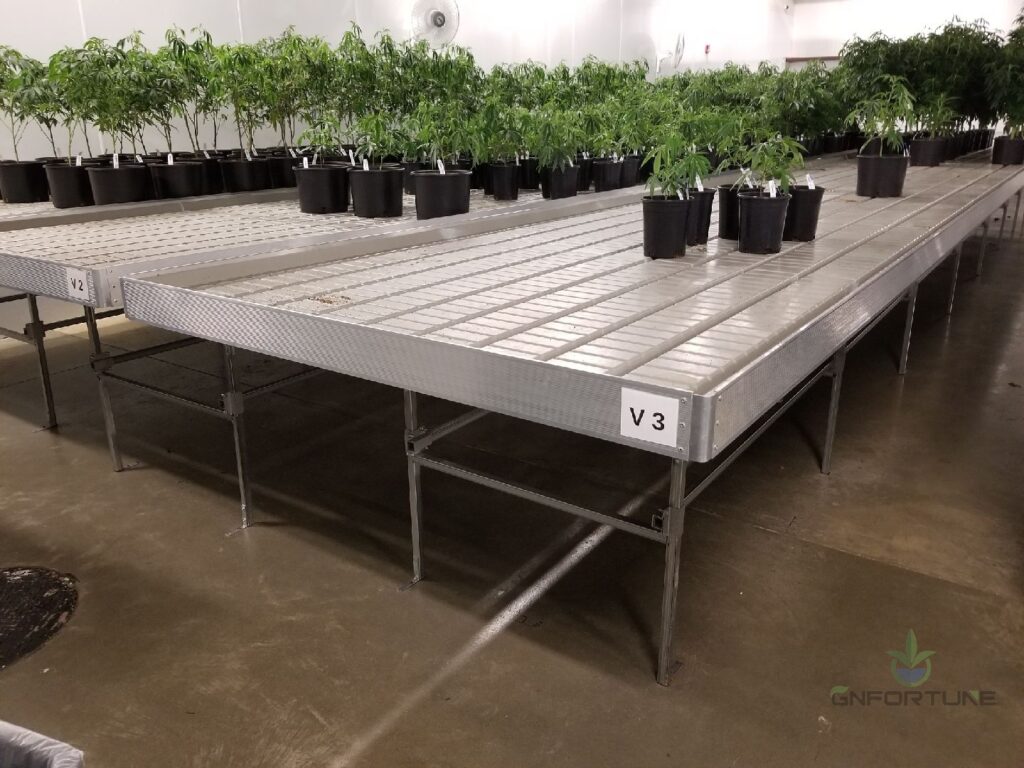
Greenhouse seedling benches with young potted plantsThree physical models dominate commercial hydro farms in 2026, and each fits a different crop, market, and capital budget:
| Model | Structure | Typical crops | Capital intensity | Best for |
|---|---|---|---|---|
| Greenhouse hydroponics | Single or multi-span polycarbonate/glass greenhouse with NFT, Dutch bucket, or ebb and flow systems | Lettuce, herbs, tomatoes, cucumbers, peppers, strawberries | Medium — structure + hydroponic equipment | Commercial leafy greens and fruiting crops; established produce markets |
| Vertical farm (indoor) | Insulated indoor space with multi-layer rack systems, LED lighting, aeroponic or NFT towers | Leafy greens, microgreens, herbs | High — lighting, HVAC, racks, automation | Urban markets, premium fresh-cut, year-round supply contracts |
| Container farm | Refrigerated shipping container retrofitted with hydroponic racks, LED, climate control | Leafy greens, herbs (small volume) | Medium-high per m² (small total area) | Pilot operations, remote locations, low-volume specialty |
Greenhouse hydroponics is the workhorse model: it uses natural sunlight, which is free, and achieves the lowest cost per kilogram of any model for leafy greens and fruiting crops. Vertical farms trade higher energy cost for higher density and full climate control — viable where land is expensive, electricity is cheap, and the market pays a premium for local, year-round produce. Container farms are pilots or niche operations — useful for proving a concept or supplying a specific remote customer, but rarely competitive at commodity produce prices.
Typical Capex and Operating Cost per Hectare
Capital expenditure for a commercial greenhouse hydroponic farm varies widely by structure type, climate control level, and equipment spec. The ranges below reflect 2026 project costs for a turnkey greenhouse hydroponic facility on a cleared site with utility access:
- Greenhouse structure (polycarbonate, multi-span, with basic climate control): the shell — frame, covering, ventilation, shading, and basic heating — is the largest single cost and typically accounts for 40–55% of total capex.
- Hydroponic equipment (NFT channels, Dutch buckets, irrigation, pumps, filters, nutrient dosing): roughly 20–30% of capex, depending on system type and automation level.
- Climate control upgrade (heating, cooling, LED supplemental lighting, CO&sub2;): 15–25% — the difference between a fair-weather greenhouse and a year-round production facility.
- Site work, water, electricity, and commissioning: 10–15%.
For detailed cost breakdowns by system type and capacity, the commercial hydroponic system cost guide provides itemized ranges. Operating cost is dominated by labor (30–45% of opex), energy for climate control (20–35%), and consumables — nutrients, seeds, substrate, packaging (15–25%). Water is a small line item in recirculating systems; it is climate control energy, not irrigation, that drives operating cost.
The consultant’s reminder: The cheapest greenhouse to build is the most expensive to run. A structure sized for fair-weather growing saves 15% on capex and then spends that 15% every year on heat, ventilation, or lost crops from a single extreme-weather week. Climate control is not a luxury line item — it is the difference between a farm that produces 10 months a year and one that produces 6. Run the annual operating cost before you sign the structure contract.
How Commercial Hydro Farms Make Money in 2026
A hydroponic farm is profitable when revenue per square meter exceeds the annualized capital cost plus operating cost per square meter. The math is simple; the execution is not. Three revenue drivers determine whether the numbers close:
- Crop selection and pricing. Leafy greens at wholesale commodity prices require high volume and tight cost control. Specialty herbs, baby greens, and premium lettuce varieties sold to restaurants or fresh-cut processors carry 2–4x the price per kilogram. The crop mix is the single biggest revenue lever.
- Capacity utilization. A greenhouse that runs at 60% of designed capacity loses money; at 90% it makes money. Utilization is driven by cycle time (how fast a crop turns over), gap time between cycles (how fast you replant), and climate control (how many months per year you can produce). The difference between a 6-month and a 10-month growing season is the difference between break-even and profit.
- Channel and contract stability. Selling to a wholesale distributor is reliable but low-margin. Selling direct to restaurants or retail is higher-margin but higher-effort. The strongest model combines a base-load wholesale contract for predictable volume with a direct channel for premium products — the wholesale contract pays fixed costs, the direct channel delivers profit.
For the full framework on running these numbers — yield per cycle, price per kilogram, utilization rate, and payback period — the hydroponic farm ROI guide walks through a worked example that most investors run before committing to a build.
Questions to Answer Before You Build
Before commissioning a design or ordering equipment, answer these questions honestly. They are the ones a consultant asks first, and the answers determine whether the project should proceed:
- Who buys your produce, and at what price? A market analysis with real price points for your region is the prerequisite, not a nice-to-have. If you cannot name three buyers and their current delivered prices, you are not ready to build.
- What is the worst-month climate, and can you control it? The system must produce through the hottest and coldest weeks of the year. If summer cooling or winter heating is not in the budget, the farm will underperform exactly when competitors with climate control are supplying the market.
- Who operates the system daily? Hydroponic farming requires technical skill: EC and pH management, nutrient dosing, pest scouting, pump maintenance. If there is no qualified operator, the capital is wasted.
- What is the realistic yield, not the catalog yield? Suppliers quote peak yields under ideal conditions. Real commercial yields for NFT lettuce are typically 70–85% of catalog numbers in the first two years. Build the business case on real yields, and treat anything above that as upside.
For the full build process — from site selection through equipment commissioning — the commercial hydroponic system build guide covers the decisions that turn a feasibility study into an operating facility.
FAQ
How much does it cost to build a hydroponic farm?
A: Cost depends on model, size, and climate control level. A turnkey greenhouse hydroponic facility for leafy greens typically ranges from a lower-cost polycarbonate structure with basic ventilation to a fully climate-controlled glass greenhouse with LED and CO&sub2; supplementation. Structure is 40–55% of capex; hydroponic equipment is 20–30%. See the system cost guide for itemized ranges.
Is a hydroponic farm profitable?
A: Yes, when the crop mix, market price, and capacity utilization are aligned. The farm makes money when revenue per square meter exceeds annualized capex plus opex per square meter. The biggest lever is crop selection — specialty greens at premium prices are more profitable than commodity lettuce at wholesale.
What is the difference between a hydroponic farm and a greenhouse?
A: A greenhouse is the structure; hydroponics is the growing method inside it. Most commercial hydroponic farms are greenhouses, but not all greenhouses are hydroponic. A hydroponic farm can also be an indoor vertical facility without any greenhouse structure.
How much land do I need for a commercial hydroponic farm?
A: A viable commercial greenhouse for leafy greens starts at roughly 1,000–2,000 m² of growing area. Smaller operations can work for specialty crops or direct-market channels, but the fixed costs of climate control and equipment favor larger footprints.
What is the fastest-paying-back hydroponic crop?
A: Fast-cycle leafy greens (lettuce, basil, cilantro) with a 3–5 week grow time and a wholesale price that covers operating cost within each cycle. The full payback analysis is in the farm ROI guide.
Send Your Project Brief for a Feasibility Note
Evaluating a hydroponic farm project? Send your brief for a feasibility note. Tell us your target crop, region, available land area, and budget range through the quote form, and we will return a feasibility note with recommended system type, indicative capex, and the engineering and shipping terms that apply to your market — before you commit capital.