

Specifying fish farm equipment for an aquaponics project means matching tanks, filters, and aeration to your fish biomass and crop area — not buying a catalog package and hoping it balances. The list looks short: tanks, a mechanical filter, a biofilter, a pump, and an air blower. What matters is whether each piece is sized to the same feeding rate, and whether the supplier provides consistent spare parts two seasons later.
Fish Tanks: Round Versus Square, and the Flow Pattern Trap
The fish tank is the first equipment decision and the one most commonly under-specified. Two shapes dominate commercial aquaponics:
- Round tanks (circular flow). Water enters tangentially and exits through a center standpipe, creating a gentle circular pattern that sweeps solids toward the center drain. Round tanks are self-cleaning for solids — the single biggest advantage for aquaponics, where fish waste must reach the mechanical filter quickly rather than accumulate on the tank floor.
- Square or rectangular tanks. Cheaper to build and pack into greenhouse footprints, but they create dead zones in corners where solids settle and anaerobic pockets form. A square tank can work with careful inlet and drain placement, but it demands more cleaning labor and carries a higher risk of water quality problems at high density.
| Tank type | Solids self-cleaning | Space efficiency | Typical material | Best for |
|---|---|---|---|---|
| Round (circular flow) | Good — center drain collects solids | Lower — circular footprint wastes corner space | PE/PP, fiberglass, galvanized steel with liner | Commercial aquaponics, high stocking density |
| Square / rectangular | Poor — dead zones in corners | High — fits bays tightly | Concrete, IBC totes (small scale), fiberglass | Budget builds, low density, retrofit greenhouses |
| Raceway (long rectangular) | Moderate — needs slope and good inlet design | High for long bays | Concrete, fiberglass | Flow-through systems, large-scale trout |
The flow pattern trap: a round tank fitted with a poorly placed inlet — too low, too high, or not tangential — loses the self-cleaning effect and performs like a square tank. Ask the supplier for the inlet height, angle, and flow rate that produce the designed circular pattern, and whether the center standpipe has a solids-capture sleeve. These details separate a tank that runs clean from one that needs daily vacuuming.
Mechanical Filtration: Swirl Separators and Drum Filters
Before water reaches the biofilter, solids — fish feces and uneaten feed — must be removed. Solids that enter the biofilter clog media, create anaerobic zones, and reduce nitrification capacity. Two mechanical filter types cover most commercial systems:
- Swirl separators (radial flow settlers). Water enters tangentially at the top of a cone-bottomed vessel; centrifugal force pushes solids to the wall and down into the cone for periodic draining. No moving parts, no mesh to clog, very low maintenance. Best as a first-stage filter capturing particles above ~100 microns.
- Rotary drum filters. Water passes through a rotating fine-mesh drum (60–100 micron). Solids are caught on the mesh and backwashed off by a spray bar into a waste trough. Drum filters capture finer solids and are the standard for intensive systems above ~5 tons of fish. They need power, clean water for backwash, and periodic mesh replacement.
For a commercial aquaponics greenhouse, the common setup is a swirl separator as first stage followed by a drum filter. If budget forces a single stage, choose the drum filter — it catches the fine solids that matter most for biofilter health. More on how solids load relates to fish density is in our aquaponics stocking density guide.
The supplier甄别 question that saves the most money: “What is the recommended mesh size for my fish species and feed type, and how often does the mesh need replacement?” A supplier who cannot answer with a micron number and a replacement interval is selling a product, not a system. Filter mesh that is too fine for your load clogs hourly; mesh that is too coarse lets solids through to the biofilter and you pay for the problem downstream.
Biological Filtration: Media Choice and Sizing Rules
The biofilter is where the nitrogen cycle happens. Its job is to provide surface area for nitrifying bacteria, and its size is set by the daily ammonia load — which is set by the daily feeding rate. Three media types dominate commercial aquaponics:
| Media type | Surface area | Cost | Maintenance | Notes |
|---|---|---|---|---|
| Moving bed (K1/K3 style) | 500–800 m²/m³ | Medium | Low — self-cleaning via aeration | Industry standard; media tumbles in an aerated vessel |
| Structured plastic blocks (fixed) | 700–1000 m²/m³ | Medium-high | Medium — periodic flushing of channels | No aeration needed in the media bed; higher clogging risk |
| Bioballs / loose plastic media | 300–500 m²/m³ | Low | Medium — channeling risk | Budget option; less efficient per unit volume |
Sizing rule of thumb: provide roughly 0.5–1.0 m² of biofilter surface area per gram of feed per day, with the low end for warm, well-oxygenated systems and the high end for cooler or lower-pH operations. A system feeding 5 kg per day needs roughly 2,500–5,000 m² of surface area — which is roughly 4–6 m³ of K1/K3 moving bed media. Always oversize by 20–30% to allow for startup colonization and future expansion.
Aeration and Water Movement: What the Fish Actually Need
Aeration is the equipment category most often under-specified in aquaponics. Fish consume oxygen directly through their gills, and the biofilter consumes roughly 4.5 g of oxygen per gram of ammonia nitrogen oxidized. The two together can draw dissolved oxygen below 4 mg/L — the threshold where fish stress begins — if the aeration system is sized only for fish, not for the biofilter.
- Blower sizing. A regenerative blower is the standard for commercial systems. Size it for the combined demand of fish, biofilter, and any moving-bed media aeration. A rule of thumb: provide 0.5–1.0 kg of oxygen per kg of feed per day, distributed through air diffusers in the tank, the biofilter, and any sump or water return channels.
- Diffuser placement. Fine-bubble diffusers at the bottom of the tank and biofilter are most efficient — smaller bubbles, longer contact time. Coarse-bubble aeration from the surface is cheaper to run but transfers less oxygen per kilowatt-hour.
- Backup and redundancy. A blower failure can drop DO below lethal levels in 30–60 minutes at high fish density. Every commercial system needs either a backup blower on a pressure switch or a diesel/PTO-driven emergency aerator. This is not optional at commercial scale.
Spec-ing a Package to Your Crop Area, Not the Other Way Round
The correct procurement logic starts with the crop area and works backward to fish biomass, then to equipment. The crop area determines how many plants you grow and how much nitrate the system must produce, which sets the fish feeding rate, which sets the biofilter and aeration capacity, which sets the tank volume and filter size. Buying equipment first and fitting crops to it is how projects end up with over-stocked fish tanks and under-planted grow beds.
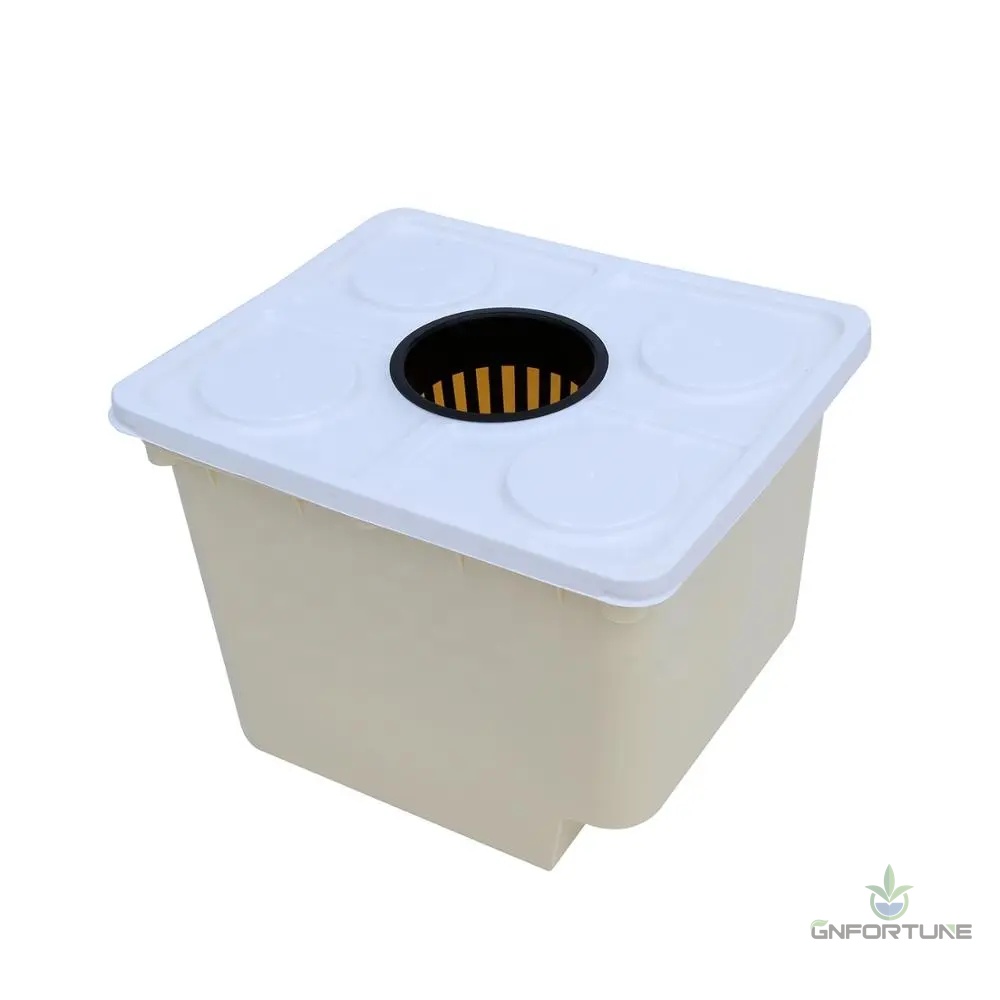
Dutch bucket with lid and grow basket for aquaponics systemsThe package looks like this for a reference 500 m² leafy-green greenhouse:
- Fish tanks: 2–3 round tanks, 5–10 m³ each, PE or fiberglass
- Mechanical filter: swirl separator sized to total flow + drum filter (60–80 micron)
- Biofilter: 3–5 m³ moving bed media (K1/K3) with matched aeration
- Pump: sized to turn over the total water volume every 1–2 hours
- Blower: sized for fish + biofilter + media aeration, with backup
When requesting quotes, give the supplier your crop area, target fish species, climate, and feeding rate. A supplier who returns a price without asking for those inputs is selling a kit, not a system. For shipping guidance on equipment orders, the container loading guide covers pallet counts and 20ft/40ft packing logic. For a complete build, the aquaponics greenhouse solution covers structure, climate control, and integrated fish-crop layout.
FAQ
What equipment do I need for a commercial aquaponics system?
A: Round fish tanks, a mechanical filter (swirl separator or drum filter), a biofilter with high-surface-area media, a pump sized to turn over the system volume every 1–2 hours, and a regenerative blower with backup.
How do I size a fish tank for aquaponics?
A: Start from your crop area and feeding rate. A common rule is 1 m³ of fish tank per 2–4 m² of crop area for leafy greens, but the real driver is the daily feed load and matching biofilter capacity.
Round or square fish tanks for aquaponics?
A: Round tanks with center drains self-clean solids. Square tanks are cheaper and fit footprints better, but create dead zones that require more maintenance and carry higher water quality risk at density.
Do I need a drum filter for aquaponics?
A: For systems above ~5 tons of fish, yes. Below that, a swirl separator may suffice. If budget allows only one stage, choose the drum filter — it catches the fine solids that threaten biofilter health.
How much aeration does an aquaponics system need?
A: Provide 0.5–1.0 kg of oxygen per kg of feed per day, covering fish and biofilter demand. Always include a backup blower — a blower failure can drop DO below lethal levels in under an hour at high density.
Get an Itemized Aquaponics Equipment Quote
Get an itemized aquaponics equipment quote for your project size. Send your crop area, target fish species, greenhouse climate, and feeding rate through the quote form, and we will return a full equipment list with tank, filter, biofilter, pump, and blower specifications — plus shipping and warranty terms for your market.