

Farm irrigation pipes are the cheapest component in an irrigation system and the most expensive one to replace, because they are buried, bracket-mounted, or woven through a greenhouse structure by the time anyone notices a problem. Most agricultural irrigation pipe in a commercial greenhouse is uPVC, PE, or aluminum, and each earns its place in a different job: permanent mainlines, flexible laterals, and mobile distribution. This guide compares PVC and aluminum on pressure rating, UV life, and cost per meter, then covers the sizes and fittings that actually matter when you lay out a greenhouse.
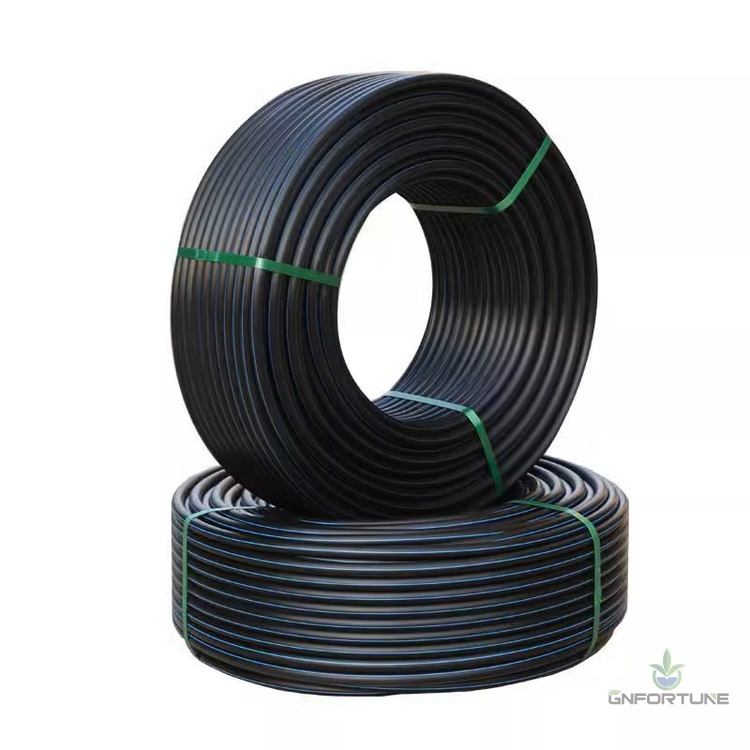
PE irrigation pipe coils for farm water supplyPVC Pipe: Pressure Classes (PN6–PN16) and UV Behavior
uPVC pipe for irrigation is sold by pressure class — PN6, PN10, and PN16 — where the number is the nominal working pressure in bar at 20 °C with the standard safety factor. PN6 suits low-pressure gravity or header duties, PN10 is the default for pumped greenhouse mainlines, and PN16 buys margin for high-head zones, deep pump pits, or water hammer. Wall thickness climbs with class, so a PN16 line costs more and carries less water for the same outside diameter.
The behavior buyers underestimate is UV. Bare PVC exposed to greenhouse sun becomes chalky, brittle, and eventually cracks — not in a season, but within a few years of direct light. Design accordingly:
- Bury or sleeve PVC that carries permanent duty, and keep it out of direct sun where it must run exposed.
- Paint exposed runs with a water-based exterior grade, or spec a UV-stabilized compound where the supplier offers it.
- Mind temperature derating: PVC pressure ratings assume cold water. Fertilizer solutions run warm in greenhouses, and very hot water (60 °C and up) is outside PVC’s practical range.
PVC also handles the mildly acidic fertilizer solutions used in hydroponics, but aggressive cleaning cycles with very low pH or oxidizers need a check against the pipe and joint spec before you commit.
Aluminum Pipe: When Mobile Irrigation Justifies the Cost
Aluminum pipe earns its higher price only where the pipe has to move. Its strength-to-weight ratio is excellent: a 50 mm aluminum line can be carried, coupled, and uncoupled by one or two people, which is why quick-couple aluminum is the standard for traveling rain guns, portable sprinkler sets, and seasonal layouts that get re-rigged between crops.
- Mobile distribution: rain guns and sprinkler laterals that move between blocks justify aluminum’s cost through saved labor and faster re-layout.
- Not for permanent fertigation: aluminum does not like continuous contact with fertilizer salts and acids, which cause pitting over seasons. Keep aluminum on clean-water duty, or prepare to replace it.
- Coupling and galvanics: quick-couple fittings rely on rubber gaskets that must be clean and lubricated; and where aluminum meets brass, steel, or copper fittings, isolate it to avoid galvanic corrosion.
If a pipe is going to sit in the same trench for ten years, buy PVC. If it will be moved every few weeks by hand, aluminum is the tool that pays for itself in labor.
Greenhouse Sizes That Actually Matter: A Pipe Sizing Table
Catalog ranges are wider than any single greenhouse needs. In practice, a Dutch bucket or NFT operation uses a handful of diameters, and the design task is choosing the right one for each layer. The table below is the sizing envelope we start projects from; velocities stay under about 2 m/s on mains and 1.5 m/s on laterals.
| Pipe role | Typical material | Common diameters | Typical flow range | Notes |
|---|---|---|---|---|
| Greenhouse mainline | uPVC, PN10 | 50–75 mm | 10–60 m³/h | Buried or shaded; isolation valves per zone |
| Submain / manifold to zones | uPVC or PE | 32–50 mm | 3–15 m³/h | Sized for the largest zone, not the sum |
| Row lateral | PE, UV-stabilized | 16–25 mm | 0.3–2 m³/h | Keeps friction low at the far end |
| Mobile / seasonal riser | Aluminum | 40–75 mm | By sprinkler set | Quick-couple; re-rigged between crops |
Two sizing habits prevent most under-spec complaints. First, size the main for the largest single zone plus reasonable overlap, not the sum of all zones, or every valve opening after the first becomes a pressure event. Second, check the far end: pipe that is big enough at the pump is often a size too small at the last row, and the fix after installation is far more expensive than the pipe would have been.
Fittings: Glue Joints vs Gaskets, and Why Greenhouses Leak
Most greenhouse irrigation leaks are not pipe failures — they are joint failures. The two joining families behave differently and fail for different reasons.
- Solvent-weld (glue) joints on PVC are permanent and strongest when done correctly: deburr the cut, clean, apply primer and cement, insert to full depth with a quarter turn, and let it cure. The classic field errors are skipping the deburr, using cement without primer on large diameters, moving the joint before cure, and loading it too early.
- Gasketed push-fit joints tolerate thermal movement and allow disassembly, which is why long runs need them or expansion loops. Their failure mode is different: a misaligned or dirty gasket, or a pipe not fully seated, weeps under pressure and looks like a hairline crack to the untrained eye.
Thermal movement is the leak cause we see most on site. A long glued PVC line in a greenhouse that heats and cools daily expands and contracts; with no expansion loops or gasketed breaks, the joints take the movement and creep until they weep. Support spacing matters too — PVC sagging between brackets puts bending stress on every joint in the sag.
A rule we give every install crew: “The pipe is never the leak; the joint is.” If a new line weeps in the first weeks, look at deburring, cure time, and support spacing before you suspect the pipe wall. If it weeps in year two, look at thermal movement with no compensation. We have re-plumbed both kinds of failures on farms that blamed the pipe material — and the material was never at fault.
Cost per Meter: PVC vs PE vs Aluminum
Unit price per meter is the obvious comparison, but the honest one is cost per meter per year of service for the duty the pipe actually does. Relative figures below are planning ranges only — actual prices vary by region, diameter, pressure class, and season.
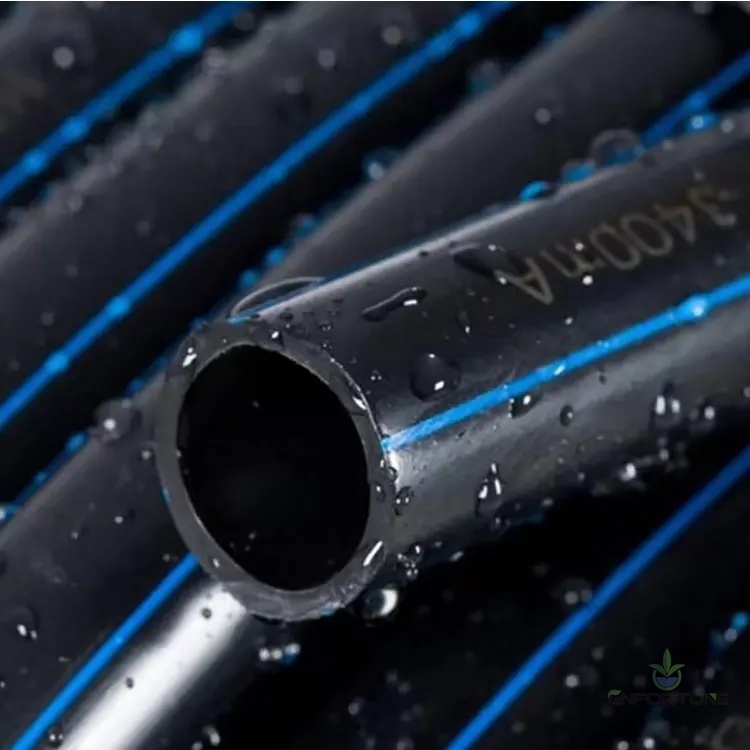
Black PE irrigation pipe with blue stripe close-up| Material | Relative cost per meter | Typical service life in greenhouse service | Best-buy duty |
|---|---|---|---|
| uPVC, PN10 | Base (1.0×) | 15–25 years when buried or shaded | Permanent mains and submains |
| PE, UV-stabilized | Roughly 1.0–1.4× | 10–20 years; flexible and forgiving | Laterals, buried feeds, re-layouts |
| Aluminum, quick-couple | Roughly 2–4× | 10–20 years on clean water, less on fertigation | Mobile sets and seasonal distribution only |
Buying tips from projects we have costed: buy the pressure class the layout needs — PN16 where a cheaper PN10 does the job is wasted money; price the fittings, because glue, gaskets, and valves routinely add a third or more to the pipe bill; and order spare gaskets and couplings with the first shipment, since the item that stops a mobile aluminum set is usually a 5-dollar rubber ring, not the pipe. Full sizing math for the dripper side of the same layout sits in the Dutch bucket drip design guide, and the whole irrigation equipment picture — pumps, valves, controllers — is covered in our agricultural irrigation equipment overview. If you are speccing pipe and fittings for a project, our irrigation systems product guide lists the mains, manifolds, valves, and drip components we supply as matched sets.
FAQ
Is PVC or aluminum better for irrigation pipe?
A: It depends on the job. PVC is the right value for permanent, buried or shaded mainlines; aluminum earns its higher cost only where pipe is moved frequently, such as rain gun and sprinkler sets.
What does PN10 mean on a pipe?
A: PN10 rates the pipe for 10 bar nominal working pressure at 20 °C. For greenhouse irrigation PN10 is the usual default for mains; PN6 suits low-pressure duties and PN16 buys margin against water hammer or high head.
Why do my PVC joints weep after a year?
A: Almost always thermal movement or poor joint prep. Long exposed runs need expansion loops or gasketed breaks, and joints need deburring, priming, full insertion, and proper cure time.
Can I use aluminum pipe for fertigation lines?
A: Not for permanent duty — continuous contact with fertilizer salts and acids pits aluminum over seasons. Keep aluminum on clean-water mobile duty and use PVC or PE for nutrient lines.
What size pipe do I need for a greenhouse?
A: Start from the largest zone’s flow, not the total. Typical layers are 50–75 mm PVC mains, 32–50 mm submains, and 16–25 mm PE laterals — verify velocity and far-end pressure before ordering.
Request Pipe and Fitting Pricing for Your Irrigation Layout
Send your greenhouse dimensions and flow plan through the quote form, and our export team will return a pipe and fitting price list sized to your layout — diameters, pressure classes, and joints matched to the zones you actually run.