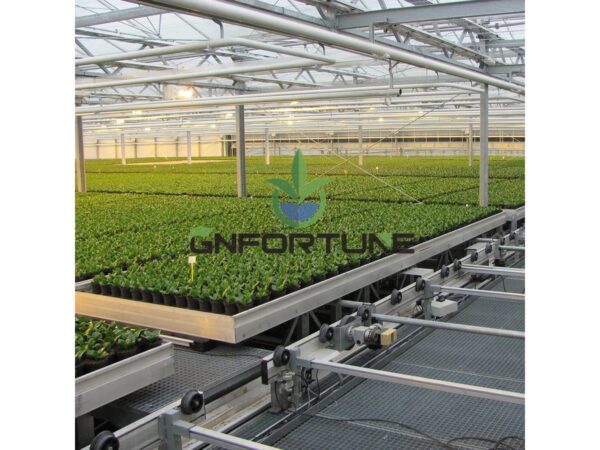
A rolling bench hydroponic system is one of the few equipment choices that changes the business case rather than just the invoice. Suppliers quote it as a space saving; what actually lands on site is a different labour pattern, a stricter floor tolerance and a maintenance line nobody budgeted for. This article separates the parts that genuinely return money from the parts that only look efficient in a layout drawing.
The analysis applies mainly to propagation houses, seedling production and short-cycle pot or tray crops — the segments where benches dominate.
What a Rolling Bench System Is
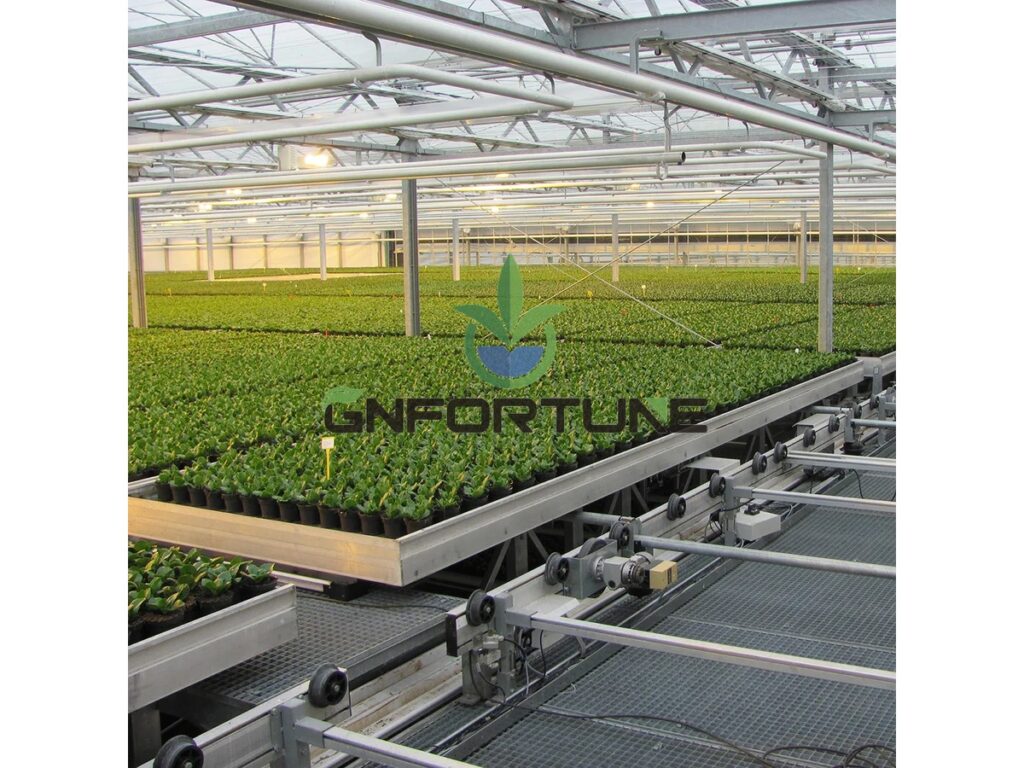
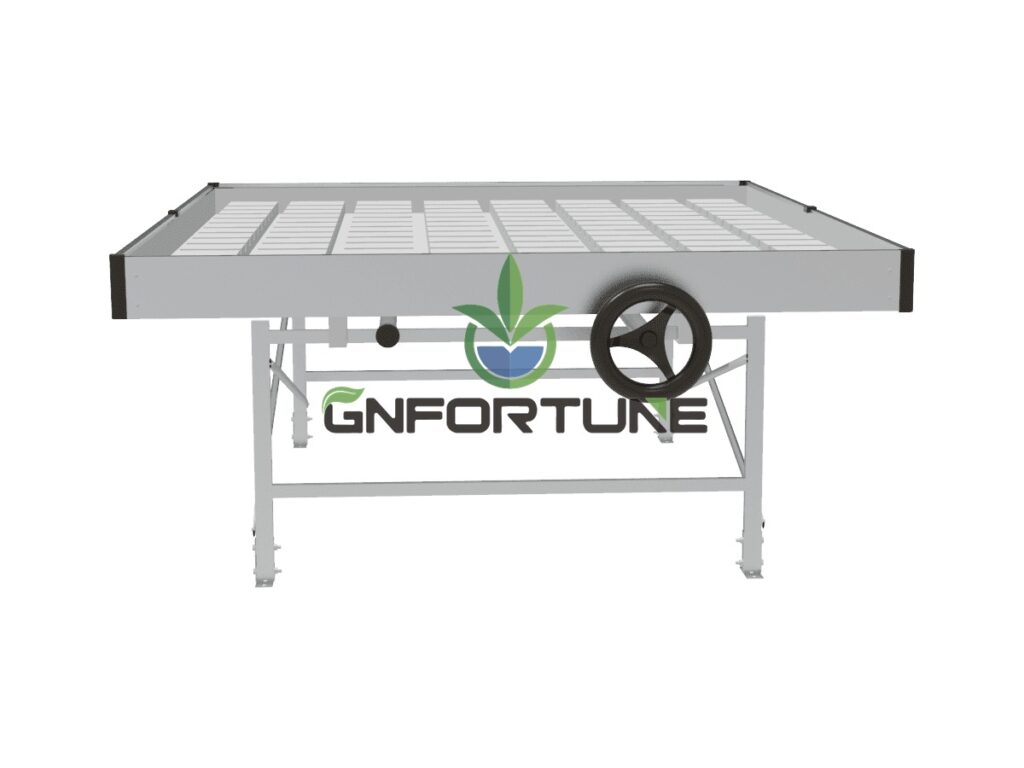
A rolling bench sits on rails or tubes spanning the width of a bay. Each bench can be pushed sideways, so only one working aisle is open at a time. Staff open a gap where they need it, work, then close it and open the next.
The result is a mobile bench greenhouse in which a single service aisle replaces fixed aisles between every row. On paper the gain looks like free growing area, and most of the time it is — provided the surrounding infrastructure can absorb the consequences.
Where the Extra Growing Area Comes From
The gain is arithmetic. In a fixed layout, every row gives up its own aisle permanently. In a rolling layout only one aisle is withdrawn from production at any moment, and the rest of that strip can carry crop.
Typical planning assumption for propagation houses: usable growing area often rises into the 60–80% range of floor area with rolling benches, versus considerably less with permanent aisles. That figure should always be checked against your own aisle widths and bay layout, because trolley dimensions and access rules set the aisle width that gets recovered.
Two caveats keep the number honest:
- Access time is not zero. Every bench move is seconds, and a full pass across a house is minutes. Multiply that by daily passes and it becomes labour cost.
- Edges and returns still need clearances. Wall gaps, column legs and doorways remain non-productive regardless of bench type.
Floor, Drainage and Structural Requirements
Engineering is where rolling layouts are most often mis-sold. A bench on rails concentrates load onto a small contact patch, and rails themselves need support along their length.
Floor flatness is the first filter. If the slab has significant deviation, benches will not roll cleanly, locks will not engage and staff will fight the equipment daily. Rolling systems usually need a tighter tolerance than trough produce; confirming what your slab can hold is cheaper than discovering it after delivery.
Structural and drainage points to settle before ordering:
- Point loads: confirm slab thickness and reinforcement against manufacturer load figures, including the full wet-crop weight.
- Floor drainage: ebb-and-flow benches discharge in known locations; falls and channels must be poured to match the final layout, not drawn later.
- Levelling: factory-levelled rails still need site adjustment budgeted.
- Clearances: heating pipes, screen systems and service booms all need to clear the bench travel envelope.
These items belong in the same capital line as the benches themselves. Treating them as site works is how projects lose their contingency.
Labour Routes and Crop Access
Rolling layouts change the shape of the working day. Instead of walking fixed aisles, crews plan routes: which bays open when, in what order tasks happen, and how many people can work a bay without blocking each other.
Operations that suit it well have frequent, short tasks spread across many small plants — sowing, spacing, grading, spraying, harvesting trays. Operations that suit it poorly involve heavy equipment or long continuous work at one position, because the open aisle is shared.
Where vertical options are also under review, the comparison is worth doing at the same time — see the vertical tower density analysis and the discussion of plants per square metre that pay.
Cost Items Buyers Forget
Quotations are rarely wrong so much as incomplete. Bench-going-cheap usually means the following were excluded, and each is genuinely required.
- Rails and support sleepers: priced per metre, and frequently quoted as an option rather than included.
- Wheels and bearings: consumable under daily load, with a replacement interval that depends on wash-down chemistry.
- Anti-tip and locking devices: a safety requirement on sloped floors and anywhere benches travel long distances.
- Bench-top finish: tray support surface, mesh or ebb-and-flow liner — a specification choice with real price spread.
- Installation labour: rolling benches take longer to commission than fixed frames; ask who supplies the install crew.
- Spare parts stock: a small holding of wheels and locks avoids idle benches during a breakdown week.
Ask each supplier for a loaded per-square-metre price including these items. Only then is a comparison meaningful.
Payback by Farm Size: Where a Rolling Bench Hydroponic System Wins
Bench capex payback is not a mystery number; it is recovered area multiplied by value per square metre, less the added operating cost. The variables below decide where the break-even sits.
| Driver | Effect on payback |
|---|---|
| Crop value per m² per week | Higher value recovers the capex faster |
| Existing usable-area ratio | Poor starting layout gains more from rolling |
| Floor quality already specified | A good slab reduces the added civil cost |
| Labour cost and task frequency | Expensive labour favours fewer, wider bays |
| Utilisation across the year | Seasonal farms spread payback over fewer weeks |
In practice the decision line looks like this rather than a single rule:
- Large propagation houses with continuous year-round programmes almost always justify rolling benches; recovered area is sold every week.
- Mid-size operations with one strong season should check whether peak-season throughput alone covers the capex within the intended hold period.
- Small or experimental sites often recover more from improving existing layout basics than from buying mobiles.
A useful test: if the recovered area cannot be sold at a known price to a known buyer, it is capacity rather than profit.
Buyers comparing options often ask for a single payback figure. Resist it. The honest answer is a range that moves with crop price and utilisation, and any supplier quoting one number without asking about either has used someone else’s assumptions.
Where horizontal NFT layout or tiered benches are also candidates, run all three through the same area and labour model. The horizontal NFT vs A-type layout comparison covers the tiered side of that decision.
FAQs About Rolling Bench Hydroponic Systems
How much growing area does a rolling bench layout actually add?
It depends on starting layout and aisle width. Recovering permanent aisles typically lifts usable area into the 60–80% band in propagation houses, but confirm against your own trolley widths and access rules.
Can rolling benches be installed on an existing slab?
Sometimes, if flatness and load capacity already meet manufacturer requirements. Have the slab surveyed before signing, because remediation after delivery is expensive and disruptive.
Do rolling systems need more maintenance?
Yes. Wheels, bearings, rails and locks are wear items with scheduled inspection. Budget parts and labour annually rather than treating failures as surprises.
Are they safe on sloped or uneven ground?
They can be, provided anti-tip devices and effective locks are fitted and the rails are levelled. Sites sloping noticeably should have this specified explicitly in the order.
When do fixed benches remain the better choice?
Where heavy equipment must reach every row simultaneously, where the programme is seasonal, or where floor remediation would cost more than the area is worth.
Next Step: What to Send for a Quotation
Rolling and fixed layouts should be quoted on identical scope so the comparison reflects equipment rather than omissions. Request loaded prices, and ask that site-preparation items be stated separately rather than buried in an installation line.
Comparing bench options? For RFQ or project consultation, send: greenhouse layout drawing or dimensions; crop list with cycle times; plant density targets and tray sizes; floor type with survey results if available; whether ebb-and-flow, flood or NFT tops are required; labour model and task frequency; automation level requested; delivery schedule; and the budget band. G AND N FORTUNE LIMITED supplies rolling bench, fixed bench and propagation house packages quoted to those inputs.