

Most equipment suppliers can quote a system. Far fewer can tell you what the system did last season, in their own house, under their own climate. A hydroponic trial greenhouse is the difference between selling hardware and selling a validated growing system — and it is the reason a manufacturer that grows in what it sells quotes differently.
Here is what our own 2,400 m² greenhouse is used for, what it has changed about the systems we sell, and what a buyer actually gets from it.
What Is a Supplier Trial Greenhouse For?
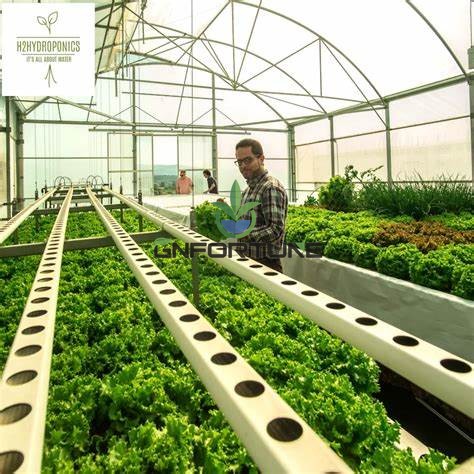
A trial greenhouse is a working production house on the factory site, planted with the same crops a customer grows — leaf vegetables in the main, across the system types we manufacture. Its job is not to grow vegetables for sale, though it does. Its job is to make sure that every claim attached to a channel, a rack or a nutrient set has been through a real crop first.
Three things get validated there: the hardware under continuous duty, the agronomy that goes with it, and the instructions we ship with it. When a customer asks “how does this behave in month eight?” or “what slope did you actually run?”, the answer comes from the house next door, not from a brochure.
What Gets Validated Before a System Reaches a Quotation?
| Validated in the house | What it confirms | What it prevents |
|---|---|---|
| Channel profiles under continuous flow | Flow behaviour, no ponding, root health along the full length | Low-spot algae and end-of-run starvation |
| Rack and structure over seasons | Corrosion behaviour, joint stability, clip retention | Structural surprises in year two |
| Assembly sequence by our own fitters | Instructions that match real installation order | Assembly manuals that only work in theory |
| Crop programs per system type | Spacing, cycle times and harvest windows by crop | Agronomy advice nobody has grown with |
| New designs before release | The next generation of profile tested in crop before it is quoted | Customers as beta testers |
The last row matters most for buyers considering the patented third-generation channel: its curved base ran a full production cycle in our own house before it was offered commercially. Design changes are earned in crop, not announced in a catalogue.
Why Does A, I and Horizontal Knowledge Come From Growing?
The three structures we manufacture suit different sites, and the differences are easier to see standing in a house than reading a table. The horizontal layout remains the most common NFT design: unrestricted sunlight, better air circulation, easy installation and management — which is why it suits large-scale farms. The “A” type uses vertical space efficiently to raise yield per square metre and suits small and medium greenhouses, with rack orientation chosen against the sun. The multi-tier “I” type is mainly for indoor, container and sightseeing installations, where grow lights replace sunlight — and because of its higher cost per area, we do not recommend it for big farms.
That guidance is written from running all three. A supplier who has never operated an “I” type indoors will happily quote one for a warehouse and let the customer discover the lighting bill.
What Does the Trial Greenhouse Give the Buyer Directly?
- System design from grown experience: layouts, slopes and flow rates that reflect a working house, not a drawing exercise.
- Assembly instruction that was tested by fitters who install: the sequence in the manual is the sequence that works on site.
- Planting technology support: crop programs, cycle planning and troubleshooting from people who run the same systems daily.
- A place to visit: buyers can see the systems running, talk to the growers and inspect production in the same trip.
- Honest recommendations: including which system we will steer you away from when it does not fit your site.
The visit is worth more than the sum of the others. Buyers who walk the trial house and the workshop on the same day leave with a sense of whether the factory grows what it sells — which is exactly the question a trial greenhouse exists to answer.
FAQs About Our Hydroponic Trial Greenhouse
Can buyers visit the trial greenhouse and the factory?
Yes, and we encourage it. The trial greenhouse sits on the factory site, so a single visit covers production lines, the warehouse and the growing systems in operation. Seeing channels installed, flowing and cropped — alongside the lines that make them — is the fastest way to evaluate a supplier you may never meet in person otherwise.
Does the greenhouse grow the same crops customers grow?
The house runs leaf vegetables — lettuces and leafy greens in the main — across the system types we manufacture, which mirrors the majority of commercial NFT installations. Where a customer’s crop falls outside that range, the greenhouse is used for setup and flow validation, and crop programs are built with the customer’s own trial data.
Will you help with growing technique after installation?
Yes. Planting technology support is part of what the trial greenhouse exists to provide: crop programs, cycle planning and troubleshooting based on what we run ourselves. Most post-installation questions are answered from experience in the house rather than from theory.
Are new products tested before being sold?
New designs — including each generation of our patented channel — run production cycles in the trial greenhouse before they are quoted commercially. Buyers therefore receive profiles that have completed a real crop, not laboratory samples. That validation loop is the main reason our design generations are slow and deliberate.
What happens if a system underperforms in the trial house?
The design goes back to engineering before it reaches a customer. That is the point of running our own houses: failures cost us a cycle instead of costing a customer a season. Several profile and rack revisions over the years never reached a catalogue precisely because the house rejected them first.
What to Send When You Request a Quotation
Send your crop, target area, site type (greenhouse, indoor or outdoor) and location, and we will propose a system with the layout and structure our own houses would run for the same conditions — plus an invitation to see it growing: contact our team.
Related reading: plan your own validation with on-farm trial design, prepare for a design conversation with the 12 design inputs, and see who does what in turnkey project scope.