

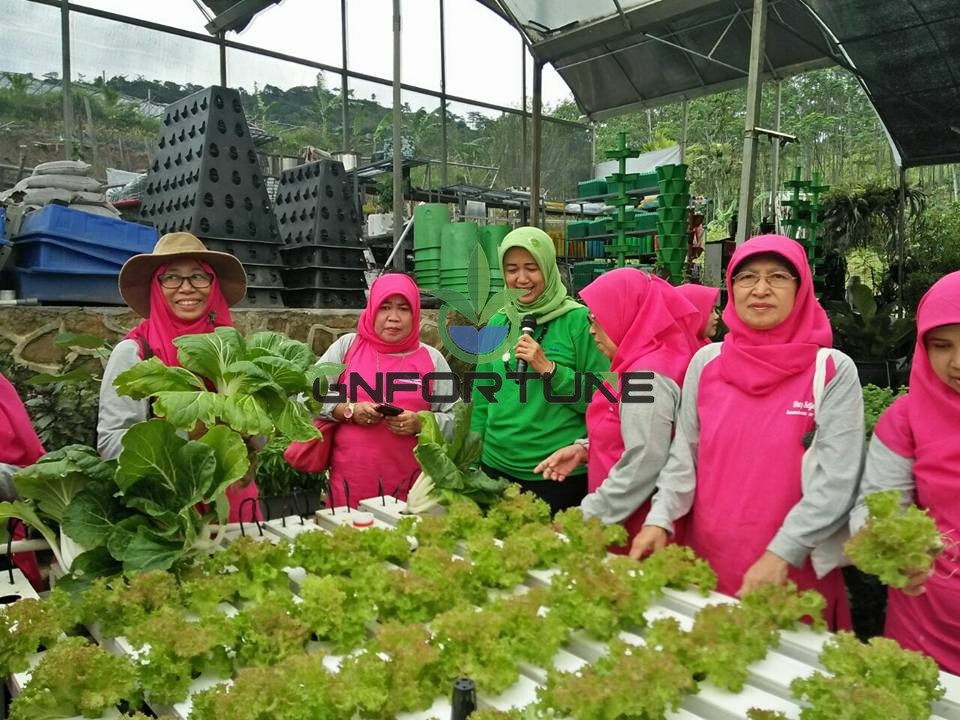
Case studies are easy to write and hard to prove, so the ones we publish tend to be short. This one records what a customer in Indonesia reported after completing harvests on our 100×50mm NFT channels: vegetable output considerably higher than their previous land growing, with noticeably less labour. The photographs from their visit — crew in the house, harvesting lettuce from the channels — say more than a yield table would.
What Did the Customer Report After Harvest?
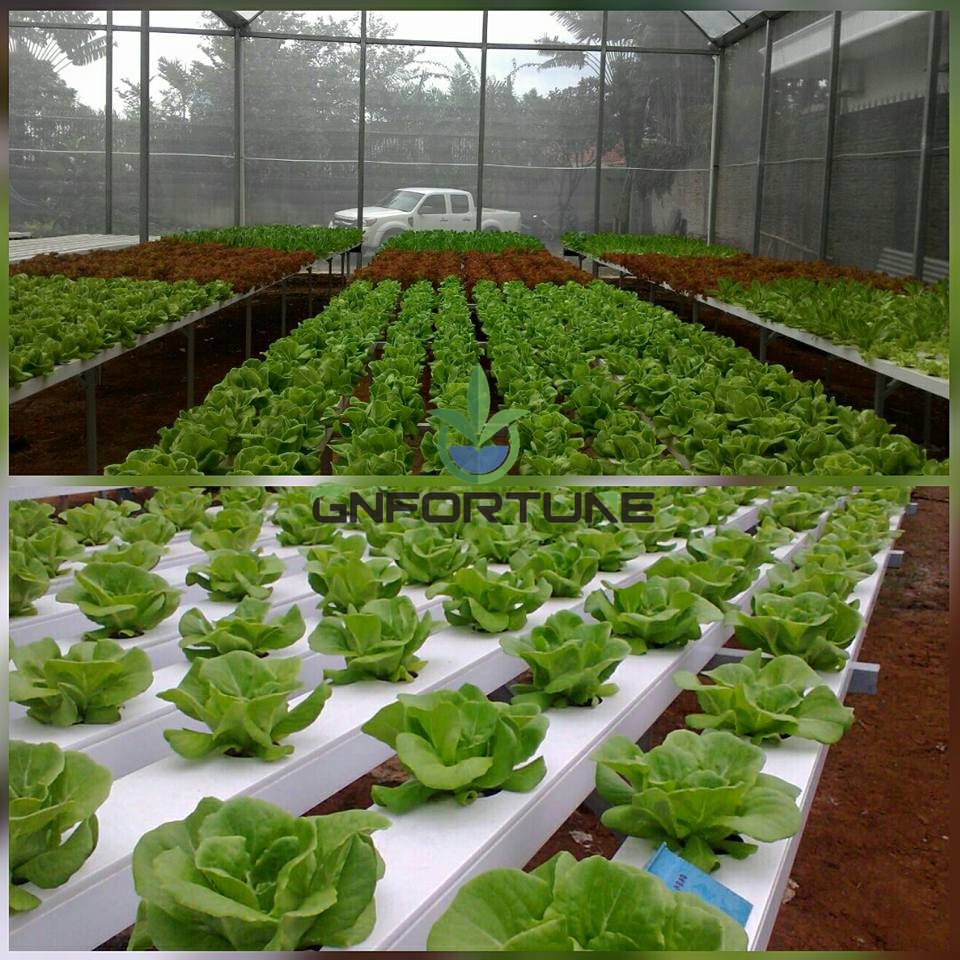
The grower compared results against their established land production and reported two differences that mattered commercially. First, output: more saleable vegetable from the same effective area than the soil operation had produced. Second, labour: the daily crop work — planting, tending, harvesting — took noticeably fewer hands, because NFT work happens at row height on a clean, uniform layout instead of across open beds.
Congratulating a customer on a good harvest is the pleasant part of this business. The useful part is what the result demonstrates for other growers in the same climate: leafy greens in a tropical greenhouse, on a standard 100×50mm profile, running a continuous cycle — not a pilot row, but production.
Why Do NFT Results Look Like This in Southeast Asia?
The yield and labour advantages reported here are not unique to this farm; they follow from how the system works. A recirculating NFT layout feeds each plant a controlled, oxygenated solution continuously, so growth is limited by light and climate rather than by water stress or nutrition swings — the two variables that hold land growing back in the tropics.
| Factor | Land growing | NFT channels |
|---|---|---|
| Water and nutrition | Applied to soil, uneven, weather-dependent | Continuous, controlled, recirculated per channel |
| Cycle time | Season-driven, weather-set | Continuous planting; steady weekly harvest rhythm |
| Daily labour | Bed preparation, weeding, wide-area work | Row-height planting and picking on a uniform layout |
| Disease interface | Soil-borne pressure | Soilless; pressure mainly airborne, managed by airflow |
The labour line deserves emphasis for tropical growers, because it compounds: fewer hands per kilogram, doing gentler work, on a schedule that can be planned — which is usually what converts a first NFT purchase into a second phase.
What Does the 100×50mm Profile Contribute?
The 100×50mm channel is the workhorse profile for leaf vegetables: wide enough for a full lettuce root zone and stable flow, standard enough that racks, spacing and accessories are off-the-shelf. For a Southeast Asian greenhouse, the dual-colour version adds two practical benefits — a light-blocking wall that suppresses algae in the channel, and an inner layer that keeps root temperature and root visibility manageable in the heat.
Results like this customer’s are the profile doing its job inside a sensible design: correct slope, balanced flow, and a crop program matched to the local climate. Hardware alone does not produce the harvest — but the wrong hardware reliably prevents one.
What Can Other Growers Take From This Result?
- Start with a standard profile, not a custom one: the 100×50mm platform is proven across climates; custom geometry is a later conversation.
- Plan the labour comparison honestly: the saving shows in daily routine, so measure it across full cycles, not one harvest day.
- Design for the climate first: ventilation, light blocking and flow balance decide tropical results more than any other choice.
- Verify before scaling: a validation block through several cycles confirms your own numbers before the full investment.
We congratulate this customer on their harvest — and thank them for the photographs and the permission to share both. Growers weighing a similar project in the region are welcome to talk with us about it, and to visit our own trial greenhouse where the same channels run daily.
FAQs About NFT Results in Tropical Climates
Does NFT really outyield soil growing for lettuce?
In controlled comparisons, yes — recirculating NFT removes water stress and nutrition swings, which are the main yield limiters in tropical land growing, and continuous planting replaces season-driven cycles. The customer whose results this article reports found exactly that: output above their previous land production on the same effective area.
How much labour does NFT save compared with land growing?
The saving comes from what disappears — bed preparation, weeding, and wide-area field work — and from what becomes uniform: every plant at row height in a predictable layout. The Indonesian grower reported noticeably fewer hands for daily work. The exact figure depends on scale and mechanisation, so plan the comparison across whole cycles.
Is the 100×50mm channel suitable for hot climates?
Yes, with the right design around it: the dual-colour version blocks light into the channel and supports root-zone management, flow is balanced to keep solution moving, and the house is ventilated for air temperature. Hot-climate NFT succeeds on these design details, which is why they are specified at quotation rather than left to chance.
Can I verify results before committing to a full farm?
Yes, and you should. Run a validation block through several full cycles, measure yield and labour against your own baseline, and expand on your numbers. For large projects, a visit to our trial greenhouse — and conversation with growers like the Indonesian customer featured here — shows the system at work before capital is committed.
What support continues after the channels arrive?
System design, assembly instruction and planting technology support continue after delivery, from people who run the same systems in our own houses. Post-installation, the common questions — flow balancing, cycle planning, troubleshooting — are answered from operating experience rather than from a manual.
What to Send When You Request a Quotation
Send your crop, site dimensions, location and current growing method, and we will propose a layout with the yield and labour logic behind it — the same conversation this Indonesian grower started: contact our team.
Related reading: run the crop with the commercial lettuce production guide, see the region’s specifics in hydroponics in Southeast Asia, and compare notes with the 1-hectare herb farm case study.