

Hydroponics in Southeast Asia is a counter-intuitive market. The region is warm, wet, and sun-rich — exactly what a temperate grower pays to create — yet commercial projects keep failing when they copy a Dutch or Japanese greenhouse design. At 28–35 °C and above 80% relative humidity for much of the year, the limiting factor is not heat but disease pressure and water management. The demand side, however, is strong: Vietnam, Thailand, Indonesia, and the Philippines import a large share of their premium leafy greens and herbs, and hotel and supermarket buyers pay import-level prices for local product of equal quality.
Why Tropical Hydroponics Is a Different Problem
In a temperate greenhouse the operator pays to add heat and light; in the tropics both are free, and the money moves to air exchange, disease prevention, and rain protection. Daytime temperatures of 28–35 °C push lettuce past its comfort zone unless the house can flush heat within minutes, nights that never drop below 24 °C mean transpiration never stops, and intense midday radiation means a standard temperate cover can scorch the crop rather than feed it.
The commercial logic works through import substitution, not export: imported premium greens carry a freight and cold-chain markup a local grower can undercut with better shelf life, and resort groups, supermarket chains, and institutional caterers have become the anchor buyers for new farms.
Climate Baseline by Country
Southeast Asia is not one climate, and the differences between countries are structural, not cosmetic:
| Country | Climate pattern | Risk season | Design implication |
|---|---|---|---|
| Vietnam | North: subtropical with cool dry winter; South: tropical, wet/dry seasons | North: Jun–Oct humidity and storms; South: May–Nov rains | Two specs in one country; the north needs no winter cooling |
| Thailand | Three seasons: hot (Mar–May), wet (Jun–Oct), cool-dry (Nov–Feb) | Flooding and disease peaks in the wet monsoon | Raised platforms, monsoon drainage, heavy fungus pressure Jun–Oct |
| Indonesia | Equatorial, high rainfall year-round, altitude cooling above ~700 m | No dry window in lowland Java and Sumatra | Highlands cut the cooling load; lowlands need rain protection plus airflow |
| Philippines | Tropical marine, 20+ typhoons per year | Jul–Oct typhoon season on the eastern seaboard | Wind-rated structure and anchoring; site choice matters more than equipment choice |
Figures vary by region and season; a real site record, not a country average, should drive the design.
Design Response: High Roof, Big Vents, Shade, Airflow
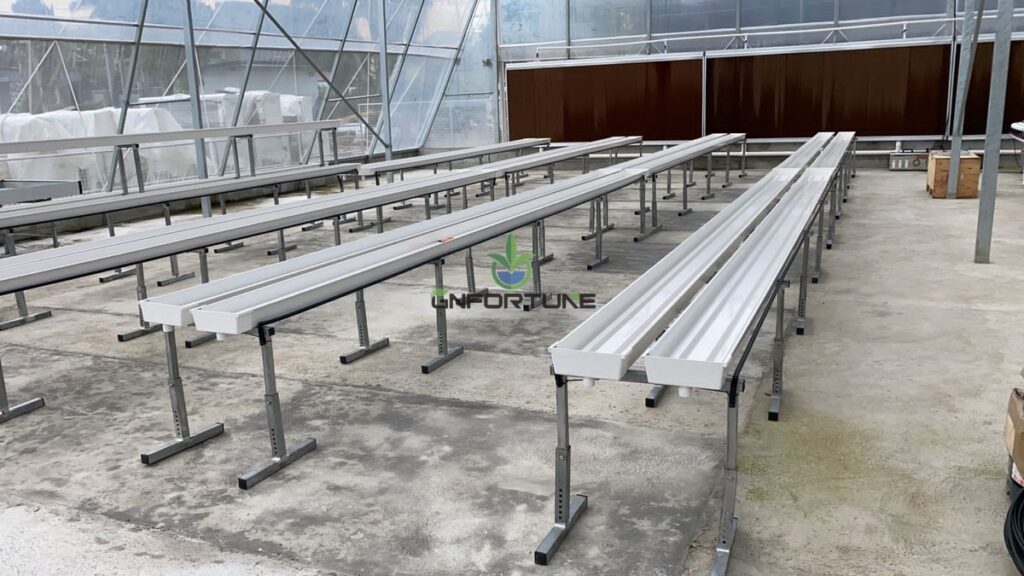
Tropical glass greenhouse in the Philippines with high gutters, NFT racks, and an evaporative pad wall coping with heat and humidityA tropical greenhouse built from a temperate plan will cook its crop. Five design responses consistently work across delivered projects in the region:
- High ridge. A 5–6 m gutter gives hot air somewhere to go and keeps the canopy out of the hottest layer; 3 m gutter houses routinely stop harvesting in April and May.
- Large vent area. Side-wall venting at 40–60% of wall area plus open ridge vents lets the wind do most of the cooling; where wind is unreliable, pad-and-fan backup closes the gap — the same greenhouse cooling fans and pad logic used in the Gulf, sized for monsoon humidity.
- External shade screen. Shade belongs outside the cover: an external retractable screen at 40–50% shading cuts radiation before it enters, instead of trapping it under an internal screen.
- Rain protection. Monsoon rain driven sideways will soak a wall vent and dump disease-carrying water onto the crop; wide eaves and gutter overhangs are standard tropical details.
- Continuous horizontal airflow. Fans across the canopy break the humid boundary layer around leaves — exactly where fungal spores settle and germinate.
Disease Pressure: The Real Constraint
Ask an operator in the region what limits yield, and the answer is rarely temperature — it is disease. At sustained humidity above 80–85%, downy mildew, botrytis, and bacterial leaf-spot pressure runs far higher than in a temperate climate, and one missed night of stagnant air can cost weeks of harvest. Tropical growers manage leaf wetness duration rather than a fixed humidity number: leaves should never stay wet longer than 2–4 hours, through night airflow and morning vent timing.
Two guides cover this in depth: the greenhouse humidity and VPD control guide explains the vapor-pressure-deficit targets that matter in high-humidity houses, and the fungal disease guide for hydroponic greenhouses gives climate triggers and a treatment ladder for the mildew and botrytis family. Between-cycle sanitation is the other half of the equation in a climate where pathogens never freeze out.
The consultant’s caution: in Southeast Asia, the cheapest structure is almost never the cheapest project. A low-roof, small-vent house saves perhaps 15–20% on steel and film, then loses it back through disease losses and abandoned summer production. Buy the structure for the hardest month of the year, not the average one.
Crop Selection: What Actually Sells Locally
The crop list that works commercially is anchored by what city buyers already import — and lettuce is only part of it, because the broad Asian-greens volume base keeps cash flow stable through the monsoon:
- Asian leafy greens — kangkong, gai lan, choy sum, and pak choi move in volume through wet markets and supermarket chains, and adapt well to NFT and deep-water culture in warm conditions.
- Salad crops for hotels and resorts — butterhead and oak-leaf lettuce, frillice, and baby-leaf mixes command import-competitive prices, but need real climate control to hold quality through the hot months.
- Culinary herbs — western and Thai basil, mint, coriander, and parsley supply hotel kitchens; herbs are consistently among the highest-margin lines.
- Strawberries — a high-value import-substitution crop in Vietnam’s highlands and the Philippines’ cooler provinces, run in gutters with careful climate management.
Import Logistics and Duties
Equipment for most regional projects ships from China, and the shipping plan deserves as much attention as the growing plan. Main entry ports: Ho Chi Minh City and Hai Phong (Vietnam), Laem Chabang (Thailand), Tanjung Priok (Indonesia), and Manila (Philippines) — ocean transit from South China is a short 5–14 days. Customs timelines vary from a few days to several weeks when documents do not match.
Three practical points repeat across delivered projects. First, packing: in a tropical port, moisture and mold in transit are real risks, so channels, pipes, and steel need desiccant and vapor-barrier wrap — the container loading guide for hydroponic equipment covers the details. Second, wood packaging must meet ISPM-15 fumigation rules for most ASEAN customs authorities; plywood crates or steel frames avoid the issue entirely. Third, duties differ by country and product classification, so the landed cost should be confirmed with the buyer’s customs broker before the order is placed.
After-Sales Reality: Spare Parts and Local Labor
A tropical project succeeds or fails in months 4 through 36, not at commissioning. Three after-sales practices have proven themselves across the region:
- Forward-stocked spare parts. Pumps, fans, sensors, and controller cards that would take three weeks to re-ship should sit on a farm shelf from day one — typically 5–10% of equipment value.
- Local labor with real training. Assembly with a local crew under a supervisor is far cheaper than flying in a full team, but the crew must be trained on the critical joints: plumbing seals, electrical terminations, and channel slope. A slope error of half a degree is invisible at startup and expensive at month six.
- Remote support with data. If the control system reports remotely, most climate and nutrient issues are diagnosed in a video call instead of a site visit — the automation and remote-monitoring options for commercial systems belong in the original spec, not a retrofit.
Project Snapshots
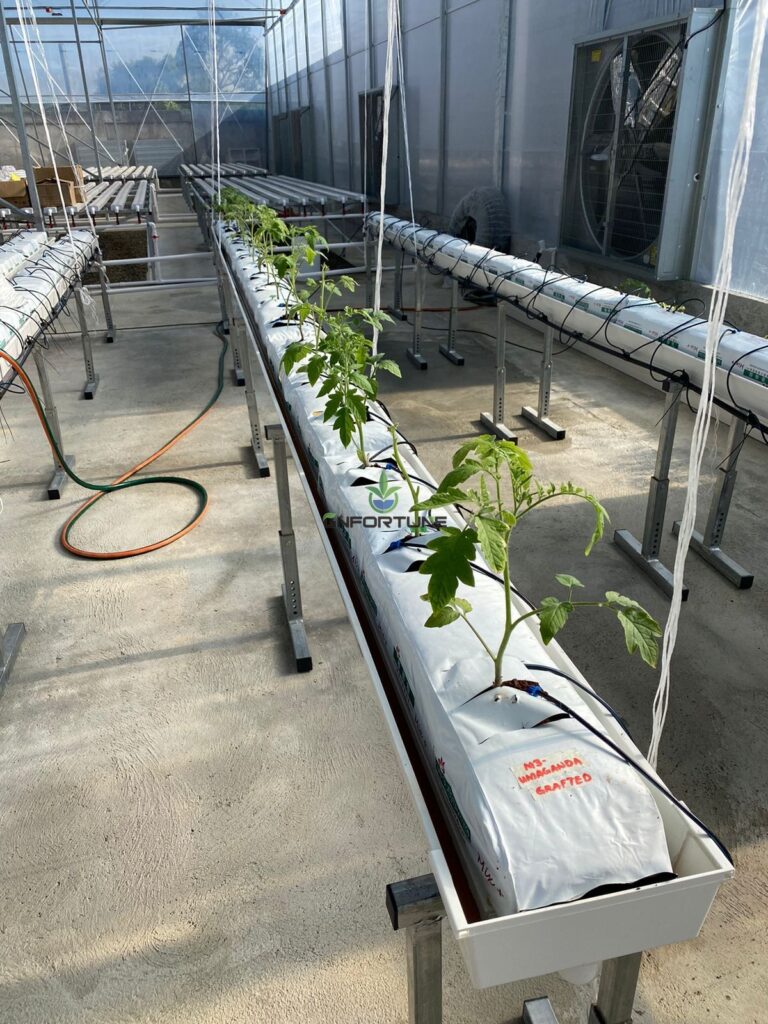
Tomato seedlings established in gutter channels under an exhaust fan in a Philippines project snapshotThree anonymized patterns from delivered regional projects. A southern-Vietnam leafy-green house with a 5.5 m gutter, 50% external shade, and screened side walls held summer production through April heat where a neighboring low-roof structure stopped harvesting. A Thailand project on a monsoon-exposed site was raised on a 0.8 m platform with perimeter drainage after a first-season flood. An Indonesian highland herb farm near 900 m altitude ran a Dutch-style NFT design almost unchanged, because altitude had already solved the cooling. The pattern: the site record drives the design.
FAQ
Q: Can lettuce be grown commercially in a tropical climate?
A: Yes — with a high roof, big vents, external shade, and strict humidity control; many farms shift to Asian greens and herbs in the hottest months.
Q: Is a typhoon-rated structure required in the Philippines?
A: In most provinces, yes — wind rating, anchoring, and post spacing should match the site’s typhoon zone; it costs more than standard steel and far less than rebuilding after the first serious storm.
Q: Which country is easiest for a first project?
A: Thailand and Vietnam — the most developed supply chains and installer experience. Indonesia and the Philippines work well but need more attention to port logistics and wind rating.
Q: How much more does a tropical greenhouse cost than a temperate design?
A: Typically 10–30% more for the higher structure, vents, screens, and shade, offset by little or no heating infrastructure. Figures vary by region and season, and by steel prices at order time.
Planning a Tropical Project?
Hydroponics in Southeast Asia rewards the buyers who plan around the monsoon instead of against it. Send your province, site conditions, and target crop mix through /quote/, and G&N Fortune will return a tropical greenhouse spec — roof height, vent and shade plan, monsoon drainage details, and a container packing list built for a humid port. We design for monsoon and ship to Ho Chi Minh, Laem Chabang, Jakarta, and Manila every month.
- Greenhouse humidity and VPD control — the disease-side targets for tropical houses.
- Fungal diseases in hydroponic greenhouses — mildew and botrytis triggers in humid climates.
- Container loading for hydroponic orders — packing, lashing, and ISPM-15 details.
- Turnkey greenhouse solutions — full-project delivery from design to commissioning.