

By the G&N commercial consulting team · First published: September 2026 · Reviewed for field accuracy
A microgreens tray goes from seed to harvest in seven to fourteen days, fits on a single shelf, and clears up to fifteen dollars per tray at wholesale — sometimes more for chef-direct sales. On a square-meter basis, no crop in the hydroponic catalog returns more per week than microgreens, and that is the structural reason the segment has grown so quickly into restaurant supply, salad kit assembly, and direct-to-consumer subscription boxes. The crop is also forgiving: a 1,000-tray-per-week operation can run from a 60 m² room with a 4-tier rack, and the same operator who started the line can usually run it alone. This guide covers what a B2B buyer needs to decide before committing capex to a microgreens line, and how the operation should be configured for predictable per-tray economics in year one.
Why Microgreens Sit at the Top of Per-Square-Meter ROI
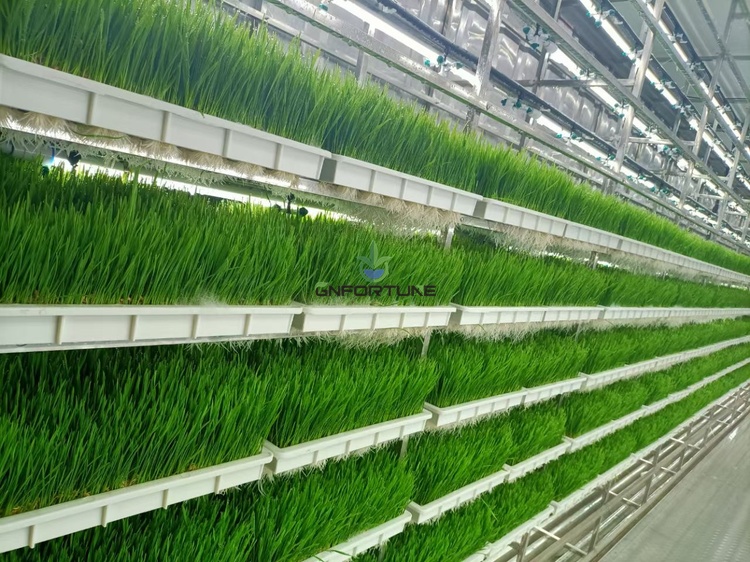
The math is independent of crop price: a microgreens tray produces ~150–250 g of finished product on day 7–14, and that product is harvested above the cotyledon or first true leaf. The same square meter that produces 8–12 kg of head lettuce per month will produce 30–45 kg of microgreens per month once the rack is up and the seeding-density recipe is correct. The difference is not the species but the turn rate — head lettuce is 30–45 days; microgreens is 7–14 days — and the per-gram price, which is typically 4–8× higher than leaf lettuce.
A commercial microgreens line breaks into three revenue tiers:
- Commodity chefs and salad processors at ~USD 12–20/kg for radish, pea shoots, sunflower.
- Premium restaurant supply at ~USD 30–60/kg for specialty mixes (amaranth, shiso, micro basil, wasabi).
- Direct retail at ~USD 60–120/kg in clamshells; this requires cold-chain logistics and brand investment.
Most commercial farms start with tier 1 for cash-flow predictability, then expand into tier 2 once the chef network is established. Tier 3 is rarely a year-one target.
The honest framing: microgreens are not a “set it and forget it” crop. Every day on the rack, the operator is doing six to eight active tasks — seeding, misting, light adjustment, harvest, wash, dry, pack. The operations tempo is closer to a mushroom farm than to a head-lettuce NFT line.
Tray Setup: Substrate, Seeding Density, and Blackout
Hydroponic microgreens do not use soil. The three substrates that dominate commercial production are:
| Substrate | Best for | Holds moisture | Biodegradable? | Notes |
|---|---|---|---|---|
| Hemp mat | Sunflower, pea, wheatgrass | High | Yes (home compost) | Strong root grip; loves high humidity at day 1–3 |
| Coco coir mat | Radish, kale, brassicas | High | Yes | Lower cost; can be saline — pre-rinse before first use |
| Wood-fiber / cellulose pad | Specialty herbs (basil, mint) | Medium | Yes | Clean cutting surface; excellent for restaurant supply where grit is a complaint |
The standard 1020 tray (27 × 53 cm) is the industry default and fits a four-tier rack with no modification. Seeding density per tray ranges from 15 g (large seed: sunflower, pea) to 2–3 g (small seed: radish, broccoli, kale). The density question is structural: too dense and the seedlings compete for light, the hypocotyl stretches, and the harvest is leggy and underweight; too sparse and the operator has paid for unused rack space. A first-time operator should follow the seed vendor’s density card for the first three batches, then tune from there.
Blackout (covering the seeded tray with a second empty tray plus a 1–2 kg weight) for the first 48–72 hours forces the hypocotyl to push the seed coat off uniformly. Without blackout the crop is unevenly germinated and visually messy at harvest. Lift the cover at day 3, run lights at 12–14 hours per day from day 4 onward.
Light and Humidity: The 5-Day Recipe
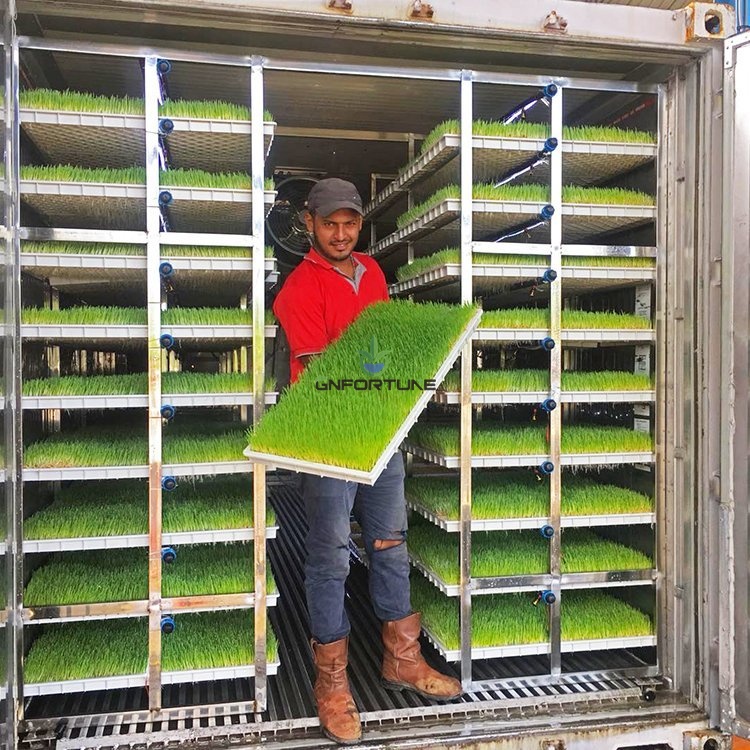
Worker pulling a fully grown microgreens tray from a multi-tier hydroponic rack for day-7 harvestThe recipe from day 4 to day 7–10 is consistent across most commercial microgreens:
- Light intensity: 80–150 µmol/m²/s PPFD at canopy. Higher than that for fast crops like radish; lower for shade-tolerant crops like pea shoots at the cotyledon stage.
- Photoperiod: 12–14 hours on / 10–12 hours off. LED fixtures on 4-tier racks should be 25–35 cm above the canopy; raise as the canopy rises.
- Day temperature: 20–24 °C. Above 26 °C the crop runs fast but becomes leggy and bolts; below 18 °C the cycle stretches past 12 days.
- Humidity: Day 1–3 at 90–95% RH (under the cover); day 4–7 at 60–70% RH; after day 7 at 50–60% RH to harden the leaves for harvest.
For the rack hardware, a 4-tier vertical system with a 1020-tray footprint per shelf is what most operations buy — paired with our vertical hydroponic rack or a comparable inline rack — running at 60 × 180 cm per rack. A 30-rack room holds ~6,000 trays in production rotation.
Day 7 Harvest: Cut Height, Washing, and Packing
The harvest is a single cut just above the substrate, done with a long-blade harvest knife or a powered reciprocating blade at 20–25 mm height. The cutter pulls leaves, hypocotyl, and seed-coat fragments off the mat in one pass. Clean cuts reduce fiber in the finished product. After the cut the microgreens move to a triple-wash tank (cold water, 1 °C below tap), then a centrifugal dryer at 280–340 rpm for 8–12 seconds, then into clamshells or perforated poly bags. Pack weights are typically 50–100 g for wholesale; 25–40 g for direct retail.
Yields and timing for common commercial varieties:
| Crop | Seeds/tray (g) | Days to harvest | Yield (g/tray) | Wholesale price (USD/kg) |
|---|---|---|---|---|
| Radish (China Rose) | 3 | 7–9 | 150–200 | 14–20 |
| Pea shoots | 15 | 9–12 | 220–280 | 16–24 |
| Sunflower | 15 | 9–12 | 200–260 | 18–28 |
| Broccoli | 3 | 8–10 | 140–180 | 30–45 |
| Kale (Red Russian) | 2.5 | 9–11 | 120–160 | 30–48 |
| Cilantro | 5 | 14–18 | 100–140 | 40–60 |
Walks through this with a buyer, the hydroponic farm ROI calculator can return a per-tray economics worksheet that pins down the dominant cost line (seed + labor).
Per-Tray Economics: Cost, Yield, Price
The per-tray economics on a 1,000-tray-per-week operation in mid-cost geography look roughly like this:
| Line item | USD per tray | Notes |
|---|---|---|
| Seed | 0.30–0.60 | Radish at low end, pea/sunflower at mid, specialty micro basil above 1.00 |
| Substrate (1020 mat) | 0.10–0.18 | Hemp higher; coir and wood-fiber mid |
| Electricity (lights + fans) | 0.12–0.18 | LED-driven; falls with off-peak time-of-use tariffs |
| Labor (seeding + harvest + pack) | 0.40–0.80 | Single operator on a 1,000-tray/week line |
| Packaging (clamshell + label) | 0.15–0.25 | Vented PET clamshell |
| Overhead (rent + water) | 0.10–0.20 | Allocated by tray-week |
| Total cost / tray | 1.20–2.20 | Midpoint USD 1.60 on a balanced mix |
| Average revenue / tray | 3.50–6.50 | Mix-dependent; chef-direct reaches 8.00+ |
| Gross margin / tray | 2.30–4.30 | Weekly line gross on 1,000 trays: USD 2,300–4,300 |
These are construction-cost ranges, not price promises. Geo-specific numbers vary with seed cost, energy tariffs, and labor rates. For a complete worksheet, the hydroponic farm ROI tool fills in the local inputs.
Common Contamination and How We Prevent It
The single biggest crop-loss cause in microgreens is fungal contamination during the blackout phase. Pythium and Rhizoctonia both thrive at 25 °C and 95% RH — the exact conditions the seeded tray wants for fast germination. Prevention is structural, not chemical:
- Sanitize trays and tools between every cycle with 1–3% hydrogen peroxide or 200 ppm quaternary ammonium. The same cleaning protocol used in NFT between crop cycles applies at this scale with smaller fixtures.
- Use RO or dechlorinated water. Chlorine above 1 ppm on small seeds damages germination; chloramine persists longer than chlorine and is harder to neutralize.
- Keep humidity under 95% from day 0. Air movement at the rack level matters: a 4-tier rack without airflow between tiers will accumulate a stagnant boundary layer, and that is where fungal spores land.
- Disinfect seed where appropriate. For higher-risk crops, a 0.1% sodium hypochlorite seed dip for 1 minute, then a water rinse, reduces pathogen load without harming germination.
FAQ
Q: What is the minimum capex for a 1,000-tray-per-week line?
A: In mid-cost geographies, USD 35,000–60,000 for the rack + LED + HVAC + wash line, excluding real estate. Real estate doubles this in tier-1 cities. The line is profitable on a 12–18 month payback at 60% gross margin in steady state.
Q: Which crop should a brand-new operator start with?
A: Radish and pea. Both germinate uniformly, tolerate rough handling, and sell well at wholesale. Sunflower is profitable but a 15 g/tray seed density is harder to dial in for a first-time operator.
Q: Do I need a packaged HVAC system?
A: Yes, sized to the rack and the lights. The standard is 25–30 W/m² of LED draw plus 8 air changes per hour at canopy height. The rack-to-room volume ratio drives a smaller blower than greenhouse systems; a 60 m² room typically needs a 5-ton split or equivalent.
Q: Is microgreens production compatible with my existing NFT line?
A: Not directly. NFT is for 3–8 week crops; microgreens is 7–14 days. The irrigation hardware is different (mist vs. gravity flow), the substrate is different (mat vs. bare root), and the rack is different (4-tier vs. multi-meter NFT channels). The two lines share facility infrastructure but not growing hardware.
Q: Are microgreens regulated as sprouts in the US?
A: The FDA’s 2017 guidance ties sprout-specific rules to sprouted seeds (grown in water to a length where cotyledons emerge). Microgreens grown on a substrate are not classified as sprouts under the same guidance. This is a per-jurisdiction question and the operator should confirm with the local food-safety authority; for international markets, see the country case in Mexico microgreens operations.
Sources
- USDA AMS microgreens market data — wholesale price ranges and chef-direct premiums.
- FDA 2017 Produce Safety Rule guidance — sprout vs. microgreens classification for compliance planning.
Request the Per-Tray Economics Worksheet
For a 1,000-tray-per-week microgreens build-out, G&N Fortune can supply the 4-tier rack, the LED fixtures tuned to your crop mix, the wash line, and the harvest table, with a BOM sized to your climate. Send rack count, target crops, and weekly tray volume to /quote/, and we will return a per-tray economics worksheet and a layout drawing for your room.
- Hydroponic farm ROI calculator — pair this recipe with a payback model.
- Basil hydroponic production guide — the next crop up the value chain from microgreens.
- Mexico microgreens operations — a regional microgreens case.
- Vertical hydroponic rack system — the rack hardware for a 4-tier microgreens room.
— G&N Fortune Limited · hydroponic equipment manufacturer since 1996 · Reviewed by the engineering team