

Two NFT channel profiles dominate commercial leafy-green greenhouses: a wide, shallow 100×50 mm channel and a narrow, deep 73×62 mm profile. Both grow lettuce well. They are not interchangeable — the difference is how water behaves inside them, and that decides which profile fits your crop cycle, channel length, and climate. This comparison covers what the numbers mean, how each profile handles flow, and the decision matrix we use when speccing a system.
What the Two Numbers Mean: Width and Gully Depth
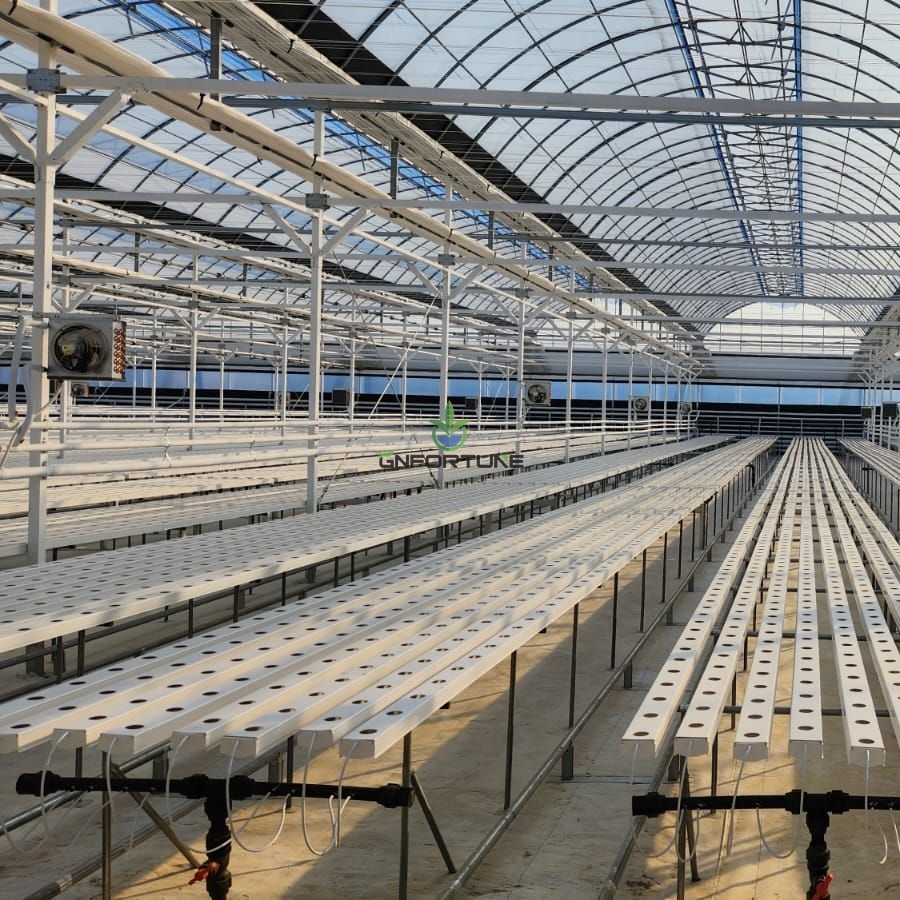
Rows of white NFT channels with planting holes in a greenhouseThe dimensions are the external width and overall height of the extruded profile, in millimeters. “100×50” is a 100 mm wide channel that is 50 mm tall; “73×62” is a narrower channel that is taller. Two consequences follow from those simple numbers:
- Width sets the wetting surface. The 100 mm profile spreads water and the root mat over a wider floor, so a given flow rate sits in a thinner, wider film.
- Height sets the buffer. The 62 mm profile has a deeper gully below the cover. Deeper means the channel holds more water for a given flow — more thermal and flow-rate buffer before the film breaks.
The number that matters for irrigation design is not the external height but the internal gully depth — the distance from the channel cover down to the floor, minus wall thickness and any root-mat buildup over the season. Two suppliers’ “100×50” profiles can differ in internal depth by several millimeters, so treat these numbers as family names, not precise specs.
100x50mm Channels: Flow Behavior and Best-Fit Crops
The 100×50 profile is the workhorse for fast, high-density leafy greens. Because the floor is wide, water spreads into a thin film that roots intercept quickly, and the wide cover gives every plant a generous hole spacing across the run.
- Flow behavior: at the recommended 1–2 liters per minute per channel and a slope around 1.5–2.5%, the 100 mm floor carries a shallow, even film. It responds fast — raise flow and the whole channel wets within minutes — but it also has less stored water, so flow interruptions show up faster on hot days.
- Best-fit crops: lettuce and short-cycle leafy greens with root mats that stay modest. Root masses are guided along the wide floor, which suits the tight, even spacing commercial lettuce lines run.
- Where it struggles: very long runs and hot climates. Past roughly 15 meters at low flow, the film thins toward the far end and you start seeing dry roots and uneven growth at the tail of the channel. For most greenhouse bays you manage this by feeding from both ends or splitting runs — details covered in the NFT channel installation guide.
73x62mm Channels: Deeper Gully, Wetter Root Zone — for Whom
The 73×62 profile trades cover width for depth. The channel is narrower, so fewer holes fit per meter, but each plant sits over a deeper water column with more buffering.
- Flow behavior: the narrow floor keeps the same flow deeper, so the channel holds more water and rides out pump pauses and hot afternoons more calmly. It tolerates a wider flow range — typically 2–4 liters per minute per channel — before overspilling or starving.
- Best-fit crops: crops with larger or longer root systems — bigger leafy greens, chard, and setups where plants stay in the channel longer. The deeper gully also accommodates heavier root mats without them plugging the film.
- Where it shines: long runs (15–40 m plus), sun-exposed greenhouses, and operations that want margin for error in irrigation timing. If a pump delay that would stress a shallow profile is absorbed by stored water, that is the deep gully doing its job.
The question that settles most profile debates: “How long is your longest channel run, and how hot does the far end get in summer?” If the answer is “over about 15 meters” or “noticeably warmer than the inlet end,” the deep 73×62 profile is usually the safer build. If you are running short, shaded lines for fast lettuce turns, the wide 100×50 profile gives you more plants per meter for less water. We have built both; we rarely see a project where the profile — not the flow design — was the limiting factor.
Flow Rate and Slope per Profile
Flow and slope are a pair: slope moves the water, flow decides how much of the gully it fills. The operating table below is where we start projects — your supplier’s data sheet may refine it, and the product team will confirm numbers against the actual profile before you order.
| Parameter | 100×50 mm profile | 73×62 mm profile |
|---|---|---|
| External size (W × H) | 100 × 50 mm | 73 × 62 mm |
| Typical internal gully depth | Shallower (roughly 35–40 mm class) | Deeper (roughly 50 mm class) |
| Recommended flow per channel | 1–2 L/min | 2–4 L/min |
| Recommended slope | 1.5–2.5% | 1–2% |
| Water buffer | Low — thin film, fast response | High — deeper film, absorbs interruptions |
| Comfortable run length | Up to ~15 m (feed both ends beyond) | 15–40 m with mid-run checks |
| Plants per meter (typical lettuce) | Higher — wider cover spacing | Lower — narrower cover |
Two installation rules apply to both profiles: keep a continuous, even slope along the whole run — a sag of a few millimeters becomes a dry patch at the next bench leg — and return nutrient to the tank without letting it fall and aerate, which shifts pH. Both are laid out in detail in the installation guide.
Which Profile for Which Crop and Climate
| Your situation | Profile we start with | Why |
|---|---|---|
| Fast lettuce turns, short shaded lines, high plant density | 100×50 | More plants per meter, thin film matches quick cycles |
| Long greenhouse bays or multi-span runs | 73×62 | Deeper gully keeps the tail of the run wet |
| Hot, sun-exposed greenhouse; limited climate control | 73×62 | Stored water buys time through heat peaks |
| Larger leafy greens, longer crop windows, heavy root mats | 73×62 | Root space and buffer for bigger plants |
| Rack or rooftop NFT with short runs and small pumps | 100×50 | Low flow keeps pump sizing and energy down |
| Mixed crop house (leafies plus herbs and chard) | 73×62 | One profile that tolerates the widest crop range |
For a plain-language foundation on how NFT works before choosing profiles, start with our What is NFT hydroponics pillar guide. If you are deciding between NFT and deep water culture, the NFT vs DWC comparison covers the system-level trade-offs. And once a profile is chosen, crop-level spacing and harvest math for lettuce sit in the commercial lettuce in NFT guide.
FAQ
Which is better: 100x50mm or 73x62mm NFT channel?
A: Neither wins outright. The 100×50 profile fits fast, high-density leafy greens on short runs; the 73×62 profile suits longer runs, hotter greenhouses, and crops with bigger root systems. Choose by run length, climate, and crop window — not by habit.
Does a deeper channel use more water?
A: The water volume in the system is higher with 73×62, but recirculating systems reuse it, so consumption is driven by crop transpiration, not channel volume. The deeper gully mainly changes buffering and pump tolerance.
Can I mix both profiles in one greenhouse?
A: Yes, and we often do — shallow wide profiles for fast lettuce lines and deep profiles for long or mixed-crop bays. Keep flow zones separate so each run gets its own feed and return.
Where can I buy these NFT channel profiles?
A: We supply both the 100×50 and 73×62 profiles with matching covers, end caps, and hole patterns. Request the data sheets for both profiles and a sample kit through the quote form below.
Get Both Profile Data Sheets and Samples
Request the technical data sheets for both profiles — dimensions, hole patterns, and recommended flow and slope — plus a sample kit so your team can hold the profiles before speccing the system.