

Ask a farm manager what hydroponic equipment lifespan means and you get a two-part answer. The big plastic and metal structures — NFT channels, flood tables, benches — are bought once and expected to run a decade or more. The moving and small parts — pumps, timers, drip fittings — are replaced on a three-year rhythm. Confusing the two clocks causes maintenance surprises in year two and premature replacements in year eight. This guide separates the 10-year from the 3-year components, explains why cheap PVC fails early under UV, and turns it all into a maintenance budget you can defend.
Hydroponic Equipment Lifespan: What Lasts 10 Years
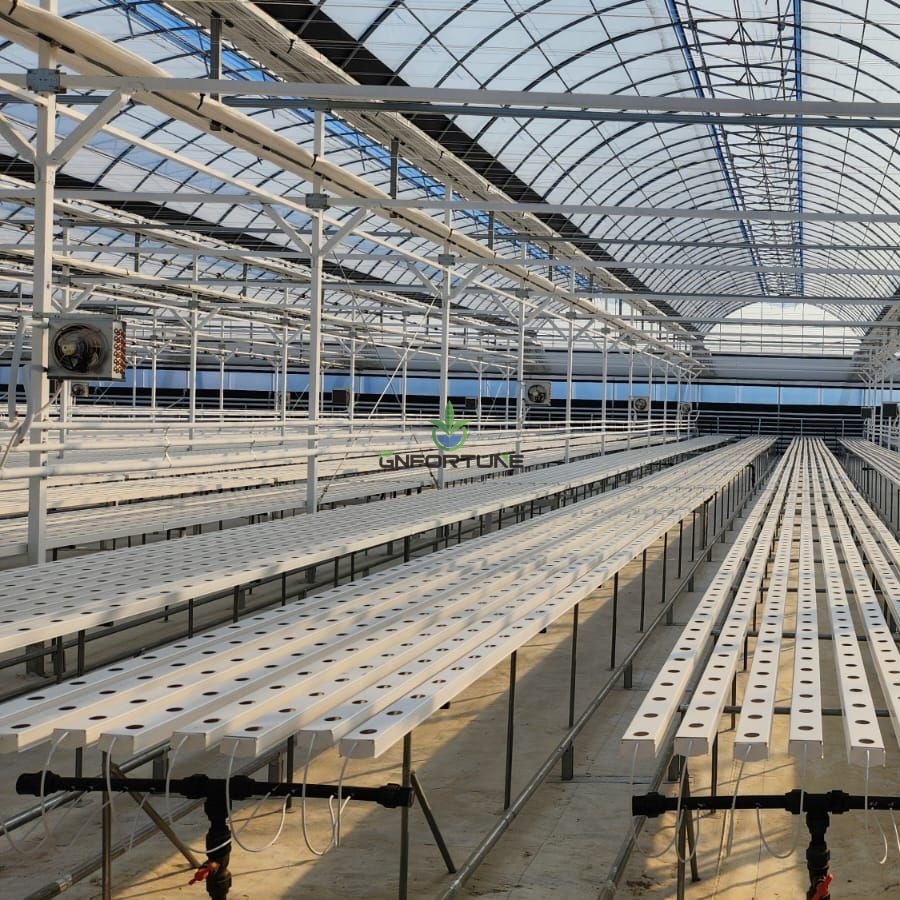
Yellow Dutch bucket rows in a long-term commercial greenhouseThe long-life group shares two features: no moving parts and no small tolerances. A quality NFT gutter is an extruded UPVC or PP profile with a UV-stabilized compound. Nothing wears against it, and nutrient solution at normal pH and EC does not attack properly formulated plastic. What limits it is sunlight — and under greenhouse UV a well-made extruded profile is realistically a 10-year component, with many installations running longer.
Tables, benches, and frames belong in the same group when the metal is right. Hot-dip galvanized or aluminum frames carry wet weight for years; what wears is fasteners and scratched coating, not the frame. Flood trays in PP or ABS last longest on a supported bench where they do not flex. Rigid UPVC or PE drain pipework is also a 10-year component when joints are solvent-welded or properly gasketed rather than relying on sealant.
| Component | Conservative service life | End-of-life signal | Maintenance action |
|---|---|---|---|
| NFT gutter profiles (UV-stabilized UPVC/PP) | 10 years or more | Chalking, surface brittleness at the ends | Inspect covers and end caps; channel body usually keeps working |
| Flood tables and benches (galvanized/aluminum) | 10–15 years | Coating wear, corroded fasteners | Replace bolts, touch up coating, keep loads within rating |
| Flood trays (PP/ABS, UV-stabilized) | 8–12 years | Cracking around the drain when flexed | Replace tray only, not the whole bench |
| Rigid drain and supply pipework | 10 years or more | Joint leaks, UV damage where exposed | Support runs, shade exposed sections |
On NFT lines the channel cover ages visibly before the gutter body, because it sees full sunlight on more surface per gram of plastic. Plan a cover refresh around years six to eight while the channel runs on.
The 3-Year Components: Pumps, Timers, and Drip Fittings
The short-life group is where a maintenance budget is actually spent. Pumps run continuously and carry the load: impellers erode, seals weep, and heat builds when a pump is oversized or blocked. A quality pump on continuous duty is a realistic 2–4 year component; the cheapest pump that fits the fitting often does not make year one. Timers and relays wear by switching cycles and voltage spikes; plan for three to five years. Drip emitters, barbs, and small-bore tubing are consumables on most farms — they clog, fatigue, and crack, and a drip line change is a normal one- or two-season event in hot greenhouses.
| Component | Realistic service | Failure signature | Planning tip |
|---|---|---|---|
| Circulation/submersible pumps | 2–4 years on continuous duty | Noise, dropped flow, seal leaks | Buy one size up, run it cooler, keep a spare |
| Dosing pumps | 2–4 years | Drift in delivery rate | Calibrate quarterly; stock diaphragm kits |
| Timers and relay controls | 3–5 years | Intermittent switching | Surge protection; log replacement date |
| Drip emitters, barbs, small tubing | 1–3 years | Clogs, cracks, uneven flow | Treat as a scheduled consumable change |
| Solenoid valves and gaskets | 2–4 years | Sticking, weeping | Clean strainers; replace seats and seals |
Why three years? Moving parts wear, small bores clog, and heat plus UV harden anything thin. None of these failures means the system is bad — it means it was designed around replaceable parts. The real failure is not budgeting for them, so the reserve below treats the 3-year group as an expense line, not an emergency.
UV and Chemical Aging: Why Cheap PVC Fails Early
The biggest quality gap between a 10-year gutter and a 3-year one is the UV stabilizer package. Sunlight breaks polymer chains in unstabilized PVC and PP: the surface turns chalky white, then brittle, and cracks under thermal expansion. Greenhouse light is intense and the failure accelerates once chalking starts. This is why value extruded profiles and trays made from recycled regrind fail in two to four seasons in high-light regions while a stabilized profile still passes inspection at year ten.
Chemical aging is the second force. Nutrient solution itself is mild, but concentrated stock, sanitizers such as hydrogen peroxide and chlorine, and hot return water stress plastics at dosing areas, sumps, and the end of the return line. We often see brittle ends and stress cracks where a sanitizer line enters the tank — the part of the system nobody shades.
The first thing to fail on a real farm is rarely the expensive structure: it is the small, hot, or flexible part — a pump seal, a solenoid seat, a drip barb in the sun. If you budget the 3-year group up front and inspect the 10-year group annually, the expensive equipment becomes the boring part of the budget — exactly what you want it to be.
Building a Maintenance and Replacement Budget
A useful planning figure for a commercial system is an annual reserve of roughly 3–8% of the equipment investment for maintenance and replacement parts. Climate, run hours, and water quality move the real number: high-light regions and hard water sit at the top of the range, temperate low-light sites at the bottom. Within that reserve the split is uneven — the 3-year group takes most of the spend, and the 10-year group sits untouched until a mid-life refresh.
Worked check (the method matters more than the example numbers):
- Capital side. Gutters, tables, frames, and main pipework depreciate over a 10-year horizon; plan a large refresh item (covers, some trays) around year six to eight.
- Consumable side. Pumps, dosing heads, timers, solenoids, and drip parts carry a 3-year replacement plan; book drip re-fits as seasonal jobs, not breakdowns.
- Operating checks. Log pump hours and current draw, calibrate dosing quarterly, inspect galvanizing and joints annually, and store one spare of each moving part.
Two planning guides put the number next to the project. The commercial hydroponic system cost guide shows the capital base your reserve should be a percentage of, and the hydroponic farm ROI guide shows how replacement timing changes payback — a crop plan that assumes zero maintenance cost will be wrong by year two.
Buying for Lifespan: What to Check Before Purchase
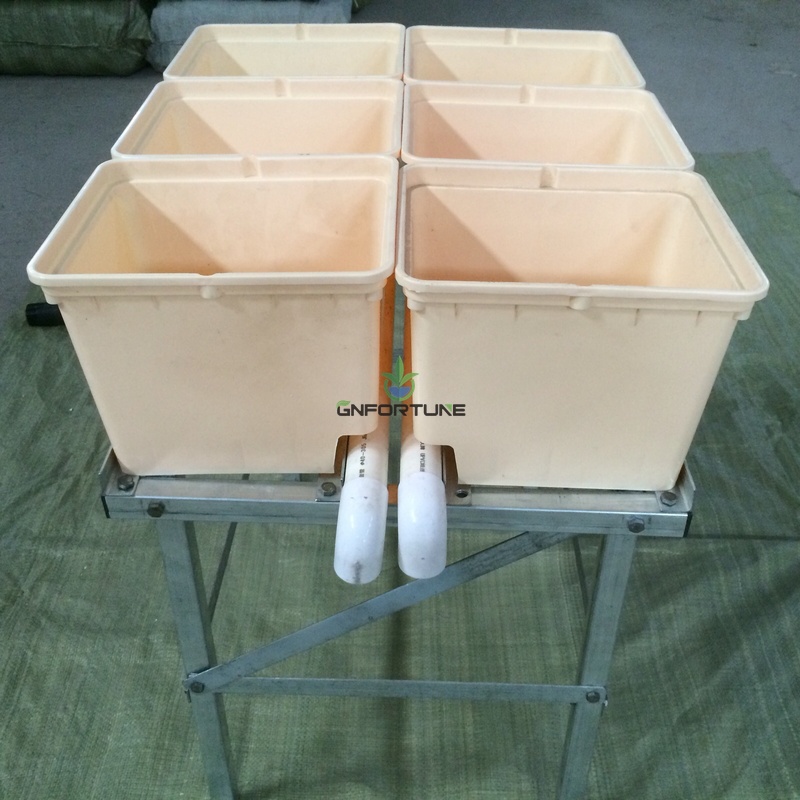
Dutch buckets on metal support rack with pipingLifespan is mostly decided at purchase, not discovered in service. Five checks separate a 10-year system from a 3-year one before the crate opens:
- UV-stabilized resin, stated. Ask for the compound spec and intended service life in writing, not a verbal “it will last.”
- Wall thickness and section weight. A heavier, thicker profile costs more resin and survives handling, UV, and thermal cycling better.
- Metal spec and fasteners. Galvanized or aluminum frames are fine; stainless fasteners at wet points avoid the rust streaks that run down good channels.
- Serviceable, standard parts. If the pump seal, valve seat, or cover is a stock item you can reorder, maintenance stays boring.
- Pumps specced with headroom. A pump running at 80% of rating lasts longer and costs less per season than one running at 100%.
Irrigation pipe and drip parts deserve their own look — the farm irrigation pipes guide covers material grades and jointing for the piping that feeds the whole system. And because lifespan planning works best when spares travel with the initial order, the container loading and MOQ guide explains how to add spare fittings and consumables to a shipment without wrecking the freight math — the cheapest replacement part you will ever buy is the one that arrives in the first container.
FAQ
Which parts of a hydroponic system fail first?
A: Pumps, timers, solenoids, and small drip fittings — the moving and thin parts. The structural plastic and metal is rarely the first replacement.
How long do NFT channels last?
A: A UV-stabilized extruded profile is realistically a 10-year component. Plan a cover refresh around years six to eight.
Is 3–8% of equipment cost per year a realistic maintenance figure?
A: It is a defensible planning range for commercial systems. Hot climates, hard water, and heavy run hours push toward the top; temperate sites sit lower.
Can I extend the life of my pumps?
A: Yes — oversize slightly so they run cooler, keep strainers clean, log current draw, and store a spare. Pumps that run hot or blocked fail early no matter the brand.
How do I recognize UV aging in plastic parts?
A: The surface turns chalky white and feels brittle; small cracks appear under flexing. Once chalking starts, plan replacement rather than waiting for failure.
Do your systems come with a stated field life?
A: Yes — components are rated by their intended service and the compound spec is available with the quotation. Ask our team which systems carry a 5–10 year field life and why the specification supports it.
Ask Which Systems Carry a 5–10 Year Field Life
Hydroponic equipment lifespan is a specification question before it is a maintenance question, so put it in the RFQ. Send your crop plan and system sketch through the quote form and ask which of our systems carry 5–10 year field life — and why. You will get the compound spec, the service life rating per component group, and a spare-parts list matched to the 3-year components, so the maintenance budget is written before the first crop is planted.