

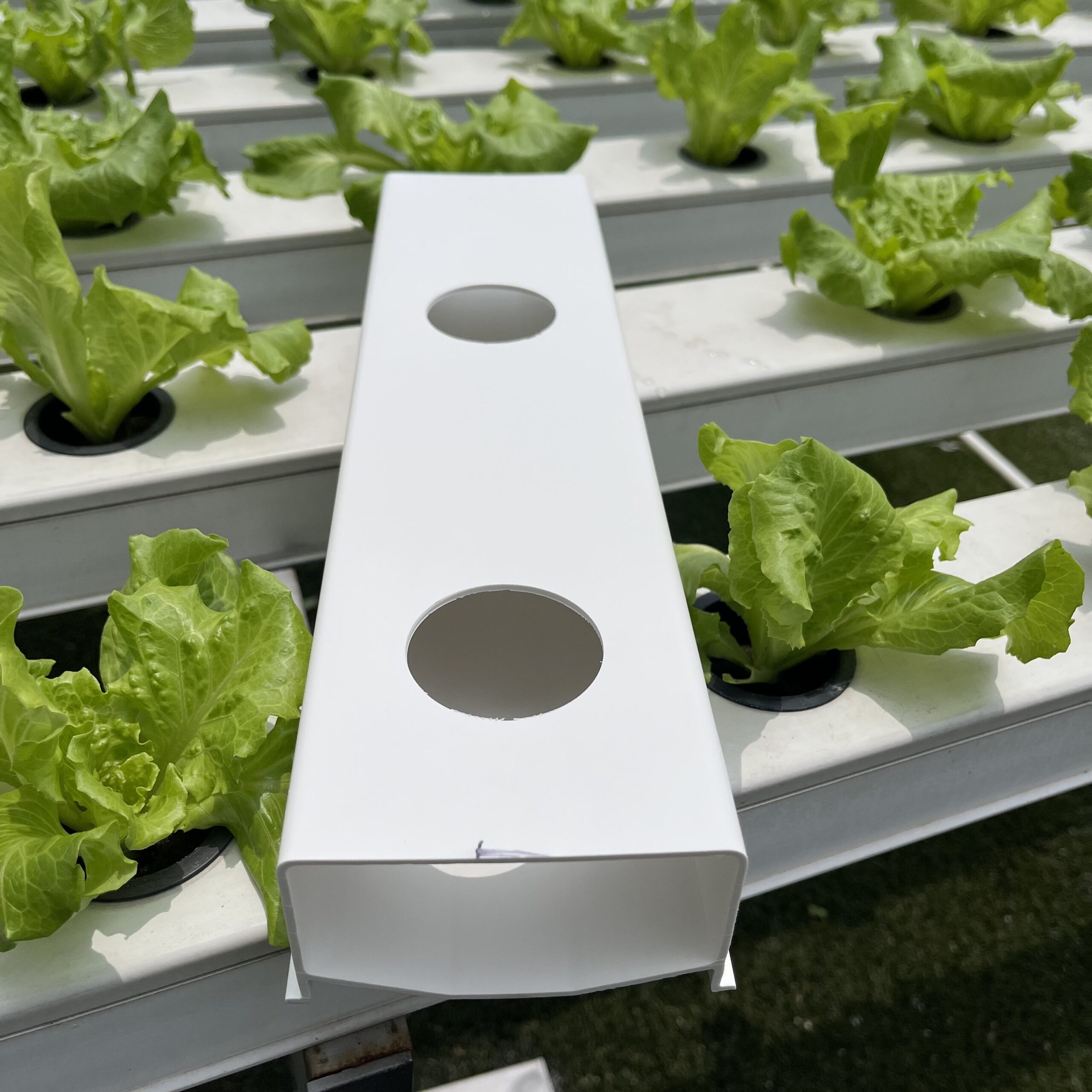
The growing channel (hydroponic channels) is the single most expensive line item in an NFT system — and the part that fails most often. Which is strange, because they all look the same: a white trough with holes.
Over the years we’ve pulled apart channels that died after two or three seasons. The failures almost always trace back to material and structure. This guide tells you exactly what to check, plus a checklist you can use before placing any wholesale order.
Material: The First Divide
Commercial NFT channels are made mainly from PVC-U. But two “PVC-U” products can differ in price by 30%, and the difference is in two places.
Food-grade resin. The nutrient solution sits against the inner wall of the channel for the life of the crop. Resin grade is not a negotiation point — ask for material documentation from any supplier.
Virgin vs. recycled resin. There is a real market for channels made from blended recycled material sold at a discount. The signs: grayish, dull color, off-gassing smell, and poor UV performance — it becomes brittle and cracks after one season of direct sun. The trap farms keep stepping into is the cheap buy that fails in the sun-exposed sections the following year.
UV resistance is a hard requirement for greenhouse environments. Put it in writing in the purchase contract.
Wall Thickness: Don’t Judge by Weight Alone
Wall thickness controls two things: load capacity (a full channel of leafy greens plus solution must not sag) and aging life. Thin-walled channels gradually droop in the middle, creating low spots where solution pools and roots sit in water.
Simple test: take a sample, cap both ends, fill with water, and watch the mid-span deflection. Manufacturers with nothing to hide welcome this test.
Profile: Flat-Top vs. Dome
- Flat-top channels (common in horizontal nft grow systems): neat, uniform hole spacing, ideal for dense multi-tier planting — the best yields per square meter
- Dome-top channels: more structural rigidity, better resistance to deformation across long spans
There’s no absolute winner — it depends on your tier design and spans. We’ll make the call in the layout for you.
Five Things to Check Before Wholesale Orders
In the normal flow of buying hydroponic nft channels wholesale, buyers consistently miss these:
- Length tolerance. Slightly uneven lengths across a large batch show up at installation as end-cap misalignment. Put the tolerance range in the contract.
- End caps and seals. Leaking end caps are the most common on-site rework during installation. Confirm the caps are matched tooling for that channel, not generic parts.
- Hole diameter and spacing. They must match your net-pot size; spacing sets planting density. Send the supplier your net-pot dimensions before ordering.
- Packaging and container loading. For export and long-haul freight, loading method decides breakage rates. Ask how it’s packed before comparing prices.
- MOQ and lead time. Custom lengths have a minimum order; standard lengths can be mixed. Lead time drives your project schedule — put the delivery date in writing.
A Checklist You Can Use at the Factory or Receiving Dock
| # | Check |
|---|---|
| 1 | Color uniform, no smell (first pass on recycled resin) |
| 2 | Wall thickness spot-check matches contract |
| 3 | Channels straight, no visible warping |
| 4 | Hole diameter/spacing spot-check passes |
| 5 | End caps trial-fit and seal properly |
| 6 | Material and UV documentation available |
| 7 | Length spot-checks within tolerance |
What We Offer as the Factory
- Food-grade PVC-U channels, custom lengths and hole patterns
- Flat-top and dome profiles, with matched caps, seals, and fasteners
- 55 automated production lines — reliable delivery on large orders
- OEM/private-label manufacturing, distribution partnerships
- Samples for verification before bulk orders
Get Wholesale Pricing
Send us the profile, length, quantity, and destination port. You’ll get factory pricing and a loading plan in return.
Request Wholesale Pricing → · WhatsApp
Related reading: NFT Hydroponic Systems · NFT Channel Installation Guide · Distributor Program