

One of the most common situations we run into on projects: a farm manager walks in with a quote for a “commercial hydroponic system” and asks whether it’s worth the money.
Nine times out of ten, the problem isn’t the price — it’s that the system type doesn’t match the crop. An NFT system bought to grow tomatoes. A Dutch bucket line for lettuce. This guide lays out all four mainstream system types honestly, including the pitfalls many farms have stepped into.
Answer These Three Questions First
Until these are answered, everything else is guesswork.
What are you growing?
Leafy greens (lettuce, spinach, bok choy) → NFT. Fruiting crops (tomatoes, peppers, cucumbers) → Dutch buckets. Strawberries → their own suspended gutter system. Choose the crop first, and the system mostly chooses itself.
Can your greenhouse handle it?
Hydroponics is much less forgiving of the building than soil growing. Floors must be level (NFT is slope-sensitive), electrical capacity must cover pumps, lighting and climate control, and cooling (pad-and-fan or similar) is usually required. On site assessments, we’ve seen more than one greenhouse built first and converted later — with a 5 cm height difference across the floor that sent all the nutrient flow to one side.
Who maintains it day to day?
Hydroponics is not “install and forget.” EC and pH need daily attention, lines need flushing, drippers clog. Large hydroponic systems without a dedicated operator start failing in year two more often than not.
The Four System Types at a Glance
| System | Best for | Cost per m² | Main risks |
|---|---|---|---|
| NFT channels | Leafy greens | Medium | Power outages, summer water temperature |
| Dutch bucket | Tomatoes, peppers | Medium-low | Clogged drippers, media replacement cost |
| Vertical towers | Lettuce, basil | High | Uneven light, labor-intensive cleaning |
| DWC | Leafy greens (short cycle) | Low | Hard to scale, difficult water-temperature control |
NFT: The Standard Answer for Leafy Greens — With Two Fatal Flaws
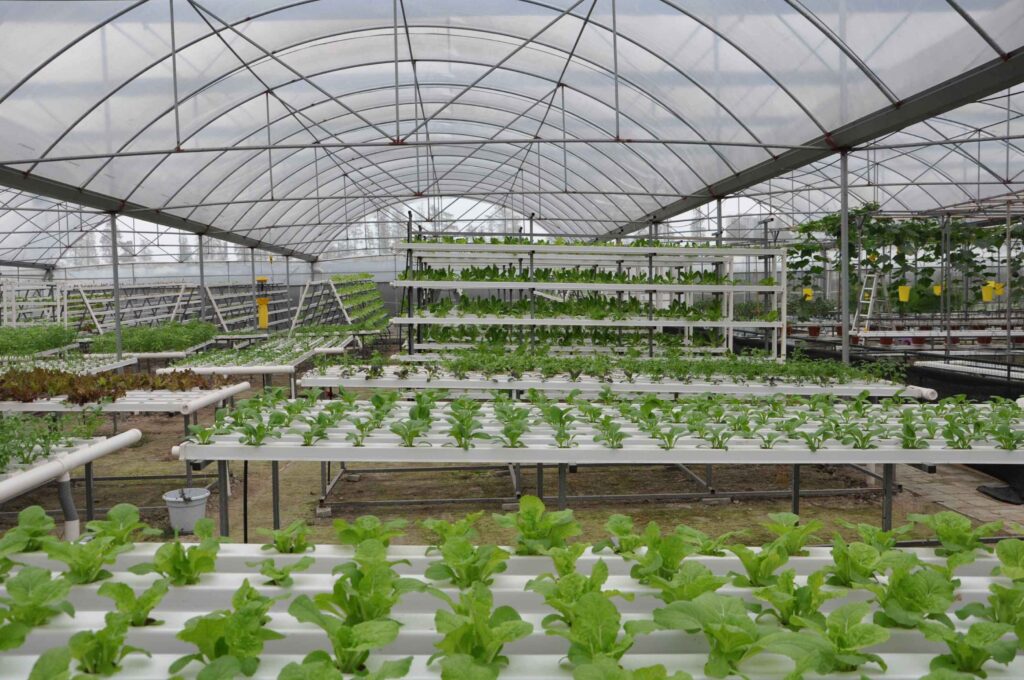
NFT (Nutrient Film Technique) runs a thin film of nutrient solution across the roots — good oxygenation, low water use, easy harvest. It’s the most common system in commercial leafy-greens projects.
The two fatal flaws: power loss and water temperature. The film is thin; when the pump stops, exposed roots dry out fast — in summer, 30 minutes can cause irreversible damage. Backup power is not optional. Above 26 °C the oxygen-holding capacity of the water drops sharply, so southern climate projects need real cooling capacity — a budget item many people forget at the planning stage.
Dutch Buckets: The Cost-Effective Answer for Fruiting Crops
For tomato growers, our default recommendation is a Dutch bucket (Bato bucket) system. The media buffer is forgiving — a Dutch bucket farm survives short outages far better than NFT — and individual buckets are easy to swap out.
The pitfall is in the details: drippers are sensitive to water quality. In hard-water regions, skip the filtration and clogged drippers become your daily routine. A trap we’ve seen repeatedly — saving money on a filter, then paying three times the amount in labor to unblock drippers.
Vertical Towers: Density at a Price
Vertical systems deliver the highest yield per square meter, which suits high-land-cost peri-urban projects. But let’s be honest: plants around the tower get uneven light, and the gap between inner and outer rows is visible to the naked eye. Planting and cleaning labor is also higher than flat systems.
In the projects we’ve handled, vertical towers tend to have the longest payback period of the four. If the budget is tight, don’t make it your first system.
DWC: Cheap, But It Hits a Commercial Ceiling
Deep water culture is simple and the cheapest to build, fine for short-cycle leafy greens. But the large water volume means slow heating and cooling, slow nutrient turn-over, and harder water management at scale. In commercial projects we usually only recommend DWC for small-scale pilots.
Where the Cost Differences Actually Come From
Commercial hydroponic growing systems for the same area can quote three times apart. The gap comes down to four line items:
- Automation level — manual valves, simple timers, or full EC/pH nutrient control; every step costs money
- Structure and materials — channel wall thickness, galvanizing grade on the frame, pipe pressure ratings
- Climate equipment — pad-and-fan, lighting, shading; often more expensive than the growing system itself
- Logistics and installation — ocean freight and on-site installation crews, the two items most often left out of the budget
The Three Most Common Reasons Projects Fail
Based on what we’ve seen on the ground:
- The wrong crop. A good system is worthless if you’re growing something with no market. We raise the off-take question on every single project — before the equipment discussion.
- Operations can’t keep up. Hydroponic yield depends on consistent water and nutrient management. Farms without proper staffing usually see yields decline from year two onward.
- The budget only covered the equipment. Electricity, consumables, media replacement and spare parts are ongoing costs. If they’re not in the cash-flow plan, year two gets painful.
FAQ
Q: What’s the minimum order for commercial hydroponic systems?
A: NFT channels and Dutch buckets ship on standard pallets; a complete system (including pumps and piping) can usually be ordered as one unit. Regional distributors are handled separately.
Q: Can you customize channel length?
A: Yes. As the manufacturer we cut channels to the greenhouse dimensions instead of forcing you to fit standard lengths.
Q: What’s the lead time?
A: 3–4 weeks of production for standard configurations. Custom projects follow a schedule confirmed after drawings are approved.
Get a Project Quote → · WhatsApp
Related reading: NFT Hydroponic Systems · Dutch Bucket Systems · Commercial Hydroponic System Cost Breakdown