
Sealing Greenhouse Openings for Pest Exclusion
Pests rarely walk in through the door. They arrive through the openings a greenhouse needs to function: the ridge vent, the fan shutter, the gap around a conduit, the 20 mm under a roller door. Greenhouse pest exclusion starts as a survey of those openings rather than as a roll of mesh. Insect mesh vent sizing is the decision that follows, because a finer weave costs air and fan capacity. This article sets out how to map openings, choose mesh by target pest, compensate the ventilation, and keep the seals honest through a season.
Greenhouse Pest Exclusion: Map Every Opening First
A survey sheet with a row per opening is the cheapest control measure on the site. Number every opening, photograph it, record the gap size and closure, and re-walk the list each season, because holes drilled after handover are the ones nobody owns.
| Opening | Typical gap | Pest risk | Closure |
|---|---|---|---|
| Ridge and side vents | 0.5 to 1.5 m open | High | Insect mesh on a tensioned frame |
| Fan shutter and louvre | 3 to 10 mm at blades | Medium | Mesh behind the louvre, or a sealed damper |
| Cooling pad intake | Large | Medium to high | Removable mesh frame, cleaned monthly |
| Personnel door | 2 to 5 mm at the reveal | High | Brush seal, closer, vestibule |
| Roller or loading door | 10 to 30 mm at the track | High | Side brush, bottom seal, strip curtain |
| Cable and pipe penetration | 5 to 50 mm | Medium | Grommet, sleeve, sealant collar |
| Drain outlet | 50 to 150 mm | Medium | Mesh cap or water trap |
| Glazing clip and base rail | 1 to 3 mm | Medium | Sealing tape or a clip with gasket |
Installation detail matters as much as the specification, and the insect netting and mesh installation guide covers frame, spline and tensioning. The survey also feeds the wider program: an opening list is the input to any integrated pest management plan.
Insect Mesh Vent Sizing by Target Pest
Choose the aperture from the body width of the smallest pest that matters, then accept the airflow cost. Sizing by mesh count alone leads to the wrong weave, since thread diameter differs between products with the same count.
| Target pest | Body width | Mesh aperture | Airflow loss | Light loss |
|---|---|---|---|---|
| Thrips | 0.15 to 0.25 mm | 150 to 200 µm | 30 to 45% | 8 to 12% |
| Whitefly | 0.3 to 0.5 mm | 300 to 400 µm | 25 to 35% | 5 to 9% |
| Aphid | 0.4 to 0.8 mm | 400 to 500 µm | 20 to 30% | 4 to 8% |
| Leafminer and moth | 1 to 2 mm | 600 to 800 µm | 12 to 20% | 3 to 6% |
| Birds and rodents | n/a | 6 to 12 mm wire | Under 5% | Low |
Two notes. A mesh that stops thrips also stops most beneficials, so the release program has to be planned around it, which is why biological control release rates change in a screened house. Where the pest list is mixed, specify to the smallest pest in the compartment: screening propagation to 200 µm costs little when that zone is a small share of ventilated area.
Airflow Loss and Fan Compensation
A screen removes flow, so the gross opening has to grow by the inverse of the loss. Design vent area divided by one minus the loss fraction gives the area needed: side vents at 18 percent of floor area need roughly 28 percent gross opening with a 35 percent loss mesh.
Worked example: a 1,000 m² house with side vents sized at 180 m² of open area. With thrips mesh removing 35 percent of flow, the gross opening has to reach about 277 m² to deliver the same air change. Where the frame cannot give that, make it up with fan capacity. Greenhouse ventilation is commonly designed at 0.03 to 0.05 m³ per second per m² of floor, so 30 to 50 m³ per second for this house, and a screened house needs roughly 20 to 35 percent more installed capacity. The vent and HAF fan design guide sets out base sizing before the mesh factor.
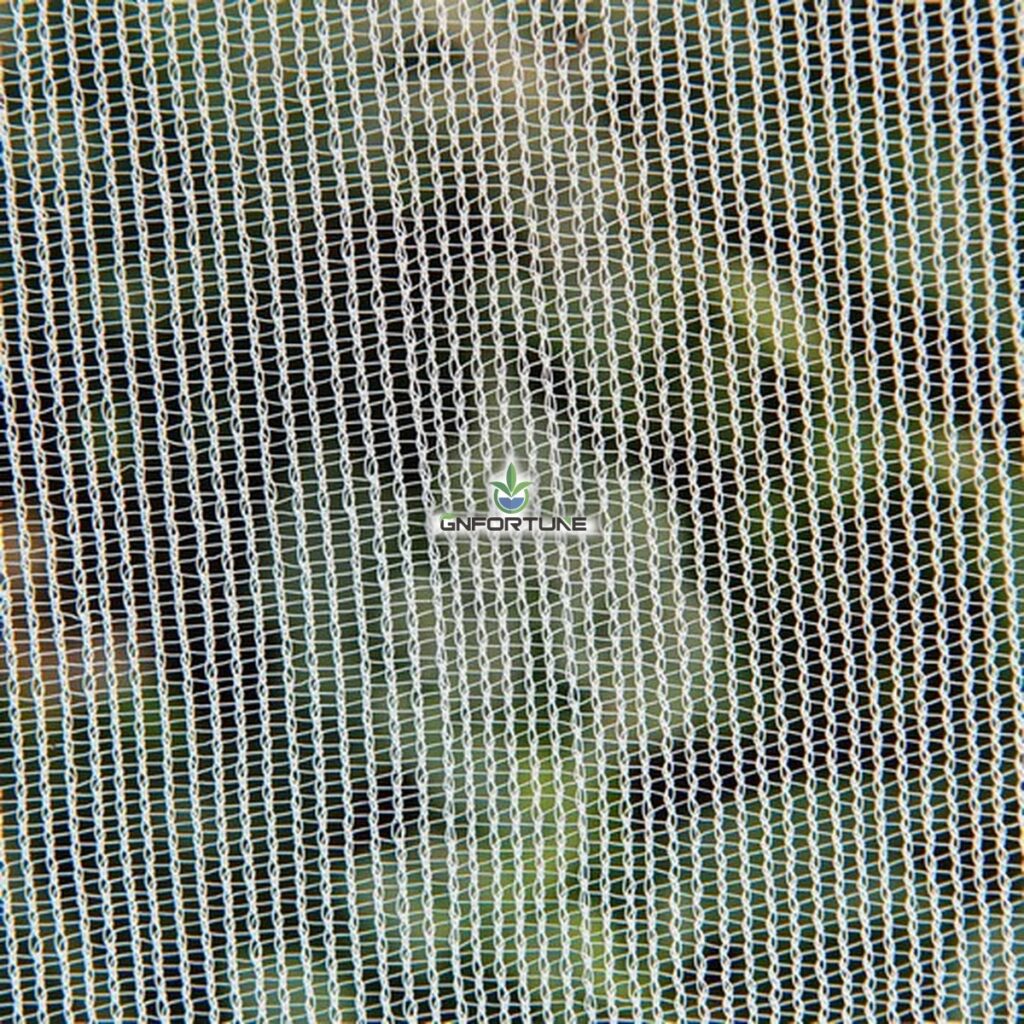
Keep face velocity through the mesh low, around 0.3 to 0.8 m per second, by increasing screened area rather than pushing more air through a small panel. Higher velocities pull debris into the weave and load the screen, quietly returning the house to the airflow it had before the fans were upgraded.
Doors, Vestibules and Strip Curtains
Personnel doors fail on two details: the gap at the reveal and the time the door stands open. Fit brush or blade seals to the frame, fit a closer set to shut in 5 to 10 seconds, and give the door a vestibule so that the crop zone is behind two barriers rather than one.
- Vestibule: 2 to 3 m deep, with a sticky mat at the outer door and a marked clean side.
- Loading doors: side brush strips along the track, a bottom seal that meets the floor, and a strip curtain behind for the hours when the door is open.
- Strip curtains: 200 to 300 mm wide, 2 to 3 mm PVC, overlapping 50 to 100 mm, replaced every 12 to 24 months as they stiffen and curl.
- Pressure: hold a slight positive pressure in propagation, 5 to 20 Pa, with filtered intake air, so leaks work outwards.
Seal the opening before upgrading the pesticide program, because every gap left open is a permanent release rate.
The most expensive exclusion failures are the ones nobody sees. A 50 mm tear at a gable vent passes more insects in a week than a season of careful scouting removes, and it sits above head height where nobody looks. Patch tears the same week they are found, and put the mesh line on the weekly walk.
Cable and Pipe Penetrations
Every service entry is a hole cut after the structure was sealed, which is why they are the most commonly missed item on a survey. A conduit through a gable, a drain line through a base rail, a sensor cable pushed through a cladding panel: each needs a closure, and each needs a number on the sheet.
- Sleeve and seal: pass the service through a sleeve, fill the annulus with expanding foam rated for the temperature range, and cap with a UV-stable sealant.
- Grommets: use a split grommet on anything that may be pulled later, so removal does not leave an open hole.
- No spare holes: cap any penetration made for a job that was never completed; a hole left “for later” is open now.
- Drains: fit a mesh cap or a water trap, since an open drain is a straight route from outside to the crop floor.
Rodents and birds use the same openings at a larger scale, so greenhouse pest exclusion should be read alongside the rodent and bird control measures. In propagation an unsealed gap costs twice, because seedlings have no tolerance for pests or the pathogens they carry, and the result shows up as damping-off and poor germination.
Maintenance: Tears, Gaps and Seasonal Checks
- Monthly in season: walk the mesh line for tears, check door closers weekly and log any repair with the opening number.
- Cleaning: brush or low-pressure wash screens every 1 to 3 months; a loaded screen costs airflow before it looks dirty.
- Seasonal: re-walk the full survey before pest pressure peaks, and after any storm or maintenance job that opened the envelope.
- Replacement: plan on 5 to 10 years of screen life depending on UV exposure, and budget the re-screen as a planned job rather than a repair.
Frequently Asked Questions
What mesh aperture stops thrips?
A: 150 to 200 µm. Anything coarser passes thrips once pressure builds outside the house.
How much airflow does insect mesh cost?
A: Fine thrips mesh typically removes 30 to 45 percent of open-area flow, so gross vent area or fan capacity has to grow by roughly the inverse.
Are both a vestibule and strip curtains needed?
A: A two-door vestibule with brush seals handles most traffic. Strip curtains earn their place on loading doors that stand open.
Can mesh be retrofitted to existing vents?
A: Yes, on a tensioned frame with a clip or spline channel, provided the vent structure and motor can carry the added wind load.
How often should exclusion mesh be inspected?
A: Walk the mesh line monthly in season and patch tears in the same week, since a small tear passes more pests than a season of clean vents saves.
Get an Opening Survey and Mesh Selection Table
Greenhouse pest exclusion is a list before it is a product: number the openings, size the mesh to the smallest pest that matters, and pay for the airflow the screen takes away. Insect mesh vent sizing is the calculation worth doing twice, because it sets the fan schedule and the climate the crop gets. Send the house dimensions, the vent layout and the pest list, and the survey sheet comes back with a mesh specification per opening.
To Ask for our opening survey sheet and mesh selection table by pest., include the vent areas and installed fan capacity, since the mesh choice changes both numbers.