

Labour Is the Cost That Grows Quietly
Equipment is bought once and depreciates predictably. Labour is bought every week, and on most hydroponic operations it becomes the largest single controllable cost within two years. Hydroponic farm staffing is also the area where business plans are most consistently optimistic — a model built on an idealised harvest rate will fail on the first Monday of a public holiday.
This guide sets out the roles a commercial site actually needs, how headcount typically scales, and how to build a training system so that the farm runs the same way regardless of who is on shift.
Roles by Scale
| Role | Small commercial (up to about 0.5 ha) | Mid-scale (roughly 0.5–2 ha) | Large or multi-site |
|---|---|---|---|
| Grower / production lead | Often the owner; sets recipes and monitors crop | Dedicated role, owns the crop plan and environmental strategy | Grower plus assistant growers by house or zone |
| Crop workers | Shared across sowing, transplant, harvest | Split into propagation team and growing team | Specialised teams per area, with team leaders |
| Propagation technician | Part of a crop worker’s duties | Dedicated person during peak sowing weeks | Full-time, with germination and sanitation responsibility |
| Maintenance technician | Contracted or owner-performed | One technician, part mechanical part plumbing | Dedicated maintenance team with a planned maintenance system |
| Pack house supervisor | Combined with production lead | Dedicated role in harvest windows | Dedicated pack house manager |
| Quality and compliance | Owner-performed | Part-time, shared with packing supervision | Full-time QA role owning records and audits |
| Logistics / dispatch | Owner or supervisor | Shared role | Dedicated dispatcher |
The first role to add after the owner stops being able to do everything is usually maintenance, because equipment failures do not wait for a convenient time, and the second is a propagation technician, because that is where losses are created silently.
Headcount Benchmarks and What Moves Them
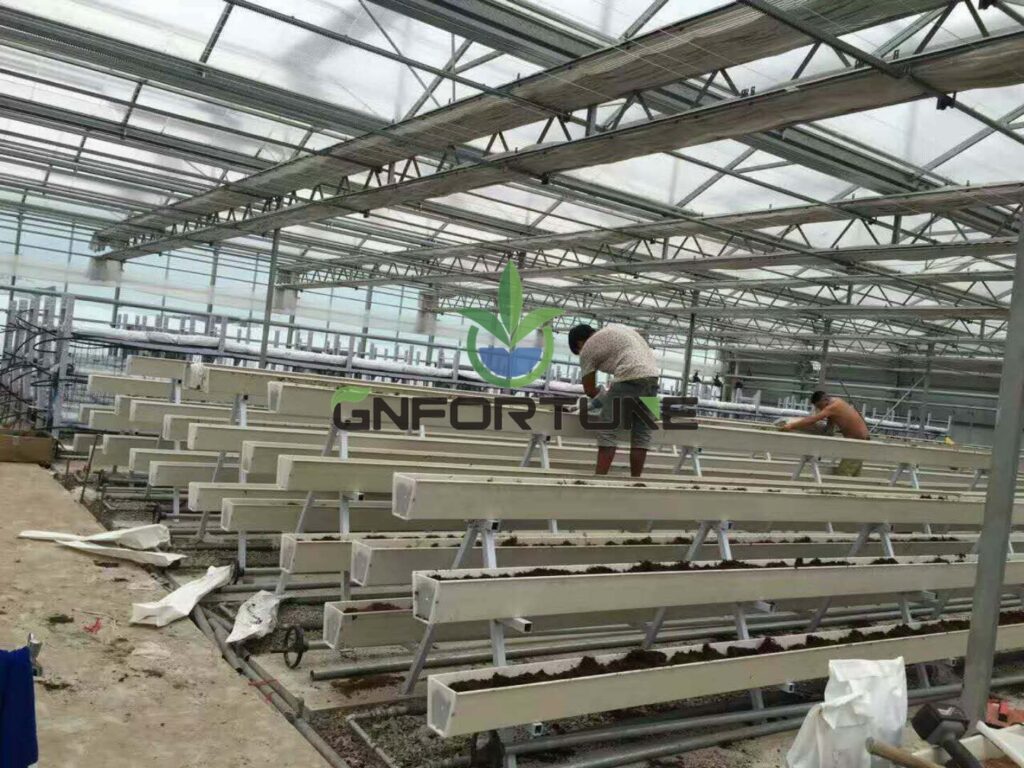
Headcount depends less on area than on four variables:
- Crop type. Leafy greens packed to retail specification are labour-heavy at harvest; vine crops are labour-heavy across the whole cycle but spread over time
- Mechanisation level. A seeding line and a packing line change the labour profile more than any other investment
- Pack specification. Field-packed whole heads and retail-packed bags are entirely different labour tasks
- Layout. Long travel distances between propagation, growing and packing are paid for every single day
Rather than adopting a benchmark from another farm, measure labour hours per unit in your own operation for four seasons, then plan the next phase against that figure. Most farms find their harvest and pack labour is 1.5 to 2 times their planning assumption in year one.
Shift Patterns and Peak Management
- Harvest early. Cutting before the house heats up protects shelf life and reduces cooling load — which means early starts and a shift pattern that accounts for it
- Stagger sowing and transplant days so that peaks do not land on the same weekly slot as the harvest peak
- Plan for absences explicitly. A team sized exactly to the workload has no slack for illness, and hydroponic schedules do not pause
- Use seasonal or contract labour for peaks but keep the core tasks — crop monitoring, dosing decisions, sanitation — with trained permanent staff
- Write the weekend and holiday rota at the start of the season. Plants are indifferent to public holidays
Training: A System, Not a Day
| Stage | Timing | Content | Sign-off |
|---|---|---|---|
| Induction | Day one | Site rules, hygiene zoning, emergency procedures, who to ask | Signed induction record |
| Core task training | Weeks one to two | The three tasks the person will do most, done to SOP standard | Competency check by supervisor |
| System awareness | Month one | How water, nutrient and environment work; what failure looks like | Walk-through assessment |
| Cross-training | Months two to six | Second and third tasks, including at least one other team’s work | Updated skills matrix |
| Refresher | Annually, and after any incident | SOP changes, chemical handling, allergen and hygiene | Refresher record |
Key disciplines that make training stick:
- Every SOP is one page. If it is longer, it will not be read on a busy morning
- SOPs live where the work happens — laminated at the point of use, not in a folder in the office
- Train to the SOP, then improve the SOP when the trained person finds a better way, and record the change
- Keep a skills matrix on the wall. It shows at a glance who can run propagation, who can calibrate sensors, and where the single-point-of-failure risk sits
- Record training. Certification schemes and buyers ask for training records, and unrecorded training did not happen as far as an auditor is concerned
Safety Items That Get Missed
- Chemical handling: acids, sanitisers and fertilisers need separate storage, labelled containers, eye wash and documented training
- Wet floors: the most common injury on a hydroponic farm; drainage design and footwear policy matter
- Confined spaces: tanks and silos are confined spaces and require a permit and a procedure
- Electrical safety in wet areas: appropriate IP ratings, residual current protection, and no improvised extension leads
- Manual handling: crates, trays and tanks are lifted repeatedly; mechanical assistance pays for itself
- Machinery guarding on packing and seeding equipment, with lock-out procedures for maintenance
- Working at height on multi-tier systems — platforms, not ladders
Hiring, Retention and the Cost of Turnover
Turnover costs more on a hydroponic farm than in most agricultural businesses, because the knowledge is procedural: where the cold spot in house two is, what the solution smells like before a problem, how a particular valve behaves. Replacing a trained person costs the recruitment fee plus weeks of reduced performance, and it usually shows up first in grading consistency rather than in yield.
- Hire for reliability and observation rather than for prior hydroponic experience in task roles; the procedure can be taught, attentiveness cannot
- Pay for the skills matrix. Progression tied to certified tasks gives people a reason to stay and gives you cross-coverage
- Rotate the unpopular tasks. Whoever always gets the wet, cold or repetitive job will leave first
- Give the grower and maintenance lead a development budget. They are the two roles whose departure is genuinely disruptive
- Run exit interviews on the packing line too, not just for salaried staff — the reasons are different and usually fixable
- Keep a simple succession note for every critical role: what this person knows that nobody else does
Where labour cost is the binding constraint on your expansion, compare the options in vertical growing systems and the blended salad line guide, both of which change the labour profile substantially.
FAQ
How many workers does a hydroponic farm need?
It depends more on crop, pack specification and mechanisation than on area. Measure your own hours per unit across a full seasonal cycle before planning expansion; published benchmarks are a starting point, not a plan.
Should I hire experienced growers or train my own?
Hire for the technical decision-making roles — grower, maintenance technician — and train for the task roles. Experience matters most where a wrong decision is expensive; procedure matters most where repetition is the job.
What causes most labour cost overruns?
Underestimated harvest and packing time, followed by rework from inconsistent grading. Both are improved by clear specifications and by measuring actual time per task rather than estimating it.
How do I keep quality consistent across shifts?
Written specifications with visual standards, a supervisor sign-off at shift handover, and cross-training so that every shift has someone competent in each critical task.
Is automation worth it for labour saving?
Usually at the seeding and packing ends first, because those are the most repetitive and the most easily measured tasks. Compare the capital against the cost of the labour hours actually displaced, including supervision and maintenance of the machine itself.
What records will an auditor ask for?
Induction records, task competency sign-offs, chemical handling training, refresher dates, and evidence that SOPs are current. If it is not written down, it does not exist for audit purposes.
Size Your Team Against Your Layout
Send your system type, area, crop and pack specification through the quote form. We will return a layout review with the travel-distance and workflow items that drive labour hours, and the equipment options that reduce them.
Related reading: labour is one of the core numbers in the commercial system cost breakdown, and automation options are covered in the harvesting and packing line guide.